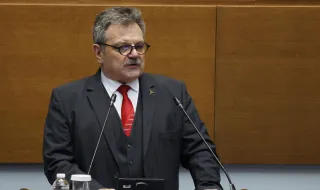
Bulgaria continues to face serious problems in donation and transplantation. Insufficient coordination between hospitals, the lack of clear institutional responsibility and doubts about the reliability of the system limit the possibilities for saving human lives. Why is our country failing to realize its potential, how can the organization of donation be improved and is it necessary for people to be able to explicitly state their consent to be donors? Dr. Alexander Simidchiev, MP from “Yes, Bulgaria“, spoke to FACTI. Dr. Simidchiev was a lecturer at the 25th national meeting of the “Media Society Family Traditions“ Foundation (MOST), held in “Albena“, which was under the title “Life as a Value“.
- Dr. Simidchiev, transplants and the donor program in Bulgaria are your topic, but the reality is different - only 16 donor situations and 34 transplants per year. Where does the system fail?
- That is exactly why it is my topic. The system does not fail in the operating room. Bulgarian transplant teams can. It fails much earlier: in the intensive care units, when brain death must be established and reported. According to estimates given by a former Minister of Health, the potential donors in our country are about 280 per year. We realize 16, that is, under 6%. We do not lack donors. We lose information about them.
The second failure is institutional. Today, transplants are a department in the Executive Agency "Medical Supervision", without an independent manager, budget and responsibility for the result.
When everyone is responsible, no one is responsible.
That is why I insist on restoring the Executive Agency for Transplantation. I am convinced that with political will, the problem can be solved in a year and a half - two.
- One donor can potentially save up to eight lives. Why doesn't it happen?
- The calculation is simple: 34 transplants from 16 donor situations makes a little over two per donor. So we are even losing the organs of people whose relatives have already said "yes".
The reasons are medical and organizational. Keeping the donor in the intensive care unit until the organs are harvested is a complex, specialized activity. If it is not done well, the organs are damaged and become unusable. We do not have developed programs and teams for all organs. And logistics (teams, transport, round-the-clock coordination) often depend on the enthusiasm of specific people, and not on a well-functioning system.
And let's not forget the price. Each non-transplanted kidney means a person on dialysis. According to Prof. Paskalev, dialysis costs the state about three and a half times more than a transplanted patient.
- What are the main reasons - lack of donors, organizational problems, insufficient coordinators or gaps in the process?
- All of the above contribute, but not to the same extent. The smallest problem is the lack of potential donors, because there are many. The main obstacles are organizational. Brain death is not diagnosed and is not reported always and everywhere where it is a fact.
Hospitals have neither a clear obligation nor an incentive to do so.
In many hospitals, the donation coordinator is an anesthesiologist who does this work in addition to everything else, without dedicated time and without adequate pay.
The solution is known and works in Spain, the world leader with over 40 donors per million population. We are below 3. There is a coordinator in every intensive care unit there and every case of brain death is necessarily reported in real time. Every death is also checked: was there a donor potential and why it was not realized.
The refusal of relatives, about 20% in our country, is a problem, but it comes only after all the above-mentioned.
- You are proposing a registry of people who explicitly agree to donate their organs. How exactly will it work?
- There is now an official register in which everyone can enter their disagreement to be a donor. Our proposal, which I am working on with colleagues in parliament, is simple: to be able to enter an explicit “yes” in the same register. This way, everyone will be able to declare their will, and if they do not, it will continue as it is now.
The declaration should be easy, at the GP or electronically, with an electronic signature or through the personal health record (eHealth). The will can be changed at any time and the last declared one is valid. Only the transplant coordination has access to the data and only after brain death has been established. No one else and never before.
Then the doctors do not ask the relatives “Do you agree?“, but tell them: “Your loved one has decided to donate his or her organs.” The difference is huge because the family doesn't have to bear the burden of the decision at its most difficult moment. That's why I sent a message to my daughter on air: “I want to be a donor!“
The registry is the institutional form of the same message.
By the current number of “consented“ we can also easily monitor the effectiveness of any campaign or program that aims to increase the number of people who agree to donate.
- Can such a registry actually increase the number of transplants, or do we risk creating yet another administrative system?
- Frankly, the registry alone will not increase transplants. If brain death is not reported, it does not matter what is written in any registry. That is why it is part of a package, together with mandatory reporting of brain death and a separate agency with responsibility for the result. But we are not creating a new administrative system. The registry exists and we are only adding one option to it. The cost is minimal, and the benefit is very large. First, relatives who know the will of the deceased are much less likely to refuse. This is the experience everywhere in the world. Secondly, the registration itself makes people talk about donation at home before a disaster happens. With our current efficiency, each prevented refusal means an average of two transplants: two lives saved or two people released from dialysis.
- Why has there been no transplant from a living donor in Bulgaria in the last year?
- This is the most worrying zero in the registry for the last year. There were years when about half of the kidney transplants in our country were from living donors. In 2021, there were 14, in 2022 - one, and in the last year - none. This is terrible.
People have not stopped wanting to help their loved ones. They simply go abroad to do it there. The issue is about trust, and one of the most serious obstacles is hospital-acquired infections (officially we call them healthcare-associated infections (HAIs) or nosocomial). A living donor is a healthy person who voluntarily lies down on the operating table to save a loved one. If this sacrifice fails due to a severe infection that can affect both the donor and the recipient, everything becomes meaningless.
Our official statistics on hospital-acquired infections are at odds with European data. As long as this is the case and until hospitals prove that they control infections, people will continue to vote with their feet. That is why for me, infections and transplants are the same topic and cause.
- Is the campaign “Yes! For Life!“ effective enough, or does Bulgaria need a completely new approach to donation?
- Campaigns are undoubtedly necessary and I respect the people who put effort into them. But a campaign cannot compensate for a system that is not structured and self-learning to work. We can convince thousands of people to say “yes”. But if the hospital where one of them dies does not establish and report brain death, that "yes" remains unused. Then we risk wasting the trust we have earned. Every campaign must be able to be measured for effectiveness - and here back to the consent register.
We must reverse the order: first the organization in the hospitals and the institution, then the invitation to people and campaigns. The new approach for me is based on three things: an independent agency with responsibility, mandatory reporting of every brain death and a register of explicit consent. The message to people must be concrete. Not the abstract "be a donor", but "tell your loved ones".
There is also a task for us - the politicians. 923 people are waiting for a transplant, about four for each MP. Each of us can ask who they are in their constituency and how long they have been waiting. This will inevitably push the process in the right direction.
- How do we convince people that donation is safe in principle and that the system deserves their trust?
- Not with bargaining, but with transparency. People need to know three things.
First, donation never starts before everything possible has been done to save a life. Brain death is established according to a strict protocol by doctors who have nothing to do with the transplant. It is irreversible, it is the final and irretrievable death of a person.
Second, organs are distributed according to medical criteria through the national waiting list, and not by connections and money.
Third, the data should be public. I want every hospital with an intensive care unit to publish annually how many cases of brain death it has had, how many it has reported, how many donor situations have occurred, and why the rest have not. When people see the numbers, the myths lose their power.
As for living donation, it is safe for carefully selected donors who are monitored for life. But that is precisely why the state must guarantee that the hospital will not harm them with an infection, and that the donor will receive the necessary medical care after the donation.
- What is the boundary between the personal will of the potential donor and the right of relatives to participate in the decision?
- For me, the line is very clear. The decision is up to the person, and the relatives are the guarantors of their will, not its substitutes. If someone said “yes“ or “no“ during their lifetime, this must be respected, both “yes“ and “no“ equally. Relatives should not be put in a position to decide for them at the most difficult moment of their lives.
This does not mean that we exclude them. Talking to them is morally and ethically obligatory. They must be informed and listened to, have time and support. But there is a difference between telling a mother “Your son has decided to help other people“ and asking her “Do you agree?“. When a person's will is not known, the role of relatives is to say what they would like, not what they want.
Therefore, the best thing that everyone can do today, without waiting for a law, is to tell their family. One message is enough.
6666666666666666666666
Dr. Alexander Simidchiev to FAKTI: We are not lacking donors, we are losing information about them
In Bulgaria, we realize only a small part of the potential donor situations, he says
Bulgaria continues to face serious problems in donation and transplantation. Insufficient coordination between hospitals, the lack of clear institutional responsibility and doubts about the reliability of the system limit the possibilities for saving human lives. Why is our country failing to realize its potential, how can the organization of donation be improved and is it necessary for people to be able to explicitly state their consent to be donors? Dr. Alexander Simidchiev, MP from “Yes, Bulgaria“, spoke to FACTI. Dr. Simidchiev was a lecturer at the 25th national meeting of the “Media Society Family Traditions“ (MOST) Foundation, held in “Albena“, which was under the title “Life as a Value“.
- Dr. Simidchiev, you mention transplants and the donor program in Bulgaria, but the reality is different - only 16 donor situations and 34 transplants per year. Where is the system failing?
- That is exactly why it is my topic. The system does not fail in the operating room. Bulgarian transplant teams can. It fails much earlier: in intensive care units, when brain death must be established and reported. According to estimates given by a former Minister of Health, the number of potential donors in our country is about 280 per year. We realize 16, that is, under 6%. We do not lack donors. We lose information about them.
The second failure is institutional. Today, transplants are a department in the Executive Agency "Medical Supervision", without an independent manager, budget and responsibility for the result.
When everyone is responsible, no one is responsible.
That is why I insist on restoring the Executive Agency for Transplantation. I am convinced that with political will, the problem can be solved in a year and a half - two.
- One donor can potentially save up to eight lives. Why doesn't it happen?
- The calculation is simple: 34 transplants from 16 donor situations makes a little over two per donor. So we are even losing organs from people whose loved ones have already said “yes”.
The reasons are medical and organizational. Keeping the donor in the intensive care unit until the organs are harvested is a complex, specialized activity. If it is not done well, the organs are damaged and become unusable. We do not have developed programs and teams for all organs. And the logistics (teams, transport, round-the-clock coordination) often depend on the enthusiasm of specific people, and not on a well-functioning system.
And let's not forget the price. Every non-transplanted kidney means a person on dialysis. According to Prof. Paskalev, dialysis costs the state about three and a half times more than a transplanted patient.
- What are the main reasons – lack of donors, organizational problems, insufficient coordinators or gaps in the process?
- All of the above contribute, but not to the same extent. The least problem is the lack of potential donors, because there are. The main obstacles are organizational. Brain death is not diagnosed and is not reported always and everywhere where it is a fact.
Hospitals have neither a clear obligation nor an incentive to do so.
In many hospitals, the donor coordinator is an anesthesiologist who does this job in addition to everything else, without dedicated time and without adequate pay.
The solution is known and works in Spain, the world leader with over 40 donors per million population. We are below 3. There is a coordinator in every intensive care unit and every case of brain death is necessarily reported in real time. Every death is also checked: was there a donor potential and why it was not realized.
The refusal of relatives, about 20% in our country, is a problem, but it comes only after all the above-mentioned.
- You are proposing a registry of people who explicitly agree to donate their organs. How exactly will it work?
- Now there is an official register in which everyone can enter their disagreement to be a donor. Our proposal, which I am working on with colleagues in parliament, is simple: to be able to enter an explicit “yes” in the same register. This way, everyone will be able to declare their will, and if they do not, it continues as it is now.
The declaration should be easy, at the GP or electronically, with an electronic signature or through the personal health record (eHealth). The will can be changed at any time and the last declared one is valid. Only the transplant coordination has access to the data and only after brain death has been established. No one else and never before.
Then the doctors do not ask the relatives “Do you agree?“, but tell them: “Your loved one has decided to donate his or her organs.“ The difference is huge, because the family does not bear the burden of the decision at their most difficult moment. So I sent a message on air to my daughter: “I want to become a donor!“
The registry is the institutional form of the same message.
By the current number of “consented“ we can easily monitor the effectiveness of any campaign or program that aims to increase the number of people who agree to donate.
- Can such a registry really increase the number of transplants, or do we risk creating yet another administrative system?
- Frankly, the registry itself will not increase transplants. If brain death is not reported, it does not matter what is written in any registry. That is why it is part of a package, together with mandatory reporting of brain death and a separate agency with responsibility for the result. But we are not creating a new administrative system. The registry exists and we are only adding an option to it. The cost is minimal, and the benefit is very large. First, relatives who know the will of the deceased are much less likely to refuse. This is the experience everywhere in the world. Second, the registration itself makes people talk about donation at home before a disaster happens. With our current efficiency, each prevented refusal means an average of two transplants: two lives saved or two people freed from dialysis.
- Why has there been no transplant from a living donor in Bulgaria in the last year?
- This is the most worrying zero in the register for the last year. There were years when about half of the kidney transplants in our country were from living donors. In 2021, there were 14, in 2022 - one, and in the last year - none. This is terrible.
People have not stopped wanting to help their loved ones. They simply go abroad to do it there. The issue is about trust, and one of the most serious obstacles is hospital-acquired infections (officially called healthcare-associated infections (HAI) or nosocomial). A living donor is a healthy person who voluntarily lies down on the operating table to save a loved one. If this sacrifice fails due to a severe infection that can affect both the donor and the recipient, everything becomes meaningless.
Our official statistics on hospital-acquired infections are at odds with European data. As long as this is the case and until hospitals prove that they control infections, people will continue to vote with their feet. That is why for me, infections and transplants are the same topic and cause.
- Is the “Yes! For Life!” campaign effective enough, or does Bulgaria need a completely new approach to donation?
- The campaigns are undoubtedly necessary and I respect the people who put effort into them. But a campaign cannot compensate for a system that is not structured and self-learning to work. We can convince thousands of people to say “yes”. But if the hospital where one of them dies does not establish and report brain death, that “yes” remains unused. Then we risk wasting the trust we have earned. Every campaign must be able to be measured for effectiveness – and here back to the consent register.
We must reverse the order: first the organization in the hospitals and the institution, then the invitation to people and campaigns. The new approach for me is based on three things: an independent agency with responsibility, mandatory reporting of every brain death and a register of explicit consent. The message to people must be concrete. Not the abstract “be a donor“, but “tell your loved ones“.
There is also a task for us - the politicians. 923 people are waiting for a transplant, about four for each MP. Each of us can ask who they are in our constituency and how long they have been waiting. This will inevitably push the process in the right direction.
- How do we convince people that donation is safe in principle and that the system deserves their trust?
- Not by bargaining, but by transparency. People need to know three things.
First, donation never begins until everything possible has been done to save a life. Brain death is determined by a strict protocol by doctors who have nothing to do with the transplant. It is irreversible, it is the final and irretrievable death of a person.
Second, organs are allocated according to medical criteria through a national waiting list, not by connections and money.
Third, the data should be public. I want every hospital with an intensive care unit to publish annually how many cases of brain death they have had, how many they have reported, how many donor situations have occurred, and why the rest have not. When people see the numbers, the myths lose their power.
As for living donation, it is safe for carefully selected donors who are followed for life. But that is precisely why the state must guarantee that the hospital will not harm them with an infection, and that the donor will receive the necessary medical care even after donation.
- What is the boundary between the personal will of the potential donor and the right of relatives to participate in the decision?
- For me, the boundary is extremely clear. The decision is the person's, and relatives are guarantors of his will, not its substitutes. If someone said "yes" or "no" during his lifetime, this must be respected, and both "yes" and "no" are equally important. Relatives should not be put in a position to decide for him at the most difficult moment of his life.
This does not mean that we exclude them. Talking to them is morally and ethically obligatory. They must be informed and listened to, have time and support. But there is a difference between telling a mother “Your son has decided to help other people“ and asking her “Do you agree?“. When a person's will is not known, the role of relatives is to say what he would like, not what they want.
Therefore, the best thing that everyone can do today, without waiting for a law, is to tell their family. One message is enough.