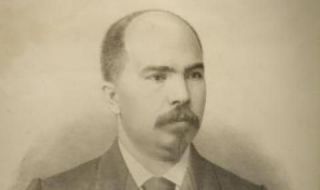
On May 31, 1894, Stefan Stambolov's term as Prime Minister of Bulgaria ended. Konstantin Stoilov was elected Prime Minister.
Stefan Stambolov is a Bulgarian revolutionary, politician and statesman.
He took an active part in the Stara Zagora (1875) and April Uprisings (1876). He is among the most deserving and popular "builders of modern Bulgaria". After the Liberation, he was one of the active figures of the Liberal Party. He was Chairman of the National Assembly; Prime Minister of Bulgaria (1888-1894). He contributed to the Unification of the Principality of Bulgaria and Southern Rumelia and to the counter-coup in 1886. His policy during the Unification and the crisis after the coup of 1886 proved decisive for the stabilization of the country and its separation from dependence on Russia. He pursued a clearly expressed nationalist policy.
This led to May 31, 1894, when Stefan Stambolov fell from power. Surprisingly, Prince Ferdinand I accepted Stambolov's resignation as prime minister and tasked Konstantin Stoilov with forming a cabinet. Stambolov's fall was received with surprise by the public at the time, because during the seven years as prime minister he resigned 14 times to the monarch.
Meanwhile, in Vienna, Prince Ferdinand I received support for the removal of Stefan Stambolov from power. He shared this intention with the Austro-Hungarian Foreign Minister Kalnoky and some foreign diplomats. He also made inquiries with the Russian ambassador in Vienna, Prince Lobanov-Rostovsky, thus preparing the ground for a change in bilateral Bulgarian-Russian relations.
Few statesmen in Bulgarian history could have such a key importance for the development of the country as Stefan Stambolov. Called by his contemporaries the “Bulgarian Bismarck”, Stambolov took over the governance of a young Balkan state torn by internal strife and placed in international isolation, which was struggling to preserve its fragile independence.
One of the first tasks faced by Stefan Stambolov was the modernization and revival of the Bulgarian economy, which was in a period of collapse. The lack of a comprehensive strategy in the course of the complex political struggles that accompanied the first years of the development of the Principality of Bulgaria seemed to have left it in the background. Stefan Stambolov, however, became the man who gave the much-desired strategy and concept of development.
He initiated Bulgarian state protectionism, following three main directions during the eight years he was at the head of the state - encouraging Bulgarian production through an active protectionist policy, attracting foreign capital, and above all, regulating trade relations with other countries, within a framework that was beneficial to Bulgaria.
It was Stambolov who advocated the normalization of relations with the Ottoman Empire. The goal was for Bulgaria to be able to take care of the Bulgarians under Ottoman rule.
He also began the construction of modern ports for that time in Varna and Burgas, and in 1892 The “Bulgarian Commercial and Steamship Company” was established. Stambolov initiated the now famous Plovdiv Fair.
Coming into conflict with Tsarist Russia and Prince Ferdinand, he was assassinated by political enemies on July 6, 1895.