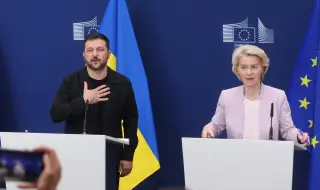
Last week, the EU presented a report in which it positively assesses the progress in implementing reforms in Ukraine. But the official start of accession negotiations remains in question. One of the reasons - Hungarian Prime Minister Viktor Orbán is blocking Ukraine's European integration.
But how can the negotiation process between Kiev and Brussels develop and when will Ukraine be able to become a full-fledged EU member? Portuguese diplomat José Manuel Pinto Teixeira, former EU representative in Kiev and now vice-president of the European Electoral Support Centre in Brussels, shares his opinion with DW.
The European Commission gives Ukraine good marks - in Brussels they say that Kiev is ready to open all six negotiation topics. But Viktor Orbán's veto blocks this process. Which will weigh more heavily?
J. Teixeira: Unfortunately, the enlargement process is implemented on the principle of unanimity. And the EU treaty allows a member state to leave it at its own will, but does not allow the exclusion of a member state from its composition. That is why I am very sorry that there are those who say: we should adhere to the position of unanimity and simply wait for the leadership to change in a certain country through democratic means. This paralyzes the European Union.
Viktor Orbán is paralyzing the EU precisely in the process of starting accession negotiations with Ukraine, and there are others who are not so frank in their actions - for example, Slovak Prime Minister Robert Fico, who we should not trust too much. The policy towards Ukraine of Andrej Babis, who won the recent elections in the Czech Republic, is also different. For now, the process remains completely paralyzed - thanks to Putin's fifth belt in the EU. And Ukraine, in my opinion, is doing its job. And it should continue with the necessary reforms, because the situation may change. We will see what decision the Hungarian people will make in the elections next year, but in general, in my opinion, support for Ukraine in the EU prevails.
How do you assess the level of the fight against corruption and anti-corruption reforms in Ukraine?
J. Teixeira: I visit Ukraine every year. In my opinion, after the Maidan of 2013, the fight against physical corruption has improved a lot - for example, in law enforcement agencies. Therefore, I cannot draw conclusions about how the system works as a whole, since I am not visiting Ukraine as an official and do not interact with the authorities on this issue. The EC report on enlargement was positive regarding Ukraine. But phenomena such as corruption can hardly be changed in a short time. Not to mention that Ukraine is in a state of war.
No country has ever gone through the EU accession process and the relevant negotiations without experiencing a brutal invasion. Every day, Ukraine is bombarded with missiles and drones targeting the civilian population. However, Russia and its supporters are indifferent to this - they feel that they are not accountable to anyone. Russia has its place on the UN Security Council, although it is the main culprit in the violations of international law and the charter of this organization.
European Commissioner for Enlargement Marta Coss stated that the EU can accept all current candidate countries without serious problems for its budget or decision-making process, except for Ukraine, because it is too big. Therefore, in order to accept Ukraine, the EU must carry out internal reforms. Do you think they are really necessary?
J. Teixeira: The fear of new member states has existed in the EU since the first moment of its enlargement. Ukraine is a large country, rich in natural resources, in agriculture. It has an educated and hardworking people, who have now shown that they are not only hardworking, but also courageous. I am convinced that Ukraine would be an important achievement for Europe in terms of territory, resources and people. Therefore, I do not share the concerns on this occasion.
In Brussels, they say that they can accept all the Balkan countries into the EU. I know the Balkans well, because I worked there for eight years - in North Macedonia, in Bosnia and Herzegovina and Croatia. Let's take Bosnia and Herzegovina, for example, a divided country, in which there is a state entity called Republika Srpska, which is also a fifth column of Russia. How can Bosnia and Herzegovina be integrated or only partially integrated? The question also arises about Kosovo and Serbia. The situation with these countries is more complicated than that with Ukraine, which is a homogeneous state.
As for Ukraine, it came to the occupation of Donbass. And some, like Trump's envoy Steve Witkoff, keep repeating that since people there speak Russian, then Donbass is Russian. Yes, many in Ukraine speak Russian, but this is a consequence of Russian domination, a colonial legacy. These people are categorically not Russians.
Therefore, I believe that Ukraine is better prepared as a country with internal unity and a homogeneous context than countries where there are some situations created by the international community.
EU officials do not like to answer questions about the deadline for Ukraine's membership, but 2030 has been mentioned several times. How realistic is this?
J. Teixeira: It is difficult to determine an exact date. I will share my personal opinion, because I am no longer an EU official. The feelings of many citizens in the EU regarding enlargement boil down to fear - they fear that it will lead to many problems in terms of decision-making, the unity of the EU. But Ukrainians are now demonstrating how cohesive and united Ukraine is.
The possible illegal occupation of parts of Ukraine should not be a reason for not accepting Ukraine, because there is a precedent with Cyprus. The northern part of Cyprus was occupied by Turkey, and the island was integrated into the EU after these events. The same approach can be applied to Ukraine.
In Ukraine in the past, there has never been separatism, regardless of what language people spoke. And the national identity of Ukrainians has only strengthened in the last period of the country's history, especially now during the war. For me, Ukraine is a country that should not be punished, because it has been punished for a long time.
Author: Victoria Vlasenko