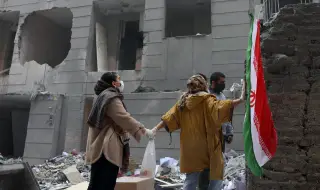
The US-Israeli war against Iran began on February 28, 2026, but it did not come out of nowhere. The conflict between the US and Iran has been developing for several generations.
The CIA and the coup
For most of the 20th century, the US and Iran maintained close relations. After World War II, Washington viewed Tehran as a key ally against the Soviet Union. The US supported Shah Mohammad Reza Pahlavi, who transformed Iran into a pro-Western monarchy in the Middle East.
In 1951, however, Iran's new prime minister, Mohammad Mossadegh, nationalized the country's oil and challenged Western control over Iran's resources. Two years later, the CIA and the British intelligence agency MI6 staged a coup against Mossadegh. Ian Lesser, vice president of the Marshall Fund, notes that the 1953 coup was a defining moment, "when the United States and Britain essentially overthrew Mossadegh to restore the Shah to power." The coup created a sense of great injustice in Iranian society. Many Iranians saw it as a foreign interference in their democracy. Negin Shiragei, founder of the Azadi Network, which promotes the cause of the Women. Life. Freedom movement for Iranian women's rights, said: "My parents' generation believed that the country's problems were due to US interference. They saw the Shah as a US puppet." This was the catalyst for the Islamic Revolution some 30 years later.
The Revolution and the Hostage Crisis
Discontent with the monarchy grew rapidly, and in the late 1970s, mass protests brought an end to the Shah's rule. The religious leader, Ayatollah Ruhollah Khomeini, returned from exile and established the Islamic Republic, based on an anti-Western and anti-American ideology. Today, many of the generation that helped the Islamic Revolution succeed are still in leadership positions in Iran. The policy of confrontation with the United States also remains at the forefront of the country's ideology.
In the United States, another memory from this period dominates - the hostage crisis of 1979-1981. On November 4, 1979, a student organization associated with the ideology of Khomeini stormed the American embassy in Tehran and took 66 Americans hostage. Their demand was that the United States hand over the exiled Shah back to Iran. The students say they want to prevent another coup like the one in 1953.
For many Americans, this was an attack on their country and a humiliation that was broadcast on television all over the world for 444 days. When the hostages were released, they were greeted as heroes - all of this left an imprint on the American position towards Iran for years to come. Lesser, a political analyst, says that many in the president's inner circle, including Donald Trump himself, have formed their positions on Iran since the hostage crisis. They have only deepened since the 1983 Beirut barracks bombing, when the Iranian-backed Hezbollah militant group killed more than 200 American soldiers in Lebanon.
Nuclear fears and failed diplomacy
Anti-American sentiment in Iran has been very strong since the Islamic Revolution. But Shiragei says it is gradually weakening, although people do not have the courage to admit it. Iranians who grew up in the 1990s and 2000s are living in a period when change seems possible. This is Shiragei's generation, who says that the propaganda slogans that portray America as "the great Satan" have already been questioned by her and her peers. "We knew that the American government had a bad side and that it was starting wars in different parts of the world. But at the same time, we asked ourselves, do we need to be so hostile?".
On a political level, Washington and Tehran do cooperate sometimes - most notably after the terrorist attacks of September 11, 2001. The United States and Iran are on the same page on Sunni fundamentalism and al-Qaeda, Lesser notes, recalling that at that time the two countries also opened the door to potential cooperation on energy security.
However, the reform movement in Iran is facing resistance from hardliners, and the hope for qualitative change is gradually disappearing. At the beginning of the 21st century, the main concern in the United States is the danger of Iran acquiring nuclear weapons. These suspicions lead to years of sanctions, pressure, and threats, which create a vicious circle of escalation that determines the policies of both countries towards each other. Attempts at a diplomatic solution give rise to the 2015 nuclear deal, which reduced Iran's uranium enrichment in exchange for the lifting of some sanctions. When the Trump administration withdrew from it in 2018, tensions increased again. The deal failed, and new negotiations stalled again and again. Iran increased its work on its nuclear program, and the United States imposed new sanctions.
In June 2025, the United States bombed Iranian nuclear facilities together with Israel. At the beginning of the 2026 war, the US and Israel assassinate Iran's Supreme Leader Ali Khamenei.
Ian Lesser believes that normalization of relations between the two countries is still possible. According to him, "generational change is working in a positive direction". A large part of Iranian society - especially young people - no longer supports the regime, Shiragei also notes. "The American dream was brought to Iran through cinema and the Internet and created a new image for young Iranians despite the heavy state restrictions", the activist notes. According to her, even during the war, anti-American sentiment among young people is limited because "they are not looking for an enemy outside. Their enemy is right next to them".
Author: Peter Hille