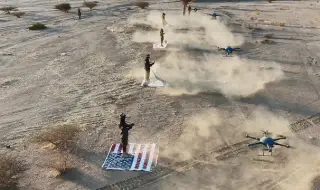
For more than a year, Israel, Washington and even the Lebanese government have been talking as if "Hezbollah" had been defeated for good. Yet the Lebanese armed movement is once again at war with Israel, striking its enemy in response to the US-Israeli war on Iran, writes Middle East Eye.
The group's behavior on the battlefield and its ability to strike deep into Israeli territory show that Hezbollah has treated its 15-month ceasefire with Israel not as the end of the war, but as a narrow and urgent window to rebuild, reorganise and prepare for what it believes will inevitably follow. When the ceasefire between Hezbollah and Israel took effect on November 27, 2024, after more than a year of conflict sparked by the Gaza war, the public narrative was stark. Israeli Prime Minister Benjamin Netanyahu said the campaign had "set Hezbollah back decades," destroyed most of its rockets, and eliminated its top leadership.
A senior U.S. official described the Lebanese group as "extremely weak." Central Command Commander Michael Kurila went further, calling Hezbollah "destroyed" while praising the deployment of the Lebanese Armed Forces in the former party's "strongholds."
In Beirut, the political language also changed. President Joseph Aoun declared that the state should have the "exclusive right to bear arms", and Prime Minister Nawaf Salam indicated that Hezbollah's military presence south of the Litani River was almost over. Analysts often claim that Israeli attacks have destroyed 80 percent of the party's military forces. Hezbollah, according to the prevailing version, was defeated and its disarmament was only a matter of time. But this version now appears to have confused heavy losses with strategic collapse.
According to four sources familiar with Hezbollah's post-war reconstruction process, the reconstruction began on November 28, one day after the ceasefire. There was no acceptance within the organization that the war was over, but that a new round of fighting with Israel was only a matter of time. From this perspective, the sources said, the ceasefire was not a political agreement. It is an operational interval, and every day of it is valuable.
"Mission Accomplished"
Various sources claim that Hezbollah believes that Israel has stopped its attacks for two reasons. First, Israel believes that the organization has been hit hard enough that international and domestic pressure will complete the task of politically and permanently collapsing Hezbollah. Second, Israel has judged that continuing the war could result in heavier losses for Israel at a stage when it believed that the strategic gains it was pursuing were already secured.
The pause in open hostilities is an opportunity for Hezbollah. This means that although the war has brought heavy casualties, it has left an open and critical space in which the organization could recover. And the subsequent efforts, according to the sources, were not limited to restoring its basic military capabilities.
The ambition was broader: to restore as much of Hezbollah’s capabilities, structure, and infrastructure as possible before October 2023. By mid-December 2025, according to the sources, military commanders had informed the leadership that everything that could be restored had been restored. "We told the leaders: mission accomplished," the military commanders were quoted as saying.
Some capabilities, especially those related to air defense and other strategically important systems, had suffered damage that could not simply be reversed. But within those constraints, the sources said, the recovery effort has been described as extensive, methodical and disciplined.
"Walking Martyrs"
Hezbollah’s task is enormous. On September 17, 2024, Israel blew up hundreds of pagers used by party members, wounding dozens, mostly civilians, and revealing a shocking intelligence leak. Later that month, fierce airstrikes on Beirut and other areas of the country killed the party’s top military leadership, as well as its longtime Secretary-General Hassan Nasrallah.
Israel has hit Hezbollah with a multi-layered shock campaign aimed at disrupting its command, exposing its networks and crippling its ability to function.
One source described Hezbollah’s leadership as “blinded, scattered and crushed” as Israeli forces launched a ground invasion in October 2024 after intense bombardment. “The steadfastness of the fighters on the border, fighting to the death, allowed the party’s remaining senior military leaders to take a breather and gather to regroup,” he told Middle East Eye. “These walking martyrs saved the party.”
When asked why some military commanders survived while others seemed to be killed at will by Israeli airstrikes, the source replied: “They didn’t pick up the phone.”
Structural changes
According to the sources, Hezbollah’s communications architecture has been penetrated much more deeply than previously thought. The party has always accepted that its members are being monitored. But it has become clear that Israel is able to track their locations in real time and pinpoint Hezbollah leaders and fighters with precision.
Sources describe how the party has largely abandoned all three of its previous communications networks for sensitive matters, reverting instead to what one source calls "basic and primitive" methods: human couriers, handwritten notes, and split channels between command and field units. A second source describes the tactical shift as "a deliberate act of adaptation" rather than a sign that the organization has regressed. And the strategy has also contributed to a broader structural rethink.
In the years since Israel’s 2006 war with Lebanon, and especially during Hezbollah’s intervention in Syria in support of Bashar al-Assad, the organization increasingly resembled a conventional army: bigger, heavier, more centralized, and more dependent on extended chains of command. This transformation expanded its capabilities, but the experience of the 2024 war has led surviving commanders to rethink that model.
Hezbollah, according to a third source, has become “a large cart that can only be moved by a team of stallions,” where it once resembled “lighter stray horses.” After the 2024 war, senior military figures are returning to the "spirit of Mughniyeh", a reference to the late commander Imad Mughniyeh and an earlier doctrine built around dispersed, semi-autonomous units. Under this model, units operate under broad, scenario-based guidelines rather than constant direct instructions.
The link to central command becomes lighter, slower, and less obvious. This change may reduce speed in some areas, but it increases resilience. It is a model designed not just for work but also for survival.
The Return to the South
The same strategy appears to have shaped Hezbollah's return to the south. Publicly, the ceasefire agreement required Hezbollah to have no military presence between the Israeli border and the Litani River, with the Lebanese army deploying in the area for more than 60 days.
By January 8, 2026, the Lebanese army claimed to have assumed operational control of the region, and Salam said that almost all weapons there were now in government hands. The reality, however, is far more complex. Hezbollah has not needed large, visible formations to reestablish its presence. Instead, it has relied on smaller cells and individual cadres to repair damaged facilities that were not completely destroyed, reactivate sites that were not revealed, and quietly reinforce positions that were not officially revealed.
Hezbollah has not retreated from Lebanon’s deep south. It has gradually reestablished itself through patience, concealment, and careful movement. "We were connecting day and night, relying on man to man to rebuild and rebuild", the source said. This contributed to the truce's controversial nature.
On paper, Lebanon was moving towards a "state monopoly on weapons". In practice, Israel continued to strike, accusing Hezbollah of trying to "re-arm and rebuild its terrorist infrastructure", while the party claimed to have respected the ceasefire in the south. While open conflict resumed earlier this month, some 400 people in Lebanon have been killed by Israeli strikes since the truce began.
There has never been a period of stable peace. It was an active and contested phase, with each side trying to shape the terms of the next confrontation.
Supply Problems
One reason Hezbollah’s enemies were confident that the organization would struggle to recover from the war in 2024 was that its supply lines seemed cut off. After Assad’s fall, Nasrallah’s successor, Naim Qassem, publicly acknowledged that the organization had lost its military supply route through Syria, even as he sought to minimize the strategic significance of that loss.
Yet the collapse of the Assad government has provided a brief but important window of opportunity. In the chaos that followed, Hezbollah was able to quickly move into empty warehouses before the new authorities consolidated control and Israeli strikes destroyed what remained.
Meanwhile, the organization spent months replenishing its stockpile of missiles and drones through Iranian support and local production. That does not mean that every capability has been rebuilt in identical form. Some advanced systems, especially air defenses, have remained difficult or impossible to replace.
The developments on the battlefield over the past two weeks prove that Hezbollah has not been completely crushed. On March 2, the group launched about 60 drones and rockets, followed by a similar number the next day, before increasing the pace soon after.
This week, Hezbollah rockets even reached southern Israel, sending Israelis in Ashkelon and communities near the Gaza Strip into hiding. An organization that was widely described as defeated is once again producing continuous fire, redeploying fighters and putting pressure on Israel both in Lebanese and Israeli territory.
"Mohammed Afif, our former media chief, used to say "Hezbollah is not a party, it is a nation, and nations do not die. People thought it was just a slogan. But we proved it wasn't," a source told Middle East Eye.