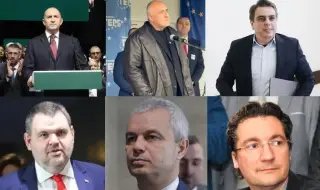
The idea of a leadership debate in Bulgaria always sounds wonderful – almost like a promise of reforms that everyone knows will not happen, but it is pleasant to pronounce. Especially when we are talking about a potential clash between Rumen Radev, Boyko Borisov and Delyan Peevski – three people who in different ways embody power, but equally avoid its direct public confrontation.
Will there be a debate before the April 19 elections? The short answer is: no. The long answer is: of course not.
Because a leadership debate means something very uncomfortable – questions without a preliminary script, answers without the right to edit and the scariest thing – a direct comparison. And the comparison is dangerous. It destroys carefully constructed images, shatters controlled narratives and, God forbid, makes the voter think.
And here comes the paradox. While the big “untouchables” carefully avoid such a format, other political figures (ed. – assuming that six parties enter parliament) – such as Assen Vassilev (PP-DB), Kostadin Kostadinov (“Vazrazhdane“) and Krum Zarkov (BSP) – have no particular problem standing in a studio and arguing. Why? Because they have something to gain. Visibility. Legitimacy.
And what do the first three have to lose? Control.
For Rumen Radev, the debate is an unnecessary risk – he no longer speaks from the position of an institution, but of a candidate. For him, distance is strength. The less he engages in direct confrontation, the more he preserves the image of a “new beginning for Bulgaria“.
With Boyko Borisov, the situation is even more interesting. A man who dominated political conversation for decades, today carefully avoids formats in which this conversation cannot be controlled. Monologue is convenient. Dialogue – risky. And debate? Downright dangerous.
As for Delyan Peevski – with him, the question is almost rhetorical. Public debate presupposes transparency, and transparency is not exactly the currency with which he traditionally operates. To appear in an open confrontation means to legitimize the format itself – something he has successfully avoided so far.
And so we come to the absurd: in a supposedly parliamentary democracy, a real leadership debate turns out to be impossible, precisely because the leaders do not want to participate.
Imagine for a moment the opposite – the three of them on one stage, questions about the economy, addictions, foreign policy, corruption. No detours, no “I'll answer another time“, no changing the subject. That would be an event. Real. Dangerous. And useful.
That's exactly why we won't see it.
Instead, we'll get the familiar: interviews of choice, comfortable studios, controlled messages and lots and lots of talking without real confrontation. Democracy on the record, politics without risk!
And then we'll wonder why trust is lacking.
The truth is simple - the leaders who talk the most about responsibility are the first to run away from its most elementary form: standing up to your opponent and defending your position in front of everyone.