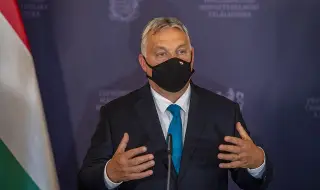
The elections in Hungary are the most important in the country since 1990. Will Orban lose and what will that mean for Europe, Russia and the world?
On April 12, Hungary will hold the most decisive parliamentary elections since 1990, when the Hungarian communists voluntarily stepped down from power. The question is whether Hungarian Prime Minister Viktor Orban and his regime will be overthrown or not. For the first time since 2010, the opposition - in the form of the conservative "Tisza" of Peter Magyar - to win.
The elections are important for both Hungary and Europe - because they will be significant for both the future of the EU and Russia's influence in Europe, as well as for the fate of right-wing conservatives and far-right populists on the continent.
Is Orban a dictator?
Viktor Orban has turned his party "Fidesz" into a strictly organized leadership party, in which nothing goes against his will, and the supreme principle is loyalty to him. After 2010, this hierarchy was transferred to the governance of the state.
Meanwhile, Orban determines everything in the country - from the renovation of buildings to the increase in pensions to geopolitics. Hungary formally remains a parliamentary democracy with free elections, but the prime minister, although he does not meet all the criteria for a dictator, is definitely an autocrat.
How did Orban change Hungary?
After coming to power, Orban made sure to place his people in all key positions in the state and administrative apparatus, as well as in the judiciary. Hungary became an ultra-centralized state.
Orban weakened the system of checks and balances. Most of the media were placed under the control of the government, the autonomy of universities was abolished, and a significant part of state and public funds were redirected to organizations close to Orban. Experts define Hungary as a "hybrid system" between democracy and dictatorship.
Why do Hungarians want a change of power?
Orban's economic and tax policies benefit his supporters. But the financial situation of many other Hungarians has worsened in recent years. Added to this is the poor state of healthcare and education, as well as dissatisfaction with widespread corruption and blatant cases of illicit enrichment.
Many Hungarians are also tired of the civil war-like atmosphere created by Orbán - for example, by portraying Ukraine as pure evil or constantly denigrating critics as enemies and national traitors.
Why are these elections so important for Europe?
Orbán has declared his goal to "take over Brussels" and reshape the EU into a union of politically sovereign nation-states with common economic interests.
The Hungarian prime minister has been attacking the EU for years and blocking important decisions in the fields of European and foreign policy. Orbán’s victory in the elections would lead to another weakening of the EU.
Why are the elections important for populists?
Orbán has become the embodiment of success in the camp of right-wing and far-right populists in Europe. No one else in this spectrum has achieved a two-thirds majority and has not ruled for so long. And no one else has made a greater contribution to the successful unification of this camp in Europe. The outcome of the elections will also be decisive for the future of populism in Europe.
Why are the elections important for Russia?
No other EU country is as closely tied to Russia as Hungary under Orbán. Even if he agrees with most of the sanctions imposed by the EU after 2014, the Hungarian prime minister continues to advocate for their lifting, imposes exceptions, and since 2022 has blocked as much support for Ukraine as possible. In this way, it weakens and divides the EU, which is declared to be a common goal of Orban and Russia. For Russia, overthrowing Orban would be a heavy loss.
Will Orban lose?
After coming to power, "Fidesz" made major changes to the electoral law, which still give it a big lead today. 106 of the 199 deputies are directly elected by a simple majority. "Fidesz" loyal constituencies are generally smaller, so even fewer votes can lead to the election of a given deputy. In the last elections in 2022, Orban's party received 53 percent of the vote, but took many more constituencies and secured 68 percent of the deputies, which is also an absolute majority.
Ethnic Hungarians from Hungary's neighboring countries who have Hungarian citizenship have the right to vote, including by mail. Hungarian labor immigrants in Western European countries, most of which are critical of Orbán, can only vote at diplomatic missions, but not by mail. According to Hungarian election experts, the electoral law is unfair. Therefore, a change of power will be difficult, but not impossible.
Could the regime falsify the elections?
Election experts in Hungary believe that there will be no falsification of the elections, since the opposition party "Tisza" is organizing a parallel count.
However, there are possibilities for falsification in the voting by mail of representatives of Hungarian minorities in neighboring countries; their votes could provide Orbán with one to two mandates. In poor regions of Hungary, vote buying has become a hot topic of discussion after a documentary exposed the practice.
How reliable are the polls?
Hungarian sociologists are convinced that the majority of citizens want change. Independent surveys for more than a year have predicted a significant lead for "Tisza" over "Fidesz". But these surveys only reflect the electoral chances of the candidates in individual constituencies to a limited extent. Moreover, they are unlikely to fully cover "Fidesz"'s core electorate - the elderly and pensioners in small towns and villages. Still, most experts believe that Orbán will lose.
How will Magyar govern?
The most important intentions and goals of Péter Magyar and his "Tisza" party are to turn Hungary away from Russia and return it as a reliable ally of the EU and NATO. However, regarding migration policy and policy towards Ukraine, Magyar intends to partially or completely continue the previous Hungarian line, although without a full confrontation with the EU.
In domestic politics, he declares himself in favor of fighting corruption and "changing the system". Magyar speaks of a fairer electoral system, limiting the prime minister's terms to two, and a new constitution. Orban and other high-ranking politicians in his entourage can expect accusations of corruption and even national treason.
Will Orban admit defeat?
The prime minister has not commented on this issue directly so far. He only says that he has won and lost elections, and that Hungary is a democracy. From then on - if Orban declares that he has won, mass demonstrations, including clashes, are likely. If Orban loses, it will be up to him whether his supporters take to the streets or not.
Orban has taken a number of measures in response to the possible loss of power. Many changes to his system require a two-thirds majority, and many of the key positions are filled for years to come. In this situation, Orban's "deep state" can easily sabotage a government if it only has a simple majority. But even with a two-thirds majority, it could take years for "Tisza" to completely dismantle Orban's system.