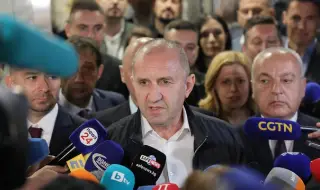
After his convincing election victory, the former President of Bulgaria Rumen Radev will be a factor in both the legislative and executive branches. The reasons for his success and the mistakes of others are analyzed by Georgi Lozanov.
The emerging analogy between Rumen Radev and Simeon Saxe-Coburg-Gotha is not only in the scale of their election victory and in the expressed suspicions of preserving Russian influence in the country. True, under the Tsar we joined NATO and the process of our integration with the EU accelerated, but his urgent arrival from Madrid to take over the function of republican Prime Minister was a way to thwart the second mandate of the democratic forces (UDS at the time). And later, in the form of the triple coalition, the former communists would also return to power, when the post-Soviet oligarchic model of “distributing portions“ to a circle of close associates steadily imposed itself.
Because if the government of Ivan Kostov, which, coping with unenviable difficulties, initiated the reforms necessary to transform Bulgaria into a Western country, had remained for another four years, this would have been an irreversible fact. And Kostov, in addition to being overthrown, was professionally demonized and made the culprit for all the people's troubles.
The campaign also affected the president from the United Democratic Forces, Petar Stoyanov, who in turn was replaced, despite the impressive preliminary support, also with a former communist in the person of Georgi Parvanov. Good stage work, good acting, a dose of luck and here is the “grand slam” of Russian interests in the Bulgarian economy: the Belene NPP, the South Stream (continued with the Balkan Stream), and the Burgas-Alexandroupolis. Over time, all three projects fell through, which Russia could not have liked, but at that stage it knew that its influence should not interfere with Euro-Atlantic attitudes in the country, so that they would not interfere with its influence. It was content with Bulgaria being some kind of hybrid state that makes visible gestures in the West and invisible ones in the East.
On the fourth wave of protests against the oligarchic model in Bulgaria
Saxe-Coburg-Gotha and Radev are similar in that they reached the executive branch through far more favorable roles in terms of image – that of tsar and president, i.e. of a father and a unifier of the nation. Never mind that the Tsar was practically like that from the age of six to nine, and the President was even less perceived as a unifier. But the Tsar, himself an anti-communist by origin and convictions, had to govern the state “hybrid“ against the backdrop of nationwide enthusiasm for the upcoming accession to NATO and the EU, while Radev will govern it when “anti-communism“ and even “democracy“ seem to have already been forgotten words.
The former President took power over the fourth powerful protest wave against the oligarchic model, with which he had nothing to do, but - as he had already learned - joined it “in step“ from the presidential corridors.
The first wave, raised back in 2009 by the triple coalition, entrusted Boyko Borisov with the fight against the oligarchic model, which would later bear his name and that of Peevski.
The next wave in 2013-14 was against the Oresharski government, further escalated by Peevski's attempt to head the National Security Agency. Ultimately, Boyko Borisov again took on the role of the hero who would fight the same dragon, but it was already clear that if he himself did not fight Peevski, sooner or later the discontent would turn towards him.
As happened with the third wave in 2020, when the square demanded his resignation and we entered an electoral spiral. However, it only contributed to another restoration of the model, which now included the use of the state's repressive apparatus against political opponents. The victim was the PP-DB-appointed mayor of Varna, where the protests that led to Radev's victory six months later actually began.
The vote for him on April 19 was the equivalent of the dissatisfaction that had accumulated over the years and was unleashed for the fourth time against the corrupt governance of the country, personified by Borisov and Peevski. If Borisov had allowed himself to admit before, and not after, the elections that what was happening "does not depend on me, but on Peevski" and that "we will restore the anti-corruption profile with which we were created", the vote for Radev would certainly have shrunk at least somewhat in favor of that for GERB.
However, the only real competitor to Progressive Bulgaria is the PP-DB, which had led the civil discontent, and Assen Vassilev personally stimulated it with the remark that became a political symbol: "Who ordered this outrage?" But the voters categorically preferred Radev's party because it is a new force in the battle with the old dragon, while the five-year attempts of the PP and DB to defeat it have never been crowned with success. What's more, at one point they allied with him, albeit for patriotic reasons, which the electorate still does not want to forgive them for. In addition, the election campaign was largely dedicated to discrediting them, and one party died heroically in its desire to destroy them. Moreover, unlike them, who - while fighting the dragon - are fighting among themselves, Radev is himself a "hero on horseback" and exactly as it should be according to the folkloric idea of a political leader in our country - Bulgarian, military (if possible), Orthodox, heterosexual, strict, patriotic.
Four reasons for Radev's electoral success
And here we come across an electoral paradox: most voters declare that they are supporters of the EU, including the euro, whose adoption Radev tried to at least postpone with a referendum for an unknown time, and yet most voters voted for his party. What could be their motivations?
First, taking advantage of the pre-election speech, they clearly refused to remember that over the years Radev has also advocated pro-Russian positions. At the end of his campaign, we even saw his photo with Putin.
Secondly, the oligarchic model has weighed on the people so much, including Peevski's pulpit addresses to them on the verge of mockery, that their only wish is to be swept away, and from then on, whatever he wants to happen.
Thirdly, Radev has managed to scare them, picking them up from his New Year's speeches as president, on the two most sensitive lines - about life and bread. And that is why we must be careful that there is no war, so as not to be miserable.
Fourthly, the frogs may already be boiled and the reassurance that there is no way anyone can take us out of the EU and NATO has "caught fire". It seems like we can't, like the Hungarians in recent years, give up on democracy and choose autocracy.
Is Rumen Radev making such a choice? We'll have to see.
* This text expresses the author's opinion and may not coincide with the positions of the Bulgarian editorial office and the State News Agency as a whole.