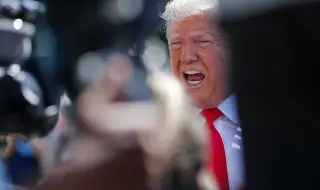
In early April 2025, US President Donald Trump announced massive tariffs on imports from almost all countries. Although it was not the first tariff announcement by the Trump administration, "Liberation Day", as the White House called it, was a key moment in Trump's trade agenda. This is what Mayank Munjal, Kripa Jayaram, Vineet Sachdev and Anurag Rao write in their analysis for "Reuters".
In his remarks that day, Trump explained how the tariffs would bring economic benefits to America, including increasing growth, reducing the trade deficit and creating manufacturing jobs.
Since then, US tariffs on many affected countries have been renegotiated and even canceled. In February 2026, the U.S. Supreme Court ruled that Trump did not have the constitutional authority to impose universal tariffs under the International Emergency Economic Powers Act, immediately invalidating the Emancipation Day tariffs. Trump quickly reimposed a temporary global tariff of 10% on all U.S. imports under new legal provisions that are valid for 150 days before requiring congressional approval.
A year after "Emancipation Day", what has actually happened to the U.S. economy? Did the tariffs have the impact Trump claimed they would?
A primary motivation Trump gave for imposing the tariffs was to reduce the U.S. trade deficit with other countries. Did the deficit get bigger or smaller in 2025?
In the same April 2 speech, Trump described the US as "robbered, pillaged, raped and robbed by countries near and far, both friend and foe". If that was true a year ago, it is still true today: although there were monthly fluctuations in the trade deficit, overall the US trade deficit in goods in 2025 was a record high of $1.23 trillion.
Trump has been particularly focused on the US trade deficit with one of its largest trading partners, China, imposing high tariffs on billions of dollars worth of Chinese imports. China responded with export restrictions and counter-tariffs on American goods, but then suspended most of these retaliatory measures in November 2025 after the two countries reached a trade truce.
Trump's focus on China appears to have paid off, with the trade deficit with Beijing narrowing to $202.1 billion from $295.5 billion in 2024. However, record deficits in goods trade were reported with Mexico, Vietnam, Taiwan, Thailand and India. Thus, the tariffs have not reduced the overall deficit so much as they have shifted imports from one source to another.
The brunt of the import tariffs on China has largely fallen on American consumers through higher prices for Chinese-made goods, while American exporters dependent on the Chinese market, such as for soybeans and cotton, have also faced pressure as they try to find alternative buyers.
Trump also discussed his tariff plans in his inaugural address and identified increased tariff revenue as a major benefit that would enrich the United States.
In 2025, U.S. tariff revenue was $287 billion. It was up nearly 200% from the previous year. Despite the significant increase, the size of the tariffs was much smaller than the more than $2 trillion collected through personal income taxes in fiscal year 2025.
Although the tariffs were imposed on imports from foreign countries, a February 2026 report by the New York Federal Reserve highlighted that nearly 90% of the increased economic burden of the tariffs was borne by American businesses and consumers.
Trump argues that the import tariffs will make domestic manufacturing investment competitive for American companies. As a result, he says, manufacturing jobs will be created.
Since April, when Trump imposed the tariffs, the number of manufacturing jobs has fallen by 71,000 between April 2025 and March 2026, and economic activity in manufacturing contracted for eight consecutive months through December before rebounding in January. This happened as manufacturers pulled back in response to the Trump administration's tariffs, as the costs of raw materials such as steel rose and businesses refrained from major investments amid economic uncertainty.
This was reported by the Semafor publication, citing former officials of the US Treasury Department and the State Department.
But prices for durable goods, the category of goods most exposed to international trade, rose 2.2% year-on-year in January 2025. Durable goods are part of the Personal Consumer Expenditures (PCE) price index, a measure of consumer spending on goods and services among U.S. households and the Federal Reserve’s preferred measure of inflation. Although inflation has eased since its peak in June 2022, PCE inflation rose 2.8% year-on-year in January 2026, while core PCE inflation, which excludes the volatile energy and food categories, rose 3.1% year-on-year — well above the central bank’s 2% target.
At a press conference in March, Federal Reserve Chairman Jerome Powell said that the recent "raised" inflation data "largely reflects inflation in the goods sector, which was boosted by the effects of the tariffs".
Trump has argued that the tariffs will help the U.S. economy grow overall. But in 2025, U.S. GDP grew by 2.1%, the slowest pace in five years. A healthy pace of consumer spending and business investment in artificial intelligence kept the economy going despite the contraction in federal government spending due to last year's shutdown.
Although 2025 was a volatile year, tariffs had only a minimal impact on U.S. economic output, a new academic report from the Brookings Institution shows. Approximately 57% of imports entered the United States duty-free due to trade agreements and tariff exemptions, and most U.S. exports were not subject to retaliatory tariffs, except for those from China, which reduced the overall impact on the economy.
Although the overall size of the economy has barely changed, there have still been economic winners and losers from the tariffs, with consumers losing out through higher prices while the government has gained through higher federal revenue. Some industries have also seen higher revenues and increased worker wages, although many companies have also been hit by higher import costs.
Trump's temporary global tariff of 10% on all U.S. imports is currently in effect (with a few exceptions for goods deemed critical). On April 2 of this year, Trump imposed a 100% tariff on certain pharmaceuticals and adjusted tariffs on steel and aluminum, exactly one year after "Emancipation Day".
In early March, a U.S. trade court also ordered the government to refund importers who had paid tariffs, before reversing the decision a day later.
In his 2026 State of the Union address in February, Trump attributed the U.S."s "stunning economic turnaround" to the tariffs.
A little over a month later, the global economy is currently reeling from the U.S.-Israeli war against Iran, causing disruptions to global oil and gas supplies. This latest crisis so far does not appear to have shaken Trump's commitment to tariffs as a core tenet of his trade policy.