The history of Bulgarian parliamentarism from 1989 to the present day shows that large parliamentary groups rarely fall apart because of the opposition, but usually first eat themselves up from within. What can be expected from the people around Radev.
In politics, there is only one thing more dangerous than a weak majority - an absolute majority. With 131 deputies, “Progressive Bulgaria” no longer needs coalition partners. But this means that all future conflicts will be internal. Unless Rumen Radev's party is united by a common ideology and party structures until next year's local elections.
The history of Bulgarian parliamentarism from the democratic changes to today shows that large parliamentary groups rarely fall apart because of the opposition. Usually, they are first eaten from within. If the history of the National Movement Simeon II (NMSI) teaches us anything, it is that a large parliamentary group without strong internal cohesion and discipline is a future multitude of separatists.
At first glance, there is no particular cohesion in the majority in the new parliament, even less ideological. But there is still one common line.
Towards progress... with Russia?
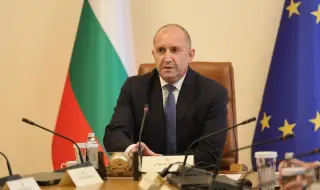
As the parliamentary representation of a formation built around a leader, “Progressive Bulgaria” (PB) will bear any drop in Radev's rating, no matter how he does in the 52nd parliament. The Prime Minister withdrew the top brass and officers from his government, and few with political and administrative experience remained in the National Assembly.
The leadership of the parliamentary group of “Progressive Bulgaria” comes with biographies and public positions that will inevitably fuel questions about the attitude towards Russia. Former MEP from the BSP/PES Petar Vitanov, today the group's chairman, has established himself as one of the faces of the softer line towards Russia in the BSP and the European left. In the European Parliament, he consistently criticized energy sanctions against Moscow, warned that Europe was paying too high an economic price for the war, and insisted that a diplomatic solution was more important than military support for Ukraine - positions that often put him close to Russian arguments in the European debate.
Olga Borisova, who worked as a legal advisor at the “Radioactive Waste” fund, teaches at the Varna University “Chernorizets Hrabar” and is known as the youngest professor in Bulgaria. The largest group of foreign students at VFU comes from Russia and former Soviet republics, and due to the fact that the university has the first Russian Center in the Balkans (established in 2009 in partnership with the “Russian World“ fund), which certifies Russian speakers from all over the world.
Galin Durev, as a BSP deputy in the 51st National Assembly and a member of the Friendship Group with Russia, visited Moscow last fall - immediately after the American sanctions against “Lukoil“.
In his own words, Bulgarian interest in energy was among the main topics of conversation, as well as spiritual ties and the role of the Orthodox Church.
Slavi Vassilev recently announced a dialogue with the Russian owners of “Lukoil” regarding their assets in Bulgaria, including the refinery in Burgas. The group also includes volleyball legend Vladimir Nikolov, who maintains visible personal and professional contacts with Russia through his son's career in Novosibirsk.
Although he is not in the leadership of the PG of “Progressive Bulgaria” Anton Kutev is among the famous deputies. An experienced party apparatchik, a BSP deputy in three parliaments and in the National Council of the “Russophile” movement; he was also the BSP spokesman during the “Oresharski” cabinet. In the same government of BSP and MRF, another MP from “Progressive Bulgaria” - Yavor Gechev, was Deputy Minister of Agriculture. Until recently, he was considered Minister of Agriculture and Food, Gechev was replaced at the last moment by business circles behind Plamen Abrovski.
But the “Oresharski” cabinet is not only remembered for the unfortunate appointment of the rising oligarch Peevski as head of the National Security Agency, which was also approved by Kutev, but also for the “South Stream” gas pipeline project, a central topic at the time along with Russian influence.
An MP from the PB is also Konstantin Prodanov, a former advisor to President Georgi Parvanov (2002-2012), who in 2017 was congratulated by Putin’s “United Russia” party upon his election as leader of the ABV.
The core of “Positano” 20
Behind the facade of a “new” political formation in “Progressive Bulgaria”, an organized and politically skilled core clearly stands out - the migrated cadres from the BSP. As it turned out, there are newcomers from “There are such people” - both among the deputies, and in the government, and from other parties. But it is precisely the people with party experience on the left who are the best prepared, they know the administration and political mechanics in general. Some of them also come with long-standing connections in the energy sector, institutions and old networks of influence.
The question is whether this core will be able to hold on to the politically diverse group around Radev, or over time the natural process of internal entrenchment in camps will begin - between former socialists, presidential loyalists, technocrats, conservative patriots and public figures who have accidentally fallen into it.
However, what is more interesting is that in the new majority there are almost no people who have built their political biography in open conflict with Russian influence in Bulgaria. Rumen Radev and his selectors have practically created a party coalition of all circles in the Bulgarian elite, who never completely broke with Russian influence after 1989.
The tests for the majority of “Progressive Bulgaria” are ahead. This year, the National Assembly must vote on the final investment decision for the 7th and 8th units of the Kozloduy NPP with the American technology of Westinghouse's Alpha P 1000, and Rosatom is once again heating up the topic of the Belene NPP.
The parliamentary group of Progressive Bulgaria has already announced that they will replace the special manager of the four companies of the Russian Lukoil - although this is the job of the government, not the National Assembly. The question is whether a professional manager will be appointed to such a position, or someone perceived as acceptable to the old Russian energy networks.
For now, Konstantin Prodanov assures that the agreement with Ukraine in the field of security, which was concluded by the caretaker cabinet, will not be withdrawn - although without any particular categoricality. But how would Radev's majority vote if someone again decided to resurrect "Belene"? In a vision for an energy strategy of the acting presidential office in 2023, it was envisaged that the "Belene" NPP would be there.
We will soon find out
It will soon become clear by what criteria the candidate deputies of "Progressive Bulgaria" were selected - by their desire to dismantle the oligarchic model, to which Russian energy dependencies have made a serious contribution, or by their ability to reconfigure it.
This text expresses the author's opinion and may not coincide with the positions of the Bulgarian editorial office and the DV as a whole.