Daniel Smilov's Comment:
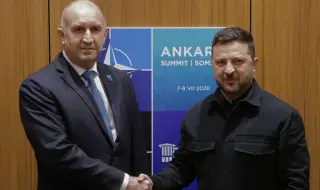
Two important events for Bulgaria took place at the NATO summit in Ankara. The first is that the EU and a united Europe (of which, let us recall, we are a part) won an important geopolitical victory. Despite Donald Trump's quarrels with Denmark (over Greenland) and with Spain (it is unclear what for), in fact the European policy for Ukraine won and the USA joined it. After winning the presidential elections again, Trump repeatedly gave signals that he favors Russia at the expense of Ukraine and is looking for a way out of the war that is closer to Russian desires at the expense of Europe. At the summit between Trump and Putin in Anchorage a year ago, the spirit of compromise was released, which for many was a betrayal of Ukraine. This "spirit of Anchorage" - if it ever existed - has already been replaced by the "spirit of Ankara", which is strongly pro-Ukrainian.
It is not known how long the new spirit will dominate the behavior of the American administration, but its first manifestations were quite impressive: open support and praise for Zelensky and the Ukrainians; a promise that they will be given the necessary licenses to produce "Patriot" missiles together with Europe; approval of drone and missile strikes deep inside Russia as a necessary escalation that could bring peace closer. All of this is actually an approval of the policy of a united Europe towards Ukraine over the past year. As well as an acknowledgement by the US that whatever tensions there may be on both sides of the Atlantic, a united West is much stronger together. Trump needs support and a united front with other countries, not least because the situation with Iran is complicated and the outcome is still unclear.
The second important event for Bulgaria is the presence of Ukraine as an almost equal member of the Western defense alliance at the Ankara meeting. The message here was very clear: formal membership is not available and may not happen soon, but Ukraine is part of the family because it shares similar values, its struggle is fair, and its interests and those of the united West coincide. This is also a big change, especially in the position of the American side, which is not very interested in values and emphasizes more on direct benefit for itself. Even from such a point of view, Trump seems to have judged that it is more profitable for the United States to support Ukraine. The fact that Russia stood by Iran, providing it with intelligence information and other logistical assistance, must have helped in this decision of his. Perhaps Trump has also felt the pressure from American society, which is quite massively sympathetic to Ukraine. Whatever the reasons, however, now (and again) the West has a common position on who is wrong and who is right in Ukraine and who should be helped.
Foreign policy and budget deficit
In this new situation, Radev's government is generally following the common European course, but at the same time it seems to be doing so reluctantly. This is probably Radev's way of flattering the Russophile part of his electorate, which may be disappointed by his substantive acceptance of the policies of a united Europe. Saving the Russian patriarch from sanctions and the "refusal" to give aid to Ukraine (which we have not given unilaterally for more than three years anyway) demonstrate this reluctant Europeanization of the foreign policy of "Progressive Bulgaria".
The reluctant Europeanization unfortunately also affects the country's fiscal policy. There is no reason for Bulgaria's budget for 2026 to have a deficit of 5.7 percent unless we assume that from the very first year we aim to violate European rules for sensible finances. "The voice of Bulgaria" will be heard powerfully as a remake of the Greek voice in the eurozone - as if national identity lies in accumulating unreasonable debt. But these demonstrations are very dangerous for the following reason: today the Bulgarian economy is strong and growing, which makes the contraction from 5.7 percent to three not only possible, but also almost painless. It has been argued many times how the deficit can be brought within limits by cutting the cost of administration and some capital expenditures.
Imagine, however, that next year there is a dramatically deteriorated economic picture worldwide due to the conflict in the Middle East, an escalation in Ukraine or other factors. If this leads to a serious slowdown in the eurozone, Bulgaria will find itself with both a huge deficit and falling income. Why are we taking this unreasonable risk? This is an indisputable political mistake, which is a symptom of a tendency towards irresponsible opportunism.
Two strategic choices
Moreover, when determining the country's financial priorities, it became clear that it was important for the government to keep all the capital expenditures bequeathed to it and promised to various clients, but not to find money for the joint investment with "Rheinmetall" in the agreed gunpowder and ammunition plant. Strategically, this is also an unjustified choice: our military industry must modernize and become involved in the European industry. The potential benefits of this are many times greater than the promises to road builders and other local clients.
During the week, another admission came from Turkey: that the "Botaş" contract is shockingly unprofitable for Bulgaria. Everyone knows this, but it is another thing when Radev himself agrees to suspend it for a while. Not that this solves the problem (especially with the already accumulated losses), but it is still a finding and registration of a major political mistake. Radev owes the Bulgarians an explanation as to why he signed an unprofitable contract for an extremely long period of 13 years. Even if we assume that there was pressure from the events, what was the reason for accepting such long-term conditions, committing Bulgaria to more than a billion dollars? After all, the interrupted gas supply contracts with Russia were for similar amounts. Why are we immediately committing to giving this money to Turkey, which obviously wants to establish itself as an intermediary for Russian gas in Europe during this period?
Peevski's flights - under the umbrella of the institutions
And the last news with a Turkish tinge of the week was that despite the commendable efforts of Minister Demerdzhiev, it was still not clear who flew with whom and how to Istanbul on a private plane with Delyan Peevski. But still, the conversation began to head in the right direction: how the gentleman in question managed to avoid sanctions under the global "Magnitsky" law. The answer here is very clear, but it still eludes the rulers: he succeeded with the help of our institutions, and especially the Ministry of Interior, the services, the banking regulators and the prosecutor's office. This must be investigated, checks must be carried out, etc. This is also the main topic for which Radev was elected: the transformation of institutions into an umbrella and a baton, their conquest by political and private interests. The fight against this problem is still at the level of clarifying the piquancy. The rulers are urging us to wait until the fall for real action. And in fact, there is no need to wait.
***
The spirit from Ankara is creating great internal torment for our new government. Its reluctance to support the European line regarding Ukraine (and not only) is based on two (disputable and downright wrong) assumptions. The first is that from a moral point of view, it is not entirely clear who is wrong and who is right in the war in Ukraine. The second is that Europe does not have the resources to become a serious and unified geopolitical player, and therefore it may be good for Bulgarians to wink at Russia from time to time. Both assumptions were rejected or at least seriously challenged in Ankara this week. More importantly, both are highly problematic as a basis for conducting foreign policy on the European side. Ultimately, whether Europe will be successful on the world stage also depends on its member states. Bulgaria, let us recall, is a member state, not a neutral observer.