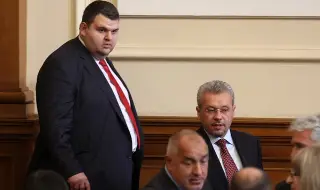
The situation in Bulgaria is dangerous. There have been similar things before, but now a systematic operation is being conducted against the main opposition party and others inconvenient for Peevski-Borisov. This is an attempt to impose autocracy.
Bulgarian democracy is in danger and all those who care about it must put aside their party biases and oppose attempts to impose autocracy and authoritarianism in the country. These terms may sound vague and exaggerated, but unfortunately they describe exactly what is happening: key institutions are being taken over and are using power and violence to impose the interests of a certain political elite, united partly on a corrupt basis.
The facts are as follows:
For a year or so, a process has been underway in which services, investigation, prosecution and courts are being used to destroy opposition parties: first it was Dogan's APS, now an attempt is being made with PP-DB;
The direct goal of this attempt is to put pressure on mayors from these parties so that they break away from the opposition and switch to DPS-New Beginning or GERB. The indirect goal is to compromise the leaders of the opposition parties and destroy their structures and support;
In developments that lasted months, the services and investigators put pressure on mayors, deputy mayors and other opposition figures to make them testify against each other or against party leaders, to disown them from their party and to encourage them to switch to the political camp of the ruling party;
Any possible offenses of the pressured are used (for example, unclear intentions for future corrupt actions), all kinds of traps are set for them with recordings and other tricks from the repertoire of Petyo Euro. Or they simply fabricate some false accusation, as in the case of the mayor of Varna, which relies on Plamenka or other curious, partisan and grown-up "witnesses" in the client network of the ruling party;
The accused oppositionists are left in prison for edification and additional blackmail, with their cases being distributed to pliant and dependent judges who are inclined to carry out political orders;
As a result of all this, the limit for the use of criminal repression and violence against the opponent was repeatedly and systematically violated.
We have already seen the collapse of democracy elsewhere
This is the situation in the homeland. Similar incidents have happened before, but now we are talking about a systematically conducted operation against the main opposition party and others inconvenient for Peevski-Borisov. In other countries, the collapse of democracy has already happened in this way. In Georgia, for example, the country is ruled by oligarchs and politicians from the “Magnitsky” list, opposition leaders are in prison and the dreams of Georgians for a free and European future are evaporating, if not completely evaporating already. Bulgaria has not reached this point, but if it does not oppose the rampant political repression, it certainly will.
The theme of the just-concluded world congress of the most authoritative international political science association IPSA in Seoul was “Resisting autocratisation in polarized societies“. Most of the reports were on how to prevent the erosion of democracy and its collapse into autocracy in the context of serious political opposition within modern societies. South Korea itself passed in December 2024. through a coup attempt organized by the country's former president, Yun Suk-yeol (from the right-wing conservative People Power Party), who briefly imposed martial law. Based on this and other examples around the world, the following conclusions and recommendations for preserving democracy can be made:
1. The separation of powers, independent courts and prosecutors are the main tools for preventing the collapse of democracy. Things are bad in our country in this regard. The acting Prosecutor General Borislav Sarafov is a convenient tool of the Peevski-Borisov tandem and as such was left in his post beyond any legal, constitutional and moral restrictions. The Supreme Judicial Council has expired, and all the offices are filled by MRF-GERB appointees. The vertical separation of power - the opposition mayors - are under constant attack and are removed from their posts by court or otherwise. President Radev remains a possible counterpoint to those in power in the constitutional system, but he has not taken a categorical position on the topic of autocratization and political repression. With his opposition to the euro, he further isolates himself from the large pro-European and pro-democratic majority in Bulgaria. In South Korea, immediately after the attempted coup and the declaration of martial law, the deputies in the parliament, led by its speaker, ran to their workplaces, jumped over the military fences, and reached the hall to announce the restoration of democratic order. No one wants Natalia Kiselova to jump over fences and risk her life, but at least she can not turn a blind eye to acts of organized and targeted punitive repression against the opposition;
2. The ruling majority and especially the parties on the right within it (GERB) must be careful not to go down an authoritarian path by allying with bad comrades. Political scientists Levitsky and Ziblat argue that the right-wing conservatives bear particular responsibility for the collapse of democracy because they succumb to authoritarian temptations, just as the right-wing bourgeois parties and von Papen did in 1933. thought they would use Hitler as their own launch pad. In our country, the Peevski-Borisov tandem could become a major tool for diverting the Citizens for European Development from their democratic path. There are many worthy and honorable people in GERB (and in the DPS). But it is precisely on them that the responsibility falls to send a signal to their leaders that what is happening with their direct or indirect blessing is absolutely unacceptable. If Borisov does not see the danger of the rampant punitive repression, then he has clearly lost his qualities as a democratic leader, which he undoubtedly has had so far (despite his serious shortcomings in terms of corruption);
3. The opposition that defends democracy must be united and not succumb to the temptation to split and fragment with partisan and ideologically puritanical goals. Where the opposition is weak and divided (in Hungary and Serbia, for example), autocratization is highly advanced and very difficult to prevent. At the same time, however, it is not necessary to bring absolutely everyone into the opposition - simply on a negative principle, because this will prevent it from becoming an effective governing factor: it is difficult to govern with parties that are opposite in their intentions. In the Bulgarian context, this means that the core of the democratic opposition around the PP-DB must be preserved and expanded and not to think about opportunistic rapprochements with diametrically opposed parties on an anti-Peevski-Borisov principle. Of course, everyone has a responsibility to oppose the violation of the principles of democracy, but this does not mean that the political differences between the opponents disappear;
4. Citizens must be ready to come out and defend their rights. In our country, civil society has both a history and potential for peaceful protests. A wave of protests in support of democracy is currently taking place, and this is a positive fact. Here, too, the intelligentsia has a special responsibility to seek mobilization and unity, and not to sow discord and mutual distrust. Ultimately, all those who turn a blind eye to blatant political repression are committing a serious sin, not only intellectually, but also as citizens;
5. International factors. Here too, the situation is mixed. Bulgaria's integration into the EU and the eurozone is a circumstance that helps democracy. The polarization of societies, which is being intensified by politicians like Trump, is a negative factor, however. The new American administration's support for the far-right and anti-Europeans in the EU is puzzling, but in any case it will have its repercussions both in our country and in other countries. The conclusion is that Bulgaria does not exist in an international hotbed for nascent democracies that would create conditions for its development that are close to ideal. The country must increasingly rely primarily on itself to defend its own democracy, although outside help will continue to be available.
Bulgaria has a chance and should not waste it
This brief analysis shows the main resources and weaknesses of the Bulgarian free democracy. The situation is not lost, but democratically thinking people - both in the government and in the opposition - must assess the danger soberly and objectively and act consistently against it. Bulgaria is close to becoming a developed, prosperous, free and democratic country. If it fails with freedom and democracy, it will quickly lose its chances for prosperity, however.
This comment expresses the personal opinion of the author and may not coincide with the positions of the Bulgarian editorial office and the State Gazette as a whole.