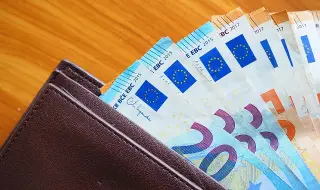
The euro is not only a currency, but also a bond - by adopting it, Bulgaria has made a lasting choice in favor of Europe, the German media write.
The adoption of the euro is a victory for pro-Europeans in Bulgaria, as there is no turning back, writes "Tageszeitung" (TAC). The publication notes in a commentary that the pro-Russian forces have lost because the Bulgarians cannot leave the eurozone and get closer to the Kremlin.
Europe is forcing the country to cooperate and preventing nationalist outbursts, TAC also points out and emphasizes that the single currency is not a door to some shopping center that you can enter and then exit again - whoever is inside, is inside. And that is precisely why the Bulgarians decided in favor of the euro.
With a new currency, but without a government
On the occasion of Bulgaria's accession to the eurozone, the Frankfurter Allgemeine Zeitung (FAZ) comes out with the headline "With a new currency, but without a government" . And this publication writes that this is how Bulgaria closes the last major chapter of its connection with the West for now. The author Michael Martens points out that in economic terms the situation in the country is better than is believed abroad - state debts are not large, and the budget deficit is low, only inflation is high.
The FAC writes that Bulgaria continues to have the lowest GDP per capita and the lowest wages in the EU, but since joining the Community 18 years ago, the country has been constantly catching up, the economy continues to grow. In 2025, GDP grew by three percent according to data from the European Commission (EC), such growth is expected in 2026.
From an economic point of view, the country is standing solid, summarizes the German publication, without hiding that this cannot be said about political relations. It is noted that although theoretically a majority for a new coalition could be found in the current parliament, this is unlikely - from then on, the eighth parliamentary elections in five years will be held. However, as Michael Martens predicts, according to the current state of affairs, they are unlikely to lead to any substantial changes; rather, the unclear relations will remain, unless the entry into politics of President Rumen Radev stirs things up.
Political instability and corruption
ARD also emphasizes that Bulgaria is joining the eurozone in times of lasting political crisis - political instability and corruption are overshadowing the project. The German public media recalls that Bulgaria was actually supposed to join the eurozone in 2024, but the government's negligence in the preparation and failure to meet the criteria for admission prevented this. Among them - most of all, high inflation, which at times reached double-digit values. ARD notes on this occasion that even now the ECB and the EC are turning a blind eye - because the reference value for inflation of 2.8 percent set by them was achieved with difficulty (2.7 percent) and with great goodwill. Critics even talk about covering up the truth, writes the German public media.
It also recalls that over a fifth of Bulgaria's population lives below the poverty line and has problems with regular food supplies. And to this is added that Bulgarians do not particularly trust their state leadership - another election is coming up, and the public is worried about the great corruption and political failures.
ARD also gives a high assessment of Bulgaria's economy, defining the economic growth of three percent as an enviable circumstance - since it is twice as high as the average for Europe. The German public media predicts that after the introduction of the euro, investments will increase, and companies are hoping for new chances. By connecting more closely to the eurozone, the pressure to impose control over the traditionally strong corruption should also increase, ARD believes.
The publication also notes that after Bulgaria joins the eurozone, there will be a pause in this process - because, for example, Romania is both far from fulfilling the criteria and does not show much interest, while Poland, the Czech Republic or Sweden prefer to keep their national currencies.
The euro will not solve all of Bulgaria's problems
In a comment on the introduction of the euro in Bulgaria, "Frankfurter Rundschau" writes that neither it nor the EU can solve all of the internal problems of the member states. But Bulgarian politicians can no longer count on the discontented emigrating - currently more Bulgarians are returning to their homeland than emigrating, and self-confident citizens, who no longer feel compelled to emigrate, can more easily intervene to correct the mistakes in development.
Bulgaria still has enough problems, writes "Frankfurter Rundschau", but the positive migration balance is an indicator that EU integration is working, at least as far as living conditions are concerned.