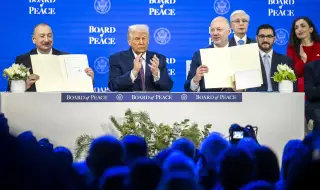
After a special summit of EU heads of state and government, European Council President Antonio Costa expressed a critical attitude towards US President Donald Trump's controversial "Peace Council", notes "Frankfurter Allgemeine Zeitung".
"We have serious doubts about a number of elements in the Peace Council's charter," Costa said in Brussels. This concerns the scope of the tasks, the chairmanship and the compatibility of the initiative with the United Nations charter.
Trump presented the "Peace Council" on Thursday during the World Economic Forum in Davos. Nineteen other countries signed the founding document, including Argentina and Hungary. Several invited countries did not participate, including Germany. Berlin has so far expressed reservations about the new body. France has already refused to participate.
The body was originally supposed to monitor the plan to end the war between Israel and the radical Islamic Palestinian organization "Hamas" in the Gaza Strip. However, the founding charter does not explicitly mention the Palestinian territories. Trump plays a dominant role in the "Peace Council". He is the chairman of the body, decides on invitations to participate and has the right to veto all votes, the "Frankfurter Allgemeine Zeitung" reports.
US President Donald Trump announced the creation of a new "Peace Council" in Davos, which he says will guarantee "peace in the world", the "Frankfurter Rundschau" reports. The signing of the charter by representatives of more than a dozen countries, however, has been criticized as a potential frontal attack on the United Nations (UN), the newspaper notes, pointing out that only Bulgaria and Hungary are represented from the EU in the new body - Germany is absent, as are other NATO partners, Japan, South Korea and Australia. "The charter is already in force, and the Peace Council is an official international organization", Trump spokeswoman Caroline Levitt emphasized after the ceremony in Davos.
Many analysts see the new organization as direct competition for the United Nations. Trump himself has sharply criticized the UN, claiming that it has failed to resolve conflicts - unlike him. At the same time, he surprisingly raised the question of the possibility of cooperation with the UN, points out "Frankfurter Rundschau".
The exact mode of operation of the "Peace Council" remains largely unclear. A total of 60 countries are said to have received invitations. Those wishing to participate for more than three years must provide one billion US dollars for the body's budget.
The invitation extended to Russian President Vladimir Putin is particularly controversial, the "Frankfurter Rundschau" reports. The Kremlin chief expressed interest but demanded that the fee be paid from frozen Russian assets. Britain has specifically refused to participate, expressing concerns that Putin - who has been waging an aggressive war against Ukraine for almost four years - would – – "participate in an event dedicated to peace," British Foreign Secretary Yvette Cooper said.
Reactions in Europe have ranged from reserved to critical, the "Frankfurter Rundschau" notes. France does not intend to accept the offer – – and immediately received a threat from Trump for a 200% tariff on wine and champagne. Norway cautiously stated that it could not agree to the current concept. Germany, through its Foreign Minister Johan Vaddefull, warned: "In a time of geopolitical crisis, the answer cannot be to withdraw from the international order."
A key point in the criticism is the absolute concentration of power in the hands of Trump. The US president will head the "Peace Council" - with a lifetime mandate that is not tied to his presidency. UN General Assembly President Analena Berbock expressed skepticism: She pointed out that the United Nations already exists as an international organization for world peace, in which all countries have a place and a voice "regardless of their size".
Under the title "Trump launches "Peace Council" in Davos, testing world order" "The Washington Post" reports that President Donald Trump wants his new "Peace Council" to work with the United Nations, but it is unclear whether the pledge will ease concerns among some leaders that he is trying to isolate the international organization.
Trump discussed the potential for cooperation at the official opening of the Council, which his administration has touted as a global conflict resolution tool with a reach rivaling that of the United Nations. He was joined by 19 world leaders but only two representatives from European Union countries, Hungary and Bulgaria, a contrast that underscores his ambition to change the world order and the limitations of his approach, the Washington Post reported.
The newspaper recalls that the Trump administration earlier this month withdrew from 66 international organizations, many of them agencies, commissions and advisory panels affiliated with the United Nations that focus on climate, labor, migration and other issues that the administration has categorized as serving diversity. Daniel Forti, head of the UN affairs department at the International Crisis Group, said in this regard that the move was "a very clear vision of a desire for international cooperation, but on terms set by Washington".
The ceremony on the stage of the World Economic Forum made it crystal clear how Trump dominated the annual conference, despite pursuing policies that put a strain on the global partnerships that the forum has fostered since its founding 55 years ago, the "Washington Post" noted.
"The New York Times" draws attention to the fact that yesterday Trump withdrew his invitation to Canadian Prime Minister Mark Carney to join his "Peace Council" - an organization he created to monitor the peace agreement between Israel and "Hamas" in Gaza, but which he is now trying to turn into an institution that rivals the United Nations.
In his speech to the World Economic Forum on Tuesday, Carney urged leaders of smaller countries to unite to oppose Trump's "America First" doctrine and his efforts to dismantle the world order established after World War II. Yesterday, hours before Trump announced the "Peace Council," Carney went even further, denouncing "authoritarianism and exclusion" in a speech that appeared to be aimed at the president.
Although Trump did not explain why he was rescinding the invitation to Carney, he, who often attacks leaders who publicly oppose him, appeared to be reacting to the Canadian prime minister's outspoken comments. A similar episode occurred a few months earlier, when Trump tried to punish Canada with additional tariffs over a Canadian television commercial in which former President Ronald Reagan condemned the tariffs, the New York Times reports.
"Together, we are in a position to end decades of suffering, to stop generations of hatred and bloodshed, and to forge a beautiful, lasting, glorious peace for this region and for the entire region of the world," Trump said when announcing the creation of the new Peace Council on stage at the World Economic Forum in Davos.
A world filled with too much suffering and strife desperately wants to believe him.
But for many observers and officials in capitals around the world, this is yet another piece of evidence of Trump's drive to dismantle the postwar international architecture and replace it with new institutions – dominated by him, the world media notes.
"The Guardian" draws attention to Trump's withdrawal of his invitation to Canada to join his "Peace Council" initiative, aimed at resolving global conflicts.
"Please let this letter serve as a sign that the Peace Council withdraws its invitation to you regarding Canada's joining what will be the most prestigious Council of Leaders ever formed", Trump wrote in a post in "Truth Social" , directed at Canadian Prime Minister Mark Carney.
Trump launched his "Peace Council" initiative at the World Economic Forum in Davos, claiming that it would be "one of the most significant bodies ever created in the history of the world". The council, which Trump will chair, was initially described as a temporary body to oversee the governance and reconstruction of Gaza.
While leaders of many liberal democracies have declined to join Trump's new international organization, Carney, ahead of Davos, accepted in principle, although he said on Sunday that his officials had not yet looked at "all the details of the structure, how it would work, what the funding would be for, etc.", the Guardian reported.