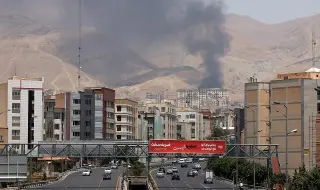
The Pentagon is preparing a massive action plan with a "final blow" in the war with Iran, Wion and Axios report.
It is claimed that the four main options include taking control of strategic islands, in addition to ground forces and a large-scale bombing. A dramatic military escalation is likely if by the end of this week there is no progress in diplomatic talks and the Strait of Hormuz remains closed.
The four options for "final blow"
Most of the four main options are related to control of the Strait of Hormuz. Among them is the possible invasion or blockade of Kharg Island, Iran's main oil export hub, two U.S. officials and two sources familiar with the internal discussions said.
The second option is to invade Larak Island, a strategic outpost that helps Iran control the Strait of Hormuz. Larak also houses Iranian bunkers, equipment for attacking cargo ships, and radars monitoring traffic in the strait.
The third option is to seize the strategic island of Abu Musa and two smaller islands near the western entrance to the Strait of Hormuz. These territories are controlled by Iran, but are also claimed by the UAE.
A fourth option is to block or seize ships exporting Iranian oil on the eastern side of the Strait of Hormuz.
Plans for ground operations are underway with the arrival of Marines and an airborne division
As reported in multiple media outlets, the US is planning possible ground attacks deep inside Iran to seize highly enriched uranium stored in nuclear facilities. Since a ground offensive could prove too risky, an alternative could be large-scale air strikes on these facilities to prevent Iran from accessing the material.
Reinforcements are either arriving or will be deployed soon. They include fighter squadrons, thousands of ground troops and a Marine expeditionary unit and are expected to join CENTCOM this week.
A dramatic escalation seems likely as talks stall
Diplomatic talks have stalled, with Iran announcing its rejection of a 15-point US peace plan sent through intermediary nations. More importantly, the Strait of Hormuz remains closed to shipping. In this context, as the five-day pause announced by Donald Trump ends on Friday, a crushing show of force could provide an advantage in peace talks or allow the US president to declare victory.
Trump has not yet settled on the specifics, but he is "not bluffing, he is ready to raise hell"
White House officials view ground operations as "hypothetical". Trump has not yet chosen a specific course of action, but he is ready to escalate if the talks fail. He could still carry out the threats made just before the pause was announced: to bomb Iranian power plants and energy facilities.
Yesterday, White House press secretary Caroline Leavitt said that Trump "is "not bluffing, he is ready to raise hell. Iran must not make the same mistake again... any violence after this point will be because the Iranian regime refuses to make a deal."
Parliamentary Speaker Mohammad Bagher Ghalibaf said Iranian intelligence had shown that US military preparations were being made "with the support of a regional state."
"All enemy movements are under the watch of our armed forces. If they take any action, the entire vital infrastructure of this regional state will be subject to endless attacks," he warned.
Although Ghalibaf did not specify which state he was referring to, there is speculation that he was referring to the United Arab Emirates.
Efforts to mediate critical talks continue
Iran has not ruled out talks, but distrust is the problem, a source said. "The Revolutionary Guard commanders are very skeptical. But the mediators have not given up," he said.
Countries such as Pakistan, Egypt and Turkey are acting as mediators, helping to organize the critical negotiations.