The failure of the peace talks has put Tehran and Washington in an awkward situation of "neither peace nor war", with each side hoping to outlast the other in a confrontation, the outcome of which will have a direct impact on the global economy, notes "The New York Times".
According to analysts, the Iranian authorities are confident that they can withstand the economic suffering from the war longer than President Donald Trump. But they remain wary of being trapped - without talks, the US or Israel could attack them at any time.
"The situation is somewhat reminiscent of the outcome of the Twelve Day War, when fighting ended without a final settlement," said Sasan Karimi, vice president in the previous Iranian government and a political scientist at Tehran University, recalling the Israeli-Iranian war of last June.
An article published last weekend by the influential conservative newspaper "Khorasan" and shared by a number of other Iranian publications described the current moment as "strategic uncertainty" fraught with significant risks.
"Both sides have renounced the costs associated with a full-scale war, but have not retreated from the logic of force and pressure," the article said. This could be more dangerous than a short-term war, the author of the article concludes.
Blockade of the Strait of Hormuz Difficult to Implement
The duration of the military confrontation, which is increasingly threatening the global economy, also depends on how long the Islamic Republic can withstand economic pressure, points out "Welt".
Oil exports are its main source of income. But the blockade imposed by Trump, although in theory a powerful lever against Iran, is extremely difficult to implement in practice. The sheer scale of the task speaks volumes.
The official tanker fleet of the Islamic Republic of Iran numbers approximately 60 to 70 ships, points out "Welt". Their total capacity is estimated at between 90 and 140 million barrels - many times more than Iran's daily production, which is just over three million barrels. In addition to the ships officially flying the Iranian flag, however, there is also a "shadow fleet" estimated to number between 400 and 480 ships, and according to the "Wall Street Journal" even more than 500. That is, the actual total capacity of the Iranian tanker fleet could reach 750 million barrels.
Tracking hundreds of ships is extremely difficult, let alone stopping them. This is especially true when they turn off their transponders and become invisible to electronic systems, only to be discovered in remote areas of the sea after weeks of pursuit.
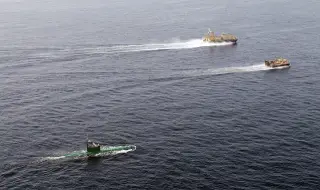
At the same time, the Islamic Revolutionary Guard Corps (IRGC) attacks not with heavy ships, but with small motorboats, some of which are propeller-driven. Their weapons are grenade launchers and machine guns, not stealth drones found on US Navy ships, notes "Welt".
Thus, Iran, with several successful attacks on individual ships, has made it appear that passage through the Strait of Hormuz is risky, and insurance premiums for shipowners are rising to unaffordable levels. At the same time, energy prices are soaring, potentially boosting Iran's revenues, the Welt reports.
Ultimately, the question of control over the Persian Gulf boils down to a psychological one: Who is suffering more from the pressure - the major Western economies or the beleaguered elite of the Islamic Republic?
What about the talks in Islamabad?
The suspension of further attempts to resume peace talks, brokered by Pakistan, reflects the situation after the bombing of Iran by the US and Israel, which ended in a ceasefire earlier this month. Both sides claim to have the upper hand. Trump also seems convinced that the US can "hold out longer" from Iran to the economic hardships of war, related to the parallel blockade of the Strait of Hormuz.
As a result, neither side is willing to give up positions for the sake of negotiations.
On Saturday, Trump canceled a trip by his special envoy Steve Witkoff and his son-in-law Jared Kushner to the Pakistani capital Islamabad for a second round of ceasefire talks. He said the Iranians would only waste the negotiators' time, the "New York Times" recalls.
Senior Iranian officials objected that they were not willing to engage in direct negotiations until Trump lifted the US naval blockade that he imposed on Iranian ports even after agreeing to a ceasefire.
However, Iran's top diplomat, Foreign Minister Abbas Araghchi, left for meetings in Oman on Saturday after visiting Pakistan the day before, and returned to Islamabad on Sunday. He then left for Russia on Monday.
In addition to Islamabad, where the second round of talks was to take place, the Iranians see coordination with Oman, another Gulf state, as key to reaching an agreement.
Meanwhile, Russian President Vladimir Putin met with Iranian Foreign Minister Abbas Araghchi, a meeting that Kremlin spokesman Dmitry Peskov described as invaluable given the events in Iran and the Middle East.
Russia considers itself an ally of Iran, but does not openly support the country militarily. However, it is not to be ignored that Moscow has repeatedly repeated its offer to store Iran's enriched uranium, which Washington has rejected. At the same time, one of the main demands of the United States is that Iran abandon its nuclear weapons program.
Iran remains convinced that it can "outlast" Trump economically and that disruptions to shipping through the strait will be more costly for Trump, said Esfandiar Batmanghelidj, executive director of the London-based Bourse & Bazaar Foundation, a research organization, according to the "New York Times".
But Iran's economy is already facing a serious crisis. The country has been hit by a wave of layoffs and is facing shortages of petrochemicals and pharmaceuticals.
Iran's most influential economic newspaper, "Donya-e Eghtesad", has predicted that annual inflation could rise to 49% under the "most optimistic scenario" of a peace agreement. A situation of "neither peace nor war" could push inflation to 70 percent in the coming months, while renewed hostilities threaten hyperinflation of over 120 percent.
On the contrary, according to Batmanghelidj, disruptions in oil and fertilizer exports could cause deeper economic turmoil in the global economy within weeks, which in turn would force Trump to continue negotiations.
However, he notes that even if Iran breaks out of its current economic impasse, its strategic dilemma remains.
"The "no war, no deal" format, from an Iranian perspective, makes them vulnerable," he concluded.
Merz: US has no strategy in war with Iran
German Chancellor Friedrich Merz believes that the Iranian leadership is in the process of "humiliating" of the US in the war, notes the "Süddeutsche Zeitung" .
The Americans clearly have no strategy, Merz said at the "Carolus Magnus" high school in Marsberg, North Rhine-Westphalia.
At the moment, the German chancellor does not understand "what exit strategy the Americans will choose from the war, especially since the Iranians are apparently negotiating very skillfully – or rather not negotiating very skillfully", commented the "Süddeutsche Zeitung". "The entire nation is being humiliated by the Iranian leadership, especially by these so-called Revolutionary Guards."
Merz once again noted that Germans and Europeans in general were not consulted at the beginning of the US and Israeli attacks on Iran. Now the chancellor has expressed her skepticism directly to US President Donald Trump.
We know from past wars like the one in Afghanistan or Iraq that the problem is always how to end conflicts. "That's why I hope this ends as quickly as possible," Merz said. But he doesn't see that happening right now, because the Iranians are clearly stronger than expected and the Americans don't have a convincing negotiating strategy. The chancellor spoke of a "quite complicated situation" that is costing Germany a lot of money and undermining its economy.