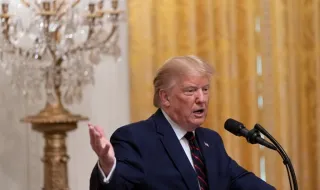
After US President Donald Trump renamed the Gulf of Mexico to "American Gulf", returned the name McKinley to the highest peak in the US, which previously bore the indigenous name "Denali", and renamed Lake Ontario to "Lake America", the question is no longer whether geographical names will continue to be part of his political agenda, but who will be the next object he will target, notes Reuters. Trump himself may have already answered this question, after signing the decree renaming Lake Ontario, stating that after a bay and a lake, "all we need is an ocean", and allowing the renaming of the Atlantic and/or Pacific Oceans.
Judging solely by his recent statements, the next geographical object to be renamed will most likely be one of the two oceans — the Atlantic or the Pacific, the agency commented. However, there is no decree or official information yet as to which of the two oceans has been targeted. This is an important clarification, because the changes so far had a specific political logic: "American Bay" was presented as a symbol of American national heritage, Mount McKinley regained a name associated with an American president, and "Lake America" appeared against the backdrop of the escalating trade conflict with Canada.
The Atlantic Ocean seems like a slightly more logical option if Trump actually decides to turn his words into deeds, CNN notes. The reason is not so much the president's specific statement as the symbolism. The Atlantic Ocean connects the United States with Europe, and renaming it would be an incomparably more serious political message than changing the name of a lake. It would raise the question of how far Washington can go in its attempts to impose American terminology outside its own territory. However, Trump has not yet given any sign that he prefers the Atlantic to the Pacific Ocean, so any categorical statement in this direction would be speculation.
The Pacific Ocean cannot be ruled out either, the American cable television points out. It is of great importance for American geopolitics, economics, and military strategy, since it is in the Indo-Pacific region that much of the rivalry between the United States and China is concentrated. If the Trump administration were to use renaming geographic features as a tool to demonstrate American power, the Pacific Ocean would be a far more significant symbolic trophy. Unlike the Gulf of Mexico or Lake Ontario, however, there is no specific dispute with another country that would provide the US administration with an immediate political impetus.
The Lake Ontario renaming case demonstrates a shift in Trump's policy on geographic names, Reuters reported. It was initially presented as part of a broader program to "restore names that honor American greatness." In an executive order in January 2025, Trump directed the Department of the Interior to change the federal name of the Gulf of Mexico and restore the name of Mount McKinley. According to an analysis by the US Congressional Research Service, renaming of geographical features is traditionally carried out by the Board on Geographic Names, which considers proposals according to an established procedure.
This explains why Trump's actions have aroused such strong interest and commentary, according to a material in the legal analysis journal "Northwestern University Law Review". The publication notes that geographical names have never been completely politically neutral — they are associated with power, history and ideology. According to the material, the traditional role of the Board on Geographic Names has been precisely to limit political interference in the choice of names through an expert process. The administration's new approach expands the president's influence over this system and turns geographical names into a tool for sending political messages.
There is, however, a significant limitation that makes the eventual renaming of an ocean much more complicated than changing a name on a U.S. map, the scientific publication "Scientific American" comments. The United States can determine how the federal government uses a given geographical name, but it cannot unilaterally oblige other countries to adopt it. This became particularly clear with the renaming of "Gulf of America", which Mexico continued to call the Gulf of Mexico. Experts point out that there is no international body that can simply force all countries to use a particular name.
The same is already visible with "Lake America", the publication notes. Trump may change the U.S. federal terminology, and "Google Maps" may introduce the new name for users in the U.S., but in Canada the lake continues to be called Ontario. For users outside of either country, "Google" displays both names. Meanwhile, Canadian Prime Minister Mark Carney and other Canadian officials have refused to accept the change, saying it does not change the official Canadian name and has no international legal force.
This means that if Trump does decide to rename the Atlantic or Pacific Ocean, the result would likely be primarily political and symbolic, says "Scientific American". The US government could start using the new name in federal documents and maps, but the rest of the world would not be obliged to follow suit. When it comes to an ocean that borders multiple countries and is part of international shipping routes, this effect would be significantly weaker than when it comes to a lake or a mountain peak.
However, for now, this is just speculation, Reuters notes. The big question surrounding Trump's geographical policy is not whether he will decide to change a name again, but how far he will go in this policy, the agency concludes.