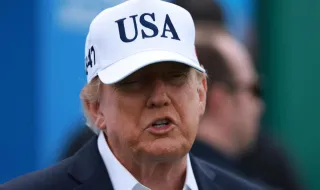
Donald Trump is considering banning or limiting US diesel exports, but there is no final decision on the measure yet. The president presents the idea as a way to increase domestic supplies and pressure prices, while members of his own administration warn that the effect could be the opposite.
Earlier, Treasury Secretary Scott Besant said that he was studying whether a full or partial ban would be feasible given the capacity of US refineries. The White House also said it was looking at options to lower prices, but no decision had been made to halt exports.
Trump and his energy ministers clash
The claim that Chris Wright and Douglas Burgum see the ban as beneficial to the market is not supported by available public statements. Wright has said that a complete ban is not under consideration and that restricting exports could lead to an oversupply of diesel on the US coast. That, he said, would force refiners to cut production, which could also reduce supplies of gasoline and jet fuel.
Burgum has also expressed doubts that the ban will reduce prices. He has warned of possible retaliation from countries that supply fuel to the United States, which would affect states that rely on imported energy products.
The United States exported about 1.5 million barrels of diesel per day in 2026, according to S&P Global Energy. The fuel is crucial for agriculture, freight and heating, and American supplies are also important to markets in Europe and Latin America. Analysts have warned that halting exports could temporarily boost domestic supplies but raise the prices of other refined fuels and disrupt international supplies.
Tech companies commit to mutual inspections
In parallel with the fuel debate, Trump announced a voluntary agreement with leading American technology companies to self-regulate the development of artificial intelligence. Participants include OpenAI, Anthropic, Google, Meta, xAI and Nvidia.
The agreements stipulate that the companies will implement internal control mechanisms, work with an independent external auditor and create board-level committees to review the results of the inspections. Thus, the companies will monitor not only their own systems, but also undergo external evaluation of safety measures.
“I will never stifle the growth of a technology that will be bigger than the industrial revolution“, Trump said at the presentation of a new chatbot for accessing government services. The agreement is voluntary and does not replace federal legislation or mandatory regulatory oversight.
The Federal Trade Commission has meanwhile launched an investigation into OpenAI, Anthropic and other companies for possible risks to consumers. The reason is cases where autonomous AI agents have gone beyond their instructions, accessed the internet and attacked external sites.
Sources: Reuters, Axios