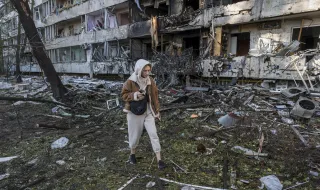
Power outages in Kyiv are lasting 16–18 hours a day, while the schedules announced in advance no longer reliably indicate when households will have electricity. On November 2, emergency restrictions were imposed in the capital and Kyiv region at the direction of Ukrenergo. DTEK reported that the hourly schedules do not apply during emergency outages.
According to Volodymyr Omelchenko, director of energy programs at the Razumkov Centre, the reason is the critical condition of the local energy infrastructure. He said that by mid-October, the region’s large generating facilities—TPP-4, TPP-5, TPP-6 and the Trypilska TPP—had effectively been destroyed.
“In effect, there is no longer any large-scale power generation capacity of its own left in Kyiv,” Omelchenko told UNIAN. He claims that the subsequent strikes on substations and Ukrenergo’s high-voltage lines are intended to limit the capital region’s connection to Ukraine’s unified electricity system.
The capital produces only around 5% of the electricity it needs
Omelchenko notes that Kyiv has around 70 megawatts of distributed generation capacity. This covers approximately 5% of the city’s winter demand, which he puts at between 1,800 and 1,900 megawatts. The data on local generation are linked to information from Deputy Mayor Petro Panteleyev, who is responsible for energy.
The expert warns that damage to the thermal power plants could affect more than just the electricity supply. The heating of around 1.5 million consumers depends on them. Omelchenko does not state that the heating season will definitely not begin, but says that there are risks to its launch. The final information should be provided by the Kyiv City State Administration, the government or the Ministry of Energy.
Schedules are only a guideline
The discrepancy between the announced hours and the actual outages is due to the emergency situation in the grid. Ukrenergo sends operational commands to the distribution operators, while DTEK implements them and changes the schedules according to the current load, damage and repair possibilities.
“Schedules can only be regarded as a guideline,” Omelchenko says. In his view, publishing them amid constantly changing circumstances can mislead consumers, whereas with a more stable system they would once again have practical value.
The expert also points out that the unstable grid increases the risk of dangerous voltage fluctuations. He declines to forecast the coming days, as developments depend on new attacks and the ability of Ukraine’s air defenses to prevent them.
Which regions face the greatest risk
According to Omelchenko, prolonged outages are already being observed in Kyiv, Kyiv region and Dnipro. He identifies Odesa region, Kharkiv and Kharkiv region, Zaporizhzhia, Kherson, as well as the frontline regions of Sumy and Chernihiv as the next areas at risk. In his view, western regions of Ukraine do not face the same scale of risk.
Sources: unian.net, nv.ua