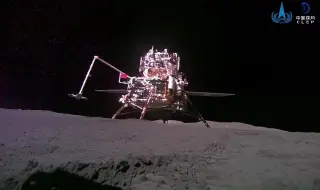
China and Russia plan to build an automatic nuclear power plant on the Moon by 2035. A memorandum of cooperation for the project was signed between the Russian space agency “Roscosmos” and the China National Space Administration (CNSA) this week.
The power plant will be part of the proposed International Lunar Research Station (ILRS) and will provide energy to enable long-term exploration of the Moon. The MLIS is seen as a rival to the US-led Artemis program, which plans to build an orbiting lunar space station called Gateway.
Artemis is a joint effort between NASA and the space agencies of 55 other countries, including the member states of the European Space Agency.
What is the International Lunar Research Station?
The MLIS project aims to create a scientific research base on the Moon, located 100 km from the lunar south pole. It will include long-term autonomous operations and short-term human missions.
“The station will conduct fundamental space research and test technologies for long-term unmanned operations, with the prospect of a human presence on the Moon“,“Roscosmos” said in a statement.
First announced in 2017, the MLIS includes participation from Pakistan, Venezuela, Belarus, Azerbaijan, South Africa, Egypt, Nicaragua, Thailand, Serbia, Senegal and Kazakhstan. China will also invite 50 countries, 500 international research institutions and 5,000 foreign researchers to join the MLIS as part of its “Project 555,” Wu Weiren, chief designer of China’s lunar exploration program, said in a statement last year.
While the MLIS is intended to be a center for scientific research, the moon’s natural resources are also an enticing prospect. The question of who actually owns parts of the moon is hotly debated among legal experts.
Will China become a leader in space exploration?
The MLIS is part of China’s mission to become a leader in space exploration and scientific exploration.
The first steps will be taken by China’s Chang’e 8 mission in 2028. It will also be China's first attempt to land an astronaut on the lunar surface. Beijing has been landing unmanned rovers on the moon since 2013, and its scientists have led missions that have mapped the lunar surface, including the "dark side of the moon." In June 2024, China became the first country to successfully collect rocks from that hemisphere.
Author: Fred Schualer