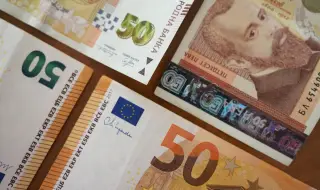
The leading Italian and French dailies today reported the information that Bulgaria received the "green light" to join the Eurozone from January next year, BTA writes.
On their websites, the Italian “Stampa“ and “Repubblica“ also quoted Bulgarian Prime Minister Rosen Zhelyazkov, who said about yesterday that it was exceptional and that Bulgaria had taken another step towards adopting the euro. However, the two publications accompany their published brief information on the topic with footage from the Reuters agency, which shows the scene of a clash in the Bulgarian parliament yesterday between opponents and supporters of the adoption of the common European currency.
„Corriere della Sera“ also dwells in brief information on the two positive opinions regarding Bulgaria's accession to the eurozone, formulated in two separate reports - that of the European Central Bank and that of the European Commission. Bulgaria's path to the euro was neither short nor without difficulties, the publication adds.
The beginning began in 2020, when the country joined the European Monetary Mechanism, a fundamental stage for testing the stability of its national currency - the leva. The publication notes that Bulgaria has now met all the necessary criteria. There has been no procedure by the EC against Bulgaria since 2012 for an excessive deficit, which has remained below 3 percent of GDP. The country's public debt is significantly lower than the ceiling of 60 percent of GDP established in the European Stability and Growth Pact. In Bulgaria, it was 24.1 percent of GDP in 2024. These indicators speak of a permanent commitment to stable and responsible financial management of the country, the publication adds.
The French publications “Libération“ and “Figaro“ reprint the information of the Agence France-Presse from yesterday regarding the “green light” received by Bulgaria from the EC and the ECB to join the euro. The article also recalls the history of the euro and when 20 EU countries successively adopted it. It is noted that Denmark, after an agreement with Brussels and a referendum in 2000, was released from the commitment to adopt the euro. It is recalled that there have also been protests in Bulgaria against the adoption of the common European currency.
A lengthy publication in the French “Le Monde“ entitled “Bulgaria on the fast track to the euro” states that “despite growing skepticism, Bulgarians are ready to adopt the euro on January 1, 2026. On Wednesday, June 4, the ECB gave the final “green light“ to the country's accession. In its positive convergence report, Frankfurt believes that all economic and legal criteria have been met, which largely satisfies the pro-European government in power in Sofia. The same day, the EC also announced that Bulgaria had fulfilled the conditions for adopting the single currency.
If there are no surprises, joining the single currency will be officially approved by eurozone economic ministers at the Ecofin meeting on July 8, the newspaper added. "This positive assessment of convergence paves the way for Bulgaria to become the 21st member of the eurozone", said Philip Lane, a member of the ECB's Executive Board, quoted by "Monde". The lev, Bulgaria's national currency, which has been in use since 1885 and is currently exchanged at a rate of 1.95 leva to the euro, will disappear, the publication added.
Business circles and the government of conservative Prime Minister Rosen Zhelyazkov promise that adopting the euro will boost the Bulgarian economy, which is currently the weakest in the EU. However, Bulgarians are increasingly worried that companies will take advantage of the currency change to raise prices, risking a resurgence of the high inflation seen since the start of the war in Ukraine in February 2022, the newspaper said.
The latest Eurobarometer survey, published in May by the European Commission, shows that public opinion is strongly divided on the euro - 50% are against and 43% - for. The number of people opposing the euro is higher than in the previous wave of surveys in the fall of 2024, which is the result of a huge anti-Euro campaign led by the pro-Russian far-right party "Vazrazhdane". On Saturday, May 31, and Wednesday, June 4, this party organized demonstrations in Sofia to preserve the leva, which were attended by several thousand people, some of whom waved Russian flags, writes "Le Monde".
In social networks in this country, which is very susceptible to conspiracy theories, very effective disinformation campaigns against the euro have been identified, the publication adds. It also recalls that in 2023, "Vazrazhdane" managed to collect almost 600,000 signatures calling for a referendum on adopting the euro. This option was ruled out by the Constitutional Court and the Bulgarian Parliament, which indicated that it was impossible to organize a referendum on a commitment related to an international treaty - that of EU membership.
But the head of state, Rumen Radev, who is also known for his ambiguous position on Russia, has also been calling for a referendum since early May. This option was rejected by 171 of the 240 deputies in the Bulgarian Parliament, representing both the government and the pro-European opposition parties. "All new member states joined with more or less equal support (for the eurozone). And a year, two, three later, support (for the euro) is over 70% almost everywhere", said the governor of the Bulgarian Central Bank, Dimitar Radev, who assures that fears of price increases after adopting the euro are exaggerated. "Bulgaria must complete its European integration", said Prime Minister Rosen Zhelyazkov, quoted by "Le Monde".
Bulgaria was initially expected to join the euro at the same time as Croatia - on January 1, 2023. But in recent years the country has experienced significant political instability, which forced European authorities to postpone the schedule, „Le Monde“ also recalls.
Although in September 2022 inflation peaked at over 15% and remained above 10% for most of 2023, falling to an average of 2.7% over the past twelve months. This is exactly what is needed for Bulgaria to qualify for the euro, the newspaper adds. The other three main economic criteria were easier to meet. Bulgaria's public finances are stable, with a deficit of 3% of gross domestic product (GDP) and a debt level of 24%, well below the eurozone average (87.5% in the last quarter of 2024, according to Eurostat). Another criterion - the exchange rate remains stable in 2023 and 2024. Finally, interest rates on Bulgarian debt are around 3.9%, close to those of other countries in the single currency.
With the adoption of the euro as early as 2026 Bulgaria will overtake neighboring Romania, which has a much larger deficit and is unlikely to adopt the euro for another few years. The remaining EU countries that are not yet members of the eurozone (Hungary, the Czech Republic, Poland, Denmark and Sweden) are so far unwilling to adopt the single currency – and their position is unlikely to change in the short term.
With a GDP per capita equal to 64% of the European average, Bulgaria will be the poorest country in the eurozone after Greece, the French publication writes. It also suffers from high levels of corruption and mafia infiltration. The ECB report warns on this issue: "Further progress is needed in the fight against money laundering and terrorist financing", the financial institution writes. In October 2023. The Financial Action Task Force, an intergovernmental organization that monitors money laundering and terrorist financing, has included Bulgaria on its "gray list", recalls "Monde" at the end of its publication.