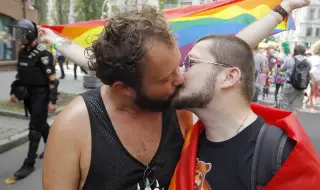
"I have been open about my orientation all my life", says 25-year-old Roman, who serves in the Ukrainian Army's Coast Guard. He announced that he was gay when he was 15. He received support from his friends, parents and two brothers, one of whom now serves in the same platoon.
Roman signed a contract to serve in the army in April 2024. Since then, he has hardly encountered prejudice, condemnation or discrimination. His comrades in the military unit reacted mostly neutrally when they found out about his sexual orientation. “There were no strange questions - it was downright offensive”, jokes Roman. But he worries that LGBTI members of the Ukrainian army (and there are several hundred of them who have openly declared their sexual orientation) do not have the same rights as heterosexual soldiers.
„We do not have equal rights“
In his platoon, Roman is involved in reconnaissance and drone operations. He recently started dating a young man who is not in the army. But in Ukraine, legalizing a same-sex partnership is impossible. „If I wanted to legalize my relationship, I would not be able to do so. If I die, my partner will not have the right to receive my body or any compensation. If I end up in intensive care, he will not be able to see me,“ the soldier complains. According to him, this is a cruel injustice. “We fight on an equal footing with others, but we do not have equal rights.“
Why is the Law on Registered Partnerships not being adopted?
The adoption of the draft law on registered partnerships, which has been under consideration in parliamentary committees for more than two years, is one of the key demands of the LGBTI community in Ukraine. The project does not address same-sex marriage, but the text would allow partners to formalize their relationship legally, including gaining the right to access medical information, inheritance, social guarantees and compensation in the event of the death of their partner.
The draft law's sponsor, Ina Sovsun, a deputy from the opposition faction “Golos“, explained to the State Duma that the document was blocked by the legal committee. “The reasons are obvious – there are many conservative people in parliament.“
According to her, less than a third of the deputies are categorically against registered partnerships, a little more than a third are ready to support the law, and the rest are hesitant or have no position on the issue at all. “Sooner or later we will adopt a law on partnerships for same-sex couples – it is a matter of time. The sad thing is that for the military, who are from the LGBTI community, the question is whether the law will be adopted in time, given that their lives are under threat“, points out Sovsun.
Discrimination against homosexuals in the army
19-year-old Dmitry has been in the Ukrainian army for about a year. He defines himself as asexual – he is interested in both young men and women, but he strives for romantic, not sexual, relationships. When the first brigade he joined found out about his asexuality, the problems began: "They started threatening me with physical violence, harassing me physically." He also heard "good" advice to look for another military unit.
As a result of the harassment he was subjected to, Dmitry had to undergo treatment and tried to end his life, but the medics saved him. He later reported the threats and aggression to the police, but never received a response. He eventually moved to another brigade, and he told DW that he knows of cases in which the command tried to transfer the soldier to another unit as quickly as possible, learning about his orientation.
Attacks against homosexuals remain almost unpunished
Dmitry says that although there are conservative people in the army and in society, both spheres are still changing. He has also had positive experiences during his service: “In one of the brigades, the platoon commander found out about my sexual orientation. He supported me, said that he would not allow me to be insulted and discriminated against - that we are a family and no one should be neglected. I agree with this opinion.“ Dmitry strives to separate his personal life from his official duties.
In addition to the adoption of the bill on registered partnerships, the LGBTI community is also demanding the introduction of criminal liability for crimes motivated by homophobia. “If someone beats me up, they will receive a minimal fine“, Dmitry points out and explains that attacks on homosexuals are usually classified as petty hooliganism and are not severely punished. A bill has also been prepared in this area, which has been in parliament since 2021, but is still being finalized.
Meanwhile, according to polls in Ukraine, over 70 percent of respondents believe that LGBTI people should have the same rights as all other citizens. 14 percent have a positive attitude towards homosexuals, 47 percent have a neutral attitude, and 32 percent have a negative attitude. The latter indicator has been steadily decreasing since 2015.
How many LGBTI soldiers are there in the Ukrainian army?
According to the organization “Military LGBTI for Equal Rights”, at least 59 units of the Ukrainian army serve homosexual, bisexual, transgender, queer, or asexual people. Their exact number cannot be named, as many do not talk about their orientation or identity.
According to rough estimates, based on the share of LGBTI people in the societies of different countries, in the army they can be between five and ten percent, according to a study by the aforementioned organization. It notes that the attitude towards representatives of the LGBTI community affects their combat effectiveness. “If there are relations of hatred and harassment, the spirit of community is lost, and this directly affects the effectiveness in performing combat missions“, Viktor Pilipenko from “Military LGBTI for Equal Rights“ told DW.
Fighter Roman is convinced that the more LGBTI representatives speak about themselves and their problems, the faster the changes will be implemented. “This is important, even if there is a wave of hate.“
Author: Anna Przemyszka