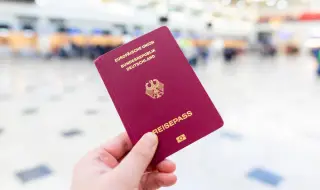
Germany is becoming more and more attractive for people of Turkish origin. This is also increasing the number of Turks who become Germans. In 2024, a total of 22,525 Turkish citizens accepted German citizenship, which is a plus of almost 110% compared to the previous year. Turkey is now the second-most common country of origin for obtaining a German passport, after Syria.
Many of the people with Turkish roots that DW spoke to cited two reasons for wanting to become German citizens: the fact that the German passport is respected all over the world and the difficulties that Turkish citizenship creates for them as migrants in Germany.
"To avoid one bureaucracy, you put up with another"
Alaz Sumer works for an NGO and is defending a dissertation on constitutional law. He has lived in Germany for eight years. He came to get a master's degree at the time. He told DW: "The ultimate goal of every migrant who arrives here is actually to obtain citizenship. Without it, you constantly have to fight the bureaucracy, and here it is really strict. Even getting a residence permit can be a big hassle.
Burak Keceli, a computer science specialist who graduated from the renowned Bosphorus University "Bogazici" in Istanbul, arrived in Germany in 2016 with the aim of building a career. Today, he still lives in Berlin. And why did he take German citizenship? "After so many years in Germany, I can speak German quite fluently, but I also wanted to have political rights to participate in important public decisions. The strong German passport was also an important factor for me: with it I can travel to many countries in the world without a visa," says the computer scientist.
According to the Global Passport Index 2025, the German passport guarantees significant freedoms. In this factor, it ranks fifth in the world – after the passports of the UAE, Spain, Singapore and France. With a German passport in your pocket, you can travel to 122 countries in the world without a visa, while with a Turkish passport - only to 69 countries.
Dual citizenship is an important incentive
The citizenship reform carried out in 2024 has also played a key role in the increased number of Turks who have become Germans: for many immigrants, the opportunity to obtain dual citizenship was the decisive motive. Alaz Sumer does not want to give up his Turkish citizenship. He points out that it brings benefits because the Turkish passport makes it possible to travel more easily to countries with which Turkey maintains close ties - something that the German passport does not always provide.
Burak Keçeli also has dual citizenship. For him, it is a huge plus. However, he admits that if dual citizenship had not been possible, he would probably have preferred a German passport.
The previous German government simplified the procedure for obtaining German citizenship - the number of years of legal residence in the country required to apply for a German passport was reduced from eight to five. And anyone who could prove special merit in integration was entitled to obtain a passport even after only three years. But the new coalition government in Germany of the CDU/CSU and SPD abolished the possibility of obtaining a passport after three years. However, the rule of retaining the original citizenship is still valid. Before it came into force, many applicants refused a German passport precisely because they felt emotionally, familially or economically connected to their home country.
The political, social and economic situation in Turkey in recent years has also motivated many migrants to apply for German citizenship. "I didn't feel free in Turkey, and when the situation there got worse, I stayed in Germany", says Sumer.
Turkey remains "homeland"
Despite living in Germany for many years and holding German citizenship, many people of Turkish origin continue to feel a sense of belonging to Turkish culture and call Turkey their homeland.
"Germany did not become my second homeland. And I would not call myself German. But even if I did - the Germans would laugh at me, and rightly so", says Sumer. Keçeli sees things in a similar way: "The people I love the most in Turkey remain. These ties have not been broken. I will continue to travel there and back regularly. I still love listening to Turkish music, and Turkey will always remain my homeland for me. I don't feel at home in Germany".
Sümer says that he generally likes life in Germany, but he doesn't feel like an integral part of society: "I don't think that when you get German citizenship, people automatically start accepting you as part of them – and in my case, that was the case. I feel closer to Turkey than to Germany. It's clear to me that I'm German only on paper. Even if you adjust your life to German rules and standards, you're still a migrant," he says.
Sümer also talks about discrimination in everyday life. When he was looking for housing, he only got rejections, while he introduced himself with his real name. It wasn't until he changed his last name to German that he started receiving invitations to view housing.
"If your name isn't German, even a German passport won't help you," he says.
Author: Burak Yunveren