


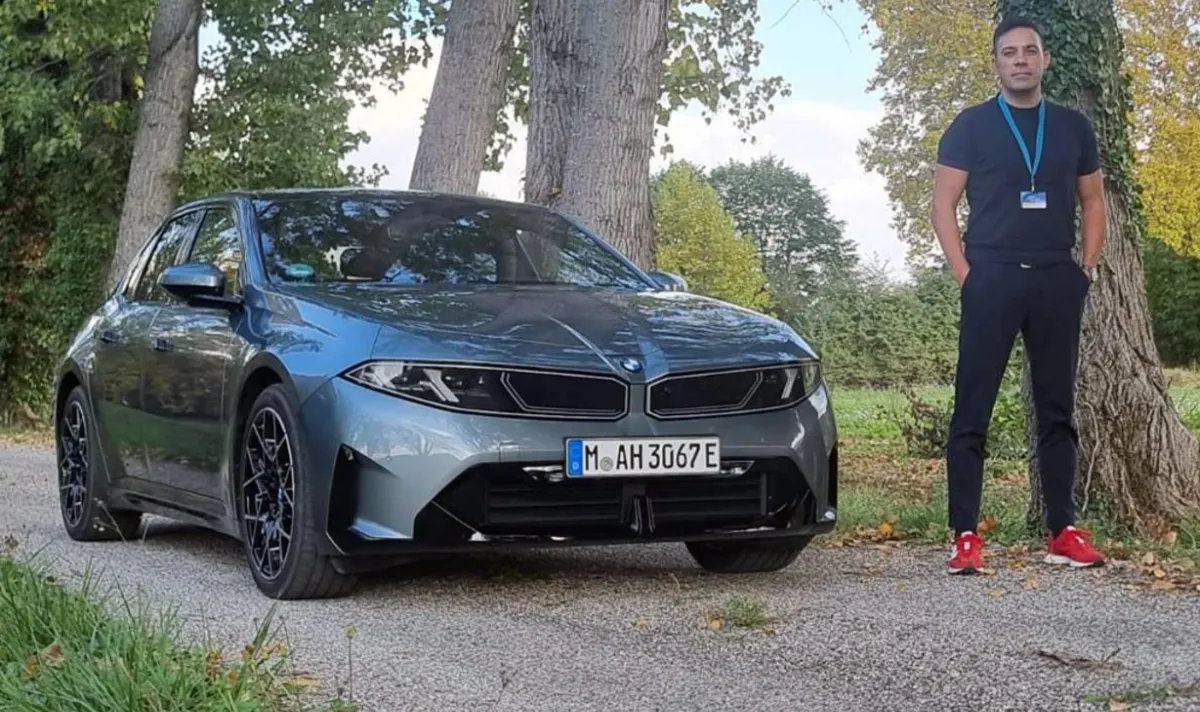

France, Aix-en-Provence. A mobile.bg team on location at the event
The Bavarian giant is entering a decisive phase in its long history, and our team put the new all-electric sedan through an extensive test. It arrives to completely redefine the electric compact car segment and demonstrate its technological leadership in an exceptionally dynamic market environment. We have already told you that the Neue Klasse project is not simply another evolution of the Bavarian range, but a fundamental shift toward a new generation of electric vehicles in which every detail has been rethought from the ground up to meet the highest environmental and dynamic requirements of modern drivers. This "new class" began with the iX3, and now the world’s longest-range production electric car is taking center stage - the BMW i3.
The parallel presence of the new 3 Series with internal-combustion engines, which we have already covered in detail, and the all-electric i3 demonstrates the brand’s pragmatic approach of offering a complete range of choices without compromises. The electric version, in particular, becomes a technological flagship for the next decade. The company’s strategy is based on a shared vision that allows flexibility in production and preserves the characteristic pleasure of driving, regardless of the energy source. According to market analysts, this will attract both traditional fans of the brand and a new generation of zero-emission enthusiasts. Overall, however, the ICE and electric models are two completely different cars, built on different platforms, with different wheelbases, but virtually identical in appearance. Here are our impressions of the electric "three".
Exterior
The exterior silhouette of the new Bavarian model represents the second major embodiment of the Neue Klasse platform after the successful introduction of the iX3 SUV. It retains the brand’s classic proportions, but is governed by an entirely new aerodynamic philosophy. The design team has opted for clean surfaces, a minimal number of joints and a distinctly sporty stance that references the legendary predecessors of the 3 Series, while adding a futuristic touch that catches eyes at every traffic light and turns the car into a true road magnet. The look is controversial, but certainly striking.
At 4,760 mm long and 1,865 mm wide, the electric sedan is just slightly shorter and a little wider than its conventionally powered relative, while preserving the perfect balance between exterior dimensions and interior volume. The engineers paid special attention to optimizing the space beneath the floor, where the massive battery pack is integrated, without compromising the low center of gravity or forcing passengers to sacrifice comfort during long journeys.
Particularly impressive is the extremely low drag coefficient of just 0.21, achieved thanks to the perfectly smoothed body panels, specially designed door handles that retract while driving, and active air flaps in the front bumper. Every body element has undergone hundreds of hours of wind-tunnel testing, which directly contributes to achieving the remarkable range and reducing aerodynamic noise in the cabin when driving at high speed on the motorway.
The engineers decided against excessively lowering the roofline at the rear, preserving the classic three-box sedan silhouette and ensuring sufficient headroom for second-row passengers. This conservative yet highly functional approach solves the perennial problem found in many modern electric cars, where aerodynamic design drastically reduces rear passenger space, proving that practicality and elegance can go hand in hand in the premium segment.
Interior
Upon entering the cabin, we immediately noticed the revolutionary new architectural layout, in which the battery pack beneath the floor is integrated directly as a load-bearing element of the entire body structure. This engineering solution makes maximum use of every millimeter of interior space, creating a sense of spaciousness that surpasses traditional cars in this class and offers the driver and passengers an entirely new level of comfort.
The seating position is slightly raised because of the battery underneath, but the exceptionally thin and precisely low-mounted seat bases manage to preserve the perfect feeling of complete control behind the wheel. We found that even on extended routes, fatigue in the lower back and legs is minimal, while the ergonomics of the seats can be compared with the industry’s best offerings, providing numerous electric adjustments and excellent lateral support in fast corners.
A key interior feature is the new BMW Panoramic Vision panoramic digital instrument panel, positioned along the base of the full width of the windshield. It successfully replaces traditional instruments and projects the most important information directly into the driver’s field of vision. This innovation radically changes the way the driver perceives information about speed, navigation and the vehicle’s status, without having to divert attention from the road, clearly improving safety and reducing reaction times in critical situations.
Material quality is of the highest level, although the Bavarian manufacturer makes extensive use of recycled and sustainable materials whose texture and tactile feel are in no way inferior to traditional luxury leather and expensive wood. The only more serious criticism we identified concerns the removal of the classic rotary iDrive controller in favor of fully touch-based control via the central screen, which takes time to get used to and slightly distracts the driver when attempting to "flip through" menus while driving.
Engine and Driving Characteristics
The powertrain of the i3 50 xDrive version we tested relies on a sophisticated configuration with two independent electric motors - a high-performance separately excited synchronous motor on the rear axle and an efficient asynchronous motor at the front, generating a system output of 462 horsepower and an impressive 640 Nm of torque. This power is distributed instantly to all four wheels, ensuring flawless traction on all types of road surfaces and turning every press of the accelerator into a genuine sensory delight.
Acceleration from a standstill to 100 km/h takes just 4.7 seconds, with takeoff being exceptionally smooth and linear thanks to precise electronic torque management, which eliminates any abrupt jolts. The electric motors have a huge power reserve across the entire speed range, making overtaking exceptionally safe and quick, even when the car is loaded to capacity with passengers and luggage.
The huge battery pack, with a net capacity of 108.7 kWh, provides remarkable range, which according to official BMW figures exceeds an impressive 900 kilometers on the WLTP cycle for the most efficient versions. In real-world mixed driving conditions, this guarantees a comfortable and entirely realistic 600-700 kilometers without the need for recharging. Such a figure radically changes the perception of long-distance travel in an electric car, completely eliminating range anxiety and allowing for the relaxed planning of long intercity and even international journeys without the need to constantly search for charging stations along the way.
Maximum charging power reaches an incredible 400 kW at suitable ultra-fast stations with high-voltage architecture, allowing the battery to be replenished from 10 to 80 percent in around half an hour. This technological feature turns charging the battery into a short coffee break, bringing the experience as close as possible, though not entirely, to the refueling speed of a conventional petrol or diesel car.
What impressed us most, however, was this electric car’s road behavior. It is remarkably precise and balanced thanks to the modern five-link rear suspension and extremely low center of gravity, achieved by incorporating the heavy battery into the load-bearing structure itself. Although the car’s curb weight reaches 2,205 kg, the suspension handles the mass brilliantly through corners, preventing unpleasant body roll and understeer while delivering a level of stability that, without exaggeration, is found only in the best sports cars on the market.
Our tests also revealed an exceptionally finely calibrated soft-braking system and adaptive regeneration, which are controlled intuitively and provide comfort when driving in heavy urban traffic. The regenerative brakes manage to capture a large portion of the kinetic energy and return it to the battery, while the software smoothly switches between electric braking and the traditional mechanical brake calipers without creating any irritating sensations through the pedal.
Conclusion, Prices and Final Assessment
The new BMW i3 sets an exceptionally high and unequivocal standard in the premium electric sedan class, offering a perfect balance between astonishing range, lightning-fast charging and dynamics that are in no way inferior to conventional sports cars. The Bavarian manufacturer has succeeded in creating a car that does not merely follow market trends but sets them, clearly demonstrating what the luxury transport of the future should look like, without any compromises to the pleasure of driving.
Main Pros and Cons:
Exceptional real-world range on a single charge and support for ultra-fast charging of up to 400 kW.
Smooth, exceptionally powerful and quiet drivetrain with incredible stability and security in corners.
Innovative, exceptionally legible panoramic digital display spanning the entire width of the windshield.
As for the main drawbacks, in our opinion they are:
The complete absence of the physical rotary iDrive controller makes intuitive menu operation while driving more difficult.
A slightly higher seating position compared with a classic ICE sedan.
Finally, and no less importantly, let us also mention the prices in Bulgaria. On the Bulgarian market, an official price list is available for only two versions - BMW i3 40xDrive - €58,350 including VAT and BMW i3 50xDrive - €64,100 including VAT. In our opinion, these prices fully reflect the model’s premium positioning. They are not low, but we believe that for this money you get the highest achievements in the world of electric mobility. In other words, this is the best electric car we have tested to date.