


- What can you say about the preparation and conduct of Operation Spider Web?
- Vasily Malyuk, the head of the Security Service of Ukraine, said that the drones were first smuggled into Russia, then placed in wooden modules, mounted on trucks and hidden under remote-controlled mobile roofs.
A base in the Russian Federation was needed from which the logistics of “Payazhina“ could be organized.
This, of course, meant that there had to be Ukrainian teams on the ground, far behind enemy lines, to carry out all the logistical and technical preparations. Indications are that the chosen location for the Russian “office“ of “Payazhina“ – as President Zelensky called it, was in the small city of Chelyabinsk. It is located more than 1,600 kilometers east of Moscow, but – perhaps this may have been important for the smuggling aspect of the operation, is only 135 kilometers by road north of the border with neutral Kazakhstan. This location is also convenient from the point of view of the rapid evacuation of the Ukrainian group after the operation.
- Russian military bloggers point to a warehouse in Chelyabinsk as the place where the preparations took place?
- It was rented for 350,000 rubles (£3,250) per month and is where the drones and their launchers were allegedly assembled and prepared for transport. The Ukrainian president also said that the “office” was next door to the local headquarters of the FSB – Federal Security Service, but did not disclose the location. The man suspected by the Russian Interior Ministry as the local organizer is Artyom Timofeev (it is not known whether this is his real name). His details are being circulated by the authorities, and his capture is a top priority. According to Russian sources, Timofeev was born in the Ukrainian city of Zhytomyr, lived in Kiev and moved to Chelyabinsk “several years ago”. Here he works as an “entrepreneur”, because he owns the trucks, and probably organized the transport of the drones from Kazakhstan through his contacts. Chelyabinsk is 3,200 km from Murmansk, about 3,000 km from Irkutsk and more than 1,600 km from the other two bases. Such distances are routinely covered by Russian truck drivers transporting large loads. And this is the brilliantly simple method by which this high-tech attack was carried out. Artyom seems to have hired five unsuspecting heavy-duty truck drivers to transport what they thought were ordinary wooden houses in containers to various locations in the Russian Federation. According to photos from Ukrainian authorities, the drones were hidden under the roofs of the containers.
- And now all the services in Russia are looking for Artyom, right...
- Russian sources indicate that all the trucks were registered in Artyom's name. According to unverified reports on the Russian Telegram channel Baza, known for its ties to the security services, the truck drivers, from who flew the drones told similar stories about how they were hired by a businessman to deliver wooden houses to various locations in Russia.
For example, according to a report in “Today“, driver Alexander Z., 55, from Chelyabinsk told investigators that he had received an order to transport “container houses“ to the Murmansk region from a businessman named Artyom, who had provided the truck. Driver Andrey M., 61, reported that Artyom had told him to transport wooden houses to Irkutsk. Sergey, 46, had an identical story. He was ordered to transport modular houses to Ryazan. Another driver was sent to Ivanovo. While en route, Alexander Z. received a call from an unknown person who told him exactly where to stop. It was a “Rosneft“ gas station next to the “Olenya“ airbase. The driver, Andrey M., was instructed to park at the Teremok cafe in Usolye-Sibirskoye, next to the Belaya base. Almost as soon as the drivers stopped at the designated spot, the action began with the "opening" of the hatches and the takeoff of swarms of drones.
- According to the Special Forces of Ukraine, the roofs of the truck trailers were "remotely opened" and the swarms of drones took off from inside. They only had a few hundred meters to reach their targets?
- The surprise was complete, and the local defense forces were helpless. Since all four attacks were carried out simultaneously, it was not possible to warn the other bases about what was happening. As I mentioned, for unknown reasons, the truck transporting the drones to the airport in the Amur region exploded, and no damage was reported. Russian air defense systems guarding the airports are not designed to detect and destroy small FPV drones, and the jamming equipment that could have caused them to deviate from their course was not turned on or was malfunctioning. Social media footage of the attack in “Belaya“ shows drones emerging from the trailer of Andrei M.'s truck. It is parked on the other side of a highway that runs past the airbase area. The roof panels are lying on the ground next to the truck, suggesting that they were thrown with pyrotechnics. Videos circulating online show drones emerging from the roof of one of the vehicles involved. A truck driver interviewed by the Russian state news agency RIA Novosti said he and other drivers tried to shoot down the drones emerging from the truck with rocks. The driver, Sergei, did not even have a chance to stop before the roof of his truck's trailer exploded and the drones began flying outwards towards their target. According to independent sources, the trucks were blown up after the drones took off. It is believed that this is how Ukrainian forces are preventing Russian investigators from getting to the technological secrets of the operation.
- About 117 suicide drones were used in the attacks. This is what we heard from President Zelensky...
- And they are controlled by the same number of pilots. Each airbase could have been hit by up to 30 drones at the same time. Sources suggest that the Ukrainians used Russia's own mobile network to communicate and guide the quadcopters to their targets. To do this, they would have had to have Russian SIM cards and modems. Ukraine claims that 41 strategic bombers were hit and "at least" 13 destroyed. Moscow has not spoken of any aircraft lost, but says some aircraft were damaged. Videos verified by the BBC show damaged aircraft at Olenegorsk air base in Murmansk and Belaya air base in Irkutsk. Satellite radar images shared by Capella Space reveal at least four heavily damaged or destroyed Russian long-range bombers at Belaya air base. This matches Ukrainian drone footage showing an attack on a Tu-95 bomber. Strategic missile-carrying bombers and A-50 aircraft are believed to have been the main targets of the attack.
Their repair will be difficult, and since none of them are in production anymore, their replacement is impossible.
The exception is the Tu-160, which is being assembled, but this process is extremely slow and data shows that only two have been made since 2022.
On June 1, 2025, Ukrainian President Volodymyr Zelensky commented on the operation on his Telegram channel, calling its results “absolutely brilliant“ and emphasizing that the preparation had lasted more than a year and a half. He stated that the operation was “independent of foreign aid to Ukraine” and that its participants had left Russian territory in advance. According to him, the operation was “the most far-reaching” Among the operations conducted by Ukraine throughout the war, 117 FPV drones and the same number of drone operators participated in it. Zelensky also expressed confidence that this operation “will certainly be included in military history textbooks“. In his address, he expressed gratitude to the Security Service of Ukraine, personally to General Vasyl Malyuk, as well as to all those who participated. It should be noted that in such complex operations, mistakes are possible. The time factor, logistical support and connectivity require precise synchronization. Probably, something did not work properly at the fifth base - Ukrainka. According to Mediazona, Ukrainian forces planned to attack the military base in the Amur region, but this action failed. The conclusion of the publication is based on an analysis of a photo of the head of the SSU Vasyl Malyuk with a diagram of the operation, published by the Ukrainian publication Babel. The Telegram channel “Attention, news” reported that a truck carrying Ukrainian drones burned down near Ukrainka airport on June 1, 2025. However, experts say that even if only half of the reported 41 aircraft were damaged or destroyed, this would have a "significant impact" on Russia's ability to launch long-range cruise missile attacks against Ukraine's civilian infrastructure.
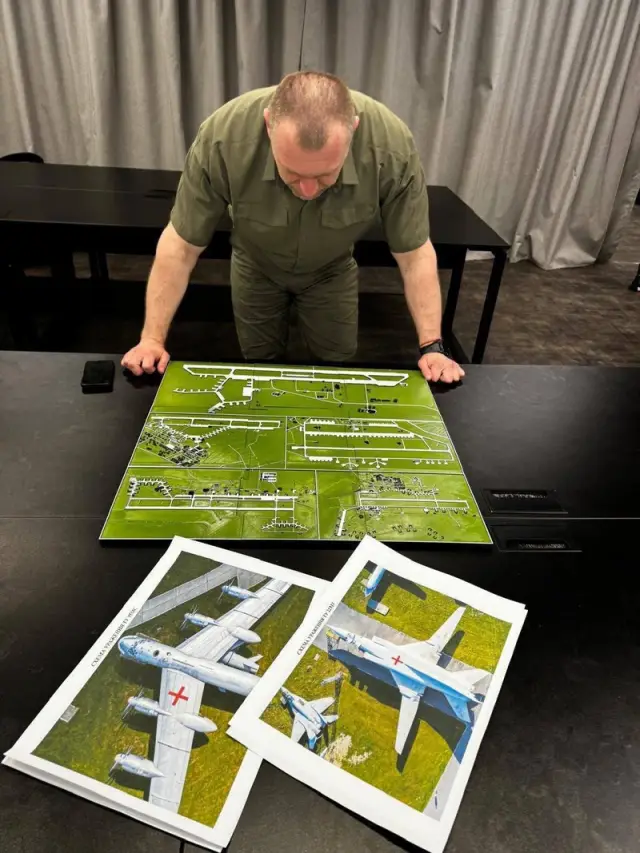
- And after all this, what conclusions do you draw about Operation Spiderweb?
- At the moment, all observers are speaking in superlatives about Ukraine's success. Former Lithuanian Foreign Minister Gabrielius Landsbergis said that the attack demonstrated Ukraine's ability to innovate and surprise the world. "The scale and ingenuity - carried out without any visible Western intelligence or logistical support - show that Ukraine is now less dependent on foreign aid," he said.
Ukraine has shown that a fleet of bombers worth $150 million each can be taken down by cheap drones, slightly modified from household drones. "The attack inadvertently 'helped the West because it targeted Russia's nuclear capabilities,'" Lieutenant General Igor Romanenko, a former deputy chief of the Ukrainian army's general staff, told Al Jazeera. Some observers say the attack has shattered Russia's image as a global nuclear superpower. "While the attack reduces Russia's ability to launch missiles at Ukraine, it will not affect the fierce fighting along the 1,200km (745 miles) crescent-shaped front line," Romanenko said.
The success of Operation Spiderweb highlights a dramatic shift in the balance of initiative in the war.
„Ukraine has demonstrated its ability to carry out a coordinated attack over vast distances with small drones, far from the theatre of hostilities. While the details of the results need to be independently verified, initial visual information suggests that this is a stunning success for Ukraine’s special services,” said Justin Bronk, an influential expert on air power at the Royal United Forces Institute.
- Could Operation Spiderweb change the course of the war...
- In my opinion, Operation Spiderweb marks a turning point in the way that low-cost, improvised unmanned systems can be used with strategic impact deep behind enemy lines. It is an exceptional example of waging “asymmetric” warfare. By combining affordable technology, creative logistics and targeted precision, Ukraine is demonstrating a new paradigm in drone warfare – one that challenges conventional assumptions about scale, cost and vulnerability. The lessons learned from this operation highlight key lessons for the future of warfare and defense planning, as inexpensive, open-source drone systems can effectively destroy high-end military platforms. Operation “Spiderweb” proved once again that FPV drones, built with inexpensive components and controlled by open-source autopilot systems like ArduPilot, can destroy strategic aircraft worth billions. These drones, which cost between $600 and $1,000, successfully downed aircraft such as the Tu-95MS and Tu-22M3, multi-billion dollar bombers that Russia uses to launch the Kh-101 and Kh-22 missiles. This case illustrates a growing trend in modern warfare - mass-produced, unmanned systems with limited range or payload can inflict disproportionate strategic damage when combined with creativity and intelligent targeting.
Russia's losses also include irreplaceable strategic bombers, which are nearly impossible to recover.
Among the damaged or destroyed aircraft, which are Soviet-era platforms and no longer in production, are those such as the Tu-95 bomber. Because the original component supply chain was scattered throughout the Soviet Union, Russia now lacks the industrial base to quickly replenish these losses. Even if some airframes could be repaired, replacing avionics, engines, or airframe parts can be prohibitively difficult. The long-term withdrawal of key aircraft from Russia’s fleet of long-range missile carriers, which are part of its nuclear triad, represents a rare and costly strategic vulnerability that also violates parity with NATO.
Also, strategic infrastructure now remains highly vulnerable without special measures to protect against unmanned aerial vehicles (UAVs). Despite being located thousands of kilometers from Ukraine – in places like Murmansk and Irkutsk – key Russian air bases were successfully hit.
- Did the attack expose critical gaps in Russia’s air base defenses?
- Conventional systems such as the Pantsir and S-300 were unable to detect or intercept the low-flying small drones that were launched from nearby parked trucks. This highlights the need for a multi-layered defense that includes simple measures such as shelters and hangars, electronic warfare assets, along with greater efforts to prevent the enemy from using mobile networks and implementing continuous surveillance of infrastructure near military facilities.
Autonomy is also essential for unmanned operations conducted outside the range of reliable communications. The drones used in Operation Spiderweb operated over 4G/LTE networks with likely ArduPilot autopilot software - a widely used open source platform that allows for stability and flight control even in the event of delays or signal loss. These systems can be installed on single-board computers (such as Raspberry Pi) connected to LTE modems and standard webcams for operator monitoring. For such long-range missions, where operators may experience delays or loss of connectivity, autonomous navigation and stabilization becomes critical. This is especially important for low-cost, disposable platforms where high-quality communications infrastructure like Starlink is either unavailable or economically unfeasible.
AI-assisted targeting allows inexpensive drones to deliver strikes with surgical precision.
Ukrainian planners have reportedly used decommissioned Soviet aircraft – on display in a museum – to train AI systems to recognize structural weaknesses, such as underwing pylons or fuel tank locations. Photos released by Ukrainian forces confirm that these locations were identified in advance and later used in strikes by manually or AI-guided drones. This precision allowed even light FPV drones to inflict catastrophic damage by hitting the most vulnerable and flammable parts of each aircraft, further increasing the cost-effectiveness of the attack. The operation reflected strategic planning aimed at disabling the entire ecosystem of Russian long-range aviation. In addition to destroying aircraft, Ukrainian forces deliberately focused their attention on facilities such as the Diaghilev air base, which functions as both a training center and an aircraft repair center. By simultaneously destroying the capabilities for training pilots and repairing equipment, Ukraine is attacking the entire operational backbone of the Russian strategic bomber air fleet.
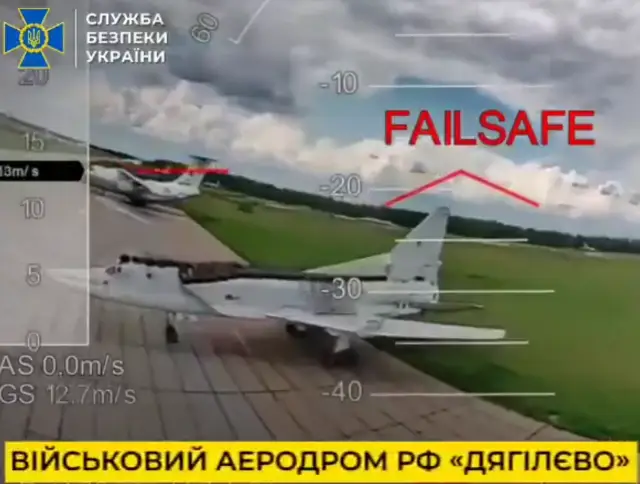 This approach demonstrates a deep understanding of strategic aviation as a system, not just a collection of aircraft. Ukraine also prioritizes operational and technical secrecy, ensuring that its technologies cannot be reverse engineered. One of the key elements to the success of the operation was denying access to the assets used. Ultimately, the FPV drones were launched from camouflaged wooden modules mounted on trucks, with the trucks self-destructing – presumably with built-in explosive charges. Just like long-range drones, which self-destruct after a certain period of time. This tactic prevents Russia from analyzing or copying the technology used. Some experts suggest that the materials found in Chelyabinsk may have been left for disinformation.
- So the question arose, how well are NATO air bases protected?
- Patton Rogers, a drone expert who is executive director of the Cornell Brooks Institute for Technology Policy, questioned how well are NATO air bases protected from such attacks, while also pointing out how the tactic could be applied elsewhere. “Drones will not be limited to a specific battlefield,” Rogers said. "While long-range drones will continue to strike, short-range armed drones will be 'hidden and waiting to be launched' to strike deep into enemy territory. The question is, are NATO allies ready for this new reality?" Ukraine has used drones against Russia many times in the course of hostilities so far.
But now they are attacking five Russian airfields simultaneously in an extremely creative move.
Operation Spiderweb not only demonstrated Ukraine’s tactical ingenuity, but also illuminated broader technological and strategic shifts that are reshaping modern warfare. As unmanned systems become increasingly sophisticated, affordable, and effective, there are four critical trends that military and political leaders around the world can no longer afford to ignore. First, the proliferation of cheap, ready-to-use technologies – both hardware and software – is accelerating. Cheap off-the-shelf FPV drones, open-source software platforms, and AI models, once designed for hobbyists, are now weaponized with devastating results. The affordability and adaptability of such systems make them attractive tools for both government and private users, requiring urgent efforts to anticipate, regulate, and counter their military use in both conflict zones and domestic settings. Second, the steady advances in autonomy are changing the way these systems operate. While current drones often separate navigation, targeting, and task execution into separate semi-autonomous functions, future versions will likely merge them into unified, fully autonomous platforms capable of performing missions independently, over vast distances, and with minimal human oversight. This progression will challenge existing doctrines, oversight mechanisms, and ethical boundaries. Third, the operation demonstrates the growing need for robust physical protection and specialized countermeasures against drone threats. From critical military infrastructure to civilian targets, the vulnerability to small, precise, and difficult-to-detect systems is increasing. Conventional air defense systems are often inadequate for this new threat landscape, leading to an urgent call for innovations in early detection, electronic warfare, and multi-layered physical defense.
So far, only China and partly the United States have built shelters for their strategic aviation.
Fourth, it is important what conclusions NATO and in particular we from the Bulgarian Army will draw about this new paradigm in modern warfare. It is becoming clear that with special knowledge, creativity, accurate calculations, and bold decisions, these tactics can make even the most modern armies in the world vulnerable. We live in a rapidly changing world under the pressure of new technologies. It is important for political leaders to realize this and make responsible decisions to ensure adequate education and cultivate an interest in mastering knowledge that will make us competitive in this world! Religion also has its place for those who are interested in it, but new technologies are clearly at the forefront! Together, these trends point to a future in which technological agility, not just industrial scale, will determine strategic advantage. Armies that adapt early – by investing in resilience, countermeasures, and adaptive doctrine – will be best positioned to meet the challenges of a rapidly evolving battlefield.