


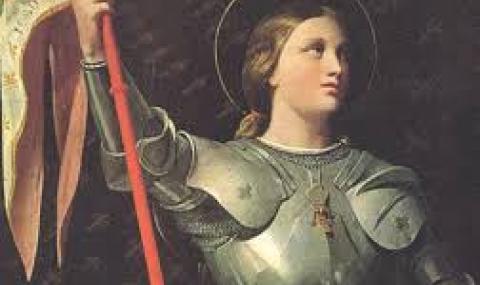

On May 30, 1431, in the French city of Rouen, 19-year-old Joan of Arc was burned at the stake. In this case, the church court was only a servant of the people who ruled England on behalf of the 10-year-old King Henry VI and who used the services of the church to deal with their opponents.
From “Hosanna” to the betrayal of the “grateful” French only one year passed, another one separated her from “Burn her!”, and 25 years after her execution, Pope Calixtus III recognized her as innocent and proclaimed her a martyr. In 1909 she was declared blessed, and in 1920 she was already a saint.
According to many researchers, Joan's fate is reminiscent of Christ, with the cross replaced by the sacrificial pyre.
During the Hundred Years' War, which began in 1337, England conquered vast territories in northern France. To completely subjugate France, the English only needed to unite the occupied areas with the long-controlled Guiana and the Kingdom of Aquitaine to the south.
An important point is that about ten years earlier, the Burgundian Duke John the Fearless had concluded an alliance with the English, he soon became the master of Paris and began to rule on behalf of the dim-witted King Charles VI together with his wife Isabella of Bavaria.
The division of France between the English and the Burgundians was already a matter of the near future. Then came the hour of Joan of Arc.
She was born in the village of Domremy on the border of the Champagne and Lorraine regions into the poor family of Jacques d'Arc and Isabelle Romay. At the age of 13, she first heard the voices of the Archangel Michael, Saint Catherine of Alexandria, and, it is believed, Margaret of Antioch.
After some time, it was they who told her that she was destined to lift the siege of Orleans, return the Dauphin to the throne, and expel the English. When Joan turned 17, she went to the captain of the city of Vaucluse, Robert de Baudricourt, and announced her mission. After being ridiculed, she returned to her village and tried again a year later. This time, the captain, struck by her persistence, was more careful, and when Joan accurately predicted the sad outcome for the French of the so-called. battle of the herrings under the walls of Orleans, agrees to give her men so that she can go to the king.
In 11 days, Joan overcomes the distance through the enemy Burgundian territory between Domrémy and the castle of Chinon, and on March 4, 1429, she enters the residence of the Dauphin Charles. The Dauphin arranges a test for her, placing another person on the throne, and he himself stands in the crowd of courtiers. Joan withstands the test and recognizes him. She announces that she has been sent to free the country from English rule and wants an army to lift the siege of Orleans.
At first, Charles hesitates, but after finding nothing to tarnish her reputation, he decides to give her troops and appoints her commander-in-chief. The leading French commanders Étienne de Vignol, nicknamed La Guerre, Poton de Centraille and Count Dunoy, from the last forces of those repelling the English attacks in Orleans, are obliged to stand under her command.
After Joan's appointment, special clothes, a flag and banners are prepared for her. A sword for her was found in the church of Sainte-Cartin de Ferbois, according to Joan's own instructions. According to legend, this sword belonged to Charles Martel. Then she left for Blois, the assembly point for the army, and at the head of it, she advanced towards Orleans.
The news that the army was led by a messenger of God caused an unusual morale boost in the army. The officers and soldiers who had lost hope, crushed by the endless defeats, were inspired, overcome with courage.
On April 29, Joan with a small detachment penetrated Orleans. On May 4, her army won its first victory, capturing the bastion of Saint-Loup. The victories followed one after another, and on the night of May 7-8, the English were forced to lift the siege. Thus, the task that the French commanders before her considered impossible, Joan solved in 4 days.
After the victory at Orleans, Joan began to be called the "Maiden of Orleans."
After a series of victories, she led the army to Reims, where on July 17 of this year she crowned Dauphin Charles as King of France under the name Charles VII, recalls Dani Ivanov in his blog. But the scale of the people's war and the immense popularity of Joan of Arc frightened the king and the court aristocracy. She was subsequently removed from leading the military operations.
On May 23, 1430, during one of the French exits from Compiègne, which was besieged by the Burgundians, the defenders of the fortress, fearing that their enemies would enter, raised the drawbridge and Joan was captured. The Burgundians handed her over to the English. The church court in Rouen accused her of heresy and burned her at the stake on May 30, 1431.
In 1456, a new trial was organized in France, in which she was rehabilitated. In 1920, she was canonized by the Catholic Church. Now Saint Joan of Arc is a national heroine of France and, together with St. Denis, St. Martin, St. Louis IX and St. Therese of Lisieux, she is the patron saint of France.