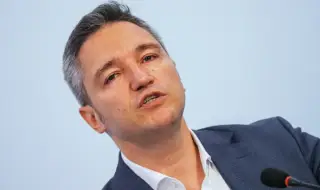
The cold relations between the United States and Europe and Bulgaria's place in this complex international situation were the focus of a program on BTV, whose guest was the MEP from the Progressive Alliance of Socialists and Democrats group and former Foreign Minister Christian Vigenin.
Vigenin expressed his sharply critical position regarding the decision of the resigned Bulgarian government to join the Peace Council, headed by Donald Trump. According to him, he has not been able to find anything positive in this move.
“The way it happened, the nature of the document we are joining, as well as the organization that is emerging, are a serious strategic problem for Bulgaria“, said Vigenin.
According to him, Bulgaria is not joining a body as envisaged in a UN Security Council resolution, but a new international organization with a far broader and problematic scope. He stressed that the UN resolution served only as an occasion for the creation of this council.
Vigenin drew attention to the organization's charter, which, according to him, contains serious legal deficiencies. Among them, he pointed out the lifetime mandate of the chairman, who is Donald Trump himself, his right to unilaterally dissolve the organization, appoint members of the executive board and adopt resolutions on behalf of all members.
“Any reasonable reading of this charter should make a democratic government run away from such a structure. Our accession is a direct threat to our national sovereignty“, he said.
According to him, the initiative also represents an attempt to undermine the role of the UN in the global plan. Vigenin noted that in the new structure, countries that contribute $ 1 billion each become permanent members, while the rest receive a limited mandate.
He emphasized that although the UN and the Security Council need reforms, this should not be done by creating parallel structures with a problematic legal basis.
Christian Vigenin also drew attention to the domestic legal aspect of Bulgaria's accession. According to him, the charter states that the parties provisionally apply its provisions even after signing, even before ratification, unless they explicitly declare a refusal.
“I don't know if the Prime Minister has stated that Bulgaria will not apply these provisions until ratification. This is an extremely serious issue“, he said.
According to Vigenin, the problem has already been created, since a possible refusal of ratification by the parliament would lead to a contradiction with the United States and the American president.
“For me, our participation is unacceptable, but the signature of the Bulgarian Prime Minister is already there, and with a unanimous decision of the government in a closed session. In my opinion, they do not have the legitimacy to join any international organization“, said Vigenin.
He suggested that the issue be left for the next National Assembly, and until then the Constitutional Court should rule on whether the charter complies with the Bulgarian constitution.
In the context of relations between the EU and the US, Vigenin stressed that Bulgaria must adhere to common European positions and seek the support of its European partners. He pointed to the situation in which the sovereignty of an EU and NATO member state - Denmark - was questioned by another NATO member state as a worrying precedent.
“To remain without a position means another dose of conciliation and humiliation“, said Vigenin and added that the protection of sovereignty and territorial integrity must be a matter of principle.
The conversation also touched on the topic of the future of the Bulgarian Socialist Party. Vigenin acknowledged that the party faces serious risks and must clearly differentiate itself from GERB and MRF, as well as show a new face.
He stressed the need to return to the core values of the BSP - social justice, a fair state and an effective judicial system - and stated that the party needs a younger leader and wider participation of young people.
According to him, the BSP should clearly state that Rumen Radev's project could also be its future partner, once it becomes clear what policies and personalities will stand behind it.
When asked if he had a specific name for a future leader of the party, Vigenin said that he did have such a name, but refused to name it publicly, expressing hope that the party would come up with a unified candidacy at the upcoming congress in February.