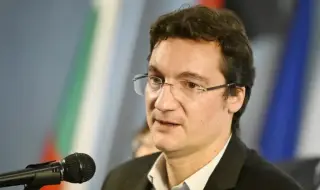
„The security of Europe comes from its unity, from the convergence between the states. Only a fair Europe will be a secure Europe.“
This was stated by the Chairman of the National Assembly of the Bulgarian Socialist Party Krum Zarkov at the public discussion: „The European Union at Two Speeds? The Challenges Before Bulgaria“. The event was organized by the Bulgarian MEP from the Group of the Progressive Alliance of Socialists and Democrats in the EP Kristian Vigenin, with the assistance of the „Center for European and International Studies“ (CEMI) Foundation. The discussion was held at the initiative of the PP ABV – Alternative for Bulgarian Revival, part of the coalition “BSP – UNITED LEFT“.
Krum Zarkov added that ideas such as “two speeds“ “formalize the division and legitimize it“. He emphasized that “driving at a faster speed… gains time, but also increases the risk of a catastrophe“, and that the strength of Europe lies precisely in the procedures that lead to consensus and sustainable solutions.
He was categorical that “for Bulgarian national security it is of utmost importance that Europe remains united“, and Bulgaria should defend the position that “for the security of Europe itself it is of key importance that it remains united“. In the context of the intensified discussions on armaments, he warned: “We will not guarantee security with gunpowder factories, with billions for armaments.“ Zarkov emphasized that “engaging in an arms race has historically not brought more security“.
“The European Union is faced with a choice that is not between “faster“ and “slower“ integration, but between fragmentation and strategic unity.“ This was stated by MEP Christian Vigenin at the opening of the discussion. “The European Union has never been simply a union of interests. This union is based on law. It is not military power, not the size of the economy, but law that guarantees equality,“ Vigenin emphasized. In his words, the strength of Europe stems from the fact that “small and large countries sit at the same table under the same rules“.
Vigenin also emphasized the social dimension of the European project. “For millions of Europeans, Europe means the protection of labor, social rights, and human dignity“, he noted. According to him, the risk today is not so much institutional division as social distancing within the union itself. “Europe cannot be strong outside while it is divided from within. Social cohesion is not an expense, but a strategic investment in the stability of the continent.“
Plamena Zayachka from ABV emphasized the risk of lasting institutional division and emphasized: “Reform - yes, division - no.“ She reminded that the European project is built on the principles of solidarity and equality and warned that the "two-speed" model could lead to a real division between center and periphery, including in access to investments, innovations and educational programs.
ABV Chairman Rumen Petkov asked the question - whether the two speeds or more speeds lead to more strategic advantage or more division. According to him, it is important whether it is a matter of "desire or opportunity" to participate. He called on Bulgaria to develop a real working position, not in principle.
MEP Tsvetelina Penkova emphasized that the debate "is not theoretical" and that "unfortunately, we see it in practice". She pointed to the differences in electricity prices between Northern and Southeastern Europe as an example of a real division and emphasized the need for greater connectivity and elimination of fragmentation in the single market. In her words, “European solidarity is measured by economic growth, real connectivity and real social policy“, and the coming months will be a test for cohesion policy and the general budget.
The Chairman of the Youth Union of the Bulgarian Socialist Party and MP Gabriel Valkov noted that the European Union “was originally intended to be multi-speed“, citing examples such as Schengen and the Eurozone. However, he believes that: “In Bulgaria, we are often observers of the processes, not direct participants“ and insisted that the country be among those who “set the direction“.
In the discussion, the participants raised questions about foreign policy, the role of Bulgaria in decision-making processes and the need for our country to formulate a clear and active position on specific initiatives, and not just be an observer. Among them were Assoc. Prof. Natalia Kiselova, Chair of the parliamentary group “BSP-UNITED LEFT”, Assoc. Prof. Dr. Hristo Hristev, Head of the Department “International Law and International Relations“ at the Sofia University “St. Kliment Ohridski“, Assoc. Prof. Dr. Svetla Boneva, Head of the Faculty “International Economics and Politics“ at the University of National and World Economy, Georgi Pirinski, Chairman of the “Solidarity Society“ Foundation, Lyubomir Kyuchukov, Director of the “Institute of Economics and International Relations“ Foundation (IIMO), Dr. Milena Angelova - Secretary General of the Association of Industrial Capital in Bulgaria (AIKB) and member of the European Economic and Social Committee (EESC), Prof. Alexander Tomov - Chairman of the party “Bulgarian Social Democracy-Euroleft“ - part of the coalition “BSP - UNITED LEFT“, politician and expert Zinaida Zlatanova, the rector of the Higher School of Telecommunications and Posts Prof. Miglena Temelkova, the former Deputy Minister of Labor and Social Policy Ivan Krastev, the sociologist Parvan Simeonov, the politician and diplomat Dr. Meglena Plugchieva.
The general message from the forum was that the future of the European Union cannot be built on a logic of division and circles of affiliation. “The time has come for different generations and people with different political beliefs in Bulgaria to work together on a national position - where is the European Union heading and what should it be“, concluded Christian Vigenin at the end of the forum.