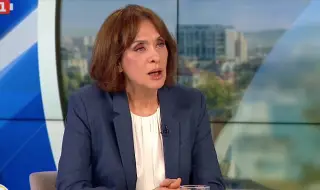
This morning brought relief for everyone in the search for an end to the conflict in the Middle East. This is how Acting Foreign Minister Nadezhda Neynsky commented on the two-week truce between the US and Iran, announced shortly before the expiration of another ultimatum from Washington on the air of "The Day Begins" on BNT.
The sustainability of the ceasefire will depend on whether Iran will give up its desire to create a nuclear bomb, on providing sufficient guarantees that enriched uranium is not used for nuclear weapons, stopping the shelling of the Gulf states, as well as the opening of the Strait of Hormuz, Neynsky also said.
Nadezhda Neynsky, acting Minister of Foreign Affairs: "In practice, this ceasefire essentially provides clear lines along which it will be sought whether it will be sustainable. Of course, it is too early for optimism, because the tense situation in recent weeks has been extremely difficult. In a conflict, the most important thing is whether such trust will be created that will lead to the end of the conflict. So let's be cautious, let's see how these negotiations will proceed. Unfortunately, we have had expectations several times that have not been crowned with success."
According to the Foreign Minister, the UN Security Council resolution that was rejected last night, which insisted on the opening of the Strait of Hormuz, has shown that conflicts around the world are connected. The reason - Russia and China, which were expected to abstain, voted against.
Nadezhda Neynsky, Acting Minister of Foreign Affairs: "Russia managed to accumulate huge financial revenues from the closure of the Strait of Hormuz, revenues that are immediately poured into its military machine. As we know, she was also essentially interested in this conflict, because it gave the military industry the opportunity to feed itself with the increase in oil prices, it has alternative routes through which to export it, so in the modern world everything is connected and interests are intertwined."
Nadezhda Neynsky added that at this stage the European Union manages to find the most correct solutions regarding the war in Iran in a discussion. She also commented on her participation in the video conference call at the initiative of the British Foreign Minister, explaining that there was a dialogue with the Persian Gulf countries, which are among the most affected by the conflict.
Nadezhda Neynsky, Acting Minister of Foreign Affairs: "I spoke with the majority of my colleagues from the Gulf countries and they were extremely angry, especially since during the holy week of Ramadan they were attacked by their neighbors in an absolutely cruel and unprecedented manner. So the aim of this conversation was to first listen to what is happening there, to bring our positions closer together. Bulgaria stated that it will not participate in any military operations in the Strait of Hormuz, but, of course, Bulgaria joined the efforts and appeals to Iran to open the strait, because it suffers economic consequences."
All efforts of the Bulgarian government are aimed at providing maximum guarantees for Bulgaria's security, our first diplomat also said. According to Neynski, these guarantees are in the policy that our country is pursuing, as well as its membership in the EU and NATO.
Nadezhda Neynski, acting Minister of Foreign Affairs: "What I want to say very clearly is that the protection of Bulgaria's national interests and national security goes through an active, not a passive foreign policy. This motto for peace - we are all for peace, there is no country that can say "I am for war". The question is what guarantees can be obtained for a peaceful solution, how Bulgaria can protect its national security, and here things are starting to fall apart."
Neinsky again explained that the publication of the note sent by Iran to Bulgaria is not a normal practice. According to her, the goal was to create tension and instill fear in society.
She also commented on the agreement with Ukraine, emphasizing that it outlines a political framework from which there are no obligations, but opportunities for Bulgaria.
Nadezhda Neynski, Acting Minister of Foreign Affairs: "Bulgaria is extremely late in signing this bilateral agreement. And Bulgaria, on the other hand, wants to take advantage of Ukraine's high-tech capacity. Ukraine, due to the necessity of this war, literally had to create within 4 years an exceptional high-tech capacity for its army. This is the know-how that the Bulgarian army needs and from the cooperation under this agreement we can really get a lot of opportunities. The Bulgarian military industry can also get extremely large opportunities, which we have assessed to be in the interest of our country."