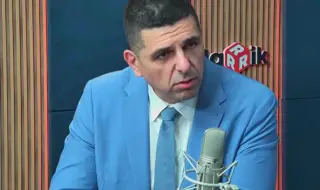
The role of “Democratic Bulgaria“ as an opposition is to work and ensure that the country moves in a direction in which we leave behind a long-standing corruption model that had conquered Bulgaria. Our role is to ensure that this model is not reproduced again. This was said in an interview with Darik Radio by the co-chair of "Yes, Bulgaria" Ivaylo Mirchev. Here are more highlights from his interview:
If he decides to run, Andrey Gyurov can win the presidential elections. He was an excellent prime minister and led one of the most successful governments, which produced the fairest elections in the past 20 years. Andrey Gyurov is liked by people far beyond the so-called democratic community.
We see big requests for reforms, then retreat and finally whining about how bad it is. The government has a heavy legacy from the “Zhelyazkov“ cabinet, but the budget situation is not apocalyptic. With focused measures, Bulgaria can get within the 3% deficit, especially when there is a 20% growth in revenues. In the long term, we need to think about a balanced budget.
The possible excessive deficit procedure is bad news for the country. It is not good to say “we told you so”, but we told you so. When the 2025 budget was being discussed, we talked a lot about the unrealistic loopholes that were put in place, which were put there only to justify huge expenses for the GERB and MRF circles.
The DB has the right-wing, reformist measures ready: the gradual release of pensioners in the administration; civil servants to start paying social security contributions; optimization of the administration and reduction of permanently vacant staff positions; a digitalization package in the administration; private hospitals to start making public procurements; patients to be notified by text message about services paid for by the health fund, etc.
All of these are measures that we have been proposing for a long time. They were not adopted last year, we will propose them again.
The government must do its job and convince the opposition and Bulgarian citizens that there is a real will for reforms. Fiscal policy and Bulgaria's position in Europe are the biggest risks facing the country.
Radev is right that the Bulgarian interest should be the leading one. But there is a legend that needs to be refuted. The truth is that Bulgaria has donated very little, mainly medicines and humanitarian aid, to Ukraine.
At the same time, Ukraine has imported weapons from Bulgaria for 6.5 billion euros. Separately, medicines, fuel and others. This is money invested in the Bulgarian economy. Bulgaria does not donate ammunition and weapons to Ukraine. There were, for example, some unusable armored personnel carriers that we donated, but for which we received hundreds of millions from the EU.
We should be in Group A in Europe, which means not playing the role of Fico or Orban. The future belongs to two groups of countries - the ones that, without much talk, look ahead and work for the future of Europe. And others who listen and bow down. One of our roles as the opposition is to insist that Bulgaria defend this future and work for the national interest. And not to say one thing to the domestic public and another to Macron and Merz.
We must cooperate with Ukraine, which is technologically ahead in terms of drones. There are many successful entrepreneurs in Bulgaria and we must work together to modernize the army. Let's, for example, produce Bulgarian-Ukrainian drones in Bulgaria.
However, we must note that we are observing a government that is giving signals that it will work for the national interest, unlike the previous one, whose efforts were focused solely on lifting the “Magnitsky“ sanctions on Peevski.