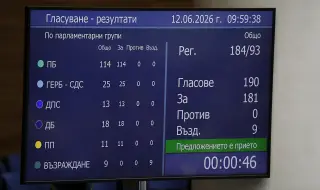
The Parliament adopted the changes to the State Debt Law, submitted by „Progressive Bulgaria“ (PB), on first reading, with 181 votes „for“, no „against“ and nine „abstentions“, BTA reports. Deputies rejected the GERB-SDF bill with 44 votes „for“, seven „against“ and 144 „abstentions“.
"Progressive Bulgaria" introduces a legal framework for the determination, control and status of primary dealers in government securities (GS). The proposed changes are also due to the need to specify the regime for the participation of licensed credit institutions and investment intermediaries in the government securities market. The reasons for the amendments state that, in accordance with the Treaty establishing the European Stability Mechanism, the same standardized collective action clauses, approved by the Economic and Financial Committee of the EU, apply to all government securities issued after the date of the introduction of the euro in Bulgaria, with an initial maturity of over one year. The collective action clauses allow the contractual terms of the issued government securities to be changed at the proposal of the Minister of Finance, based on a decision of the Council of Ministers.
The bill also states that the Minister of Finance may issue government securities intended for investors - individuals. Investors - individuals do not owe fees and commissions for the initial acquisition of government securities - they are at the expense of the state budget. It is also proposed to establish an electronic system for registering and servicing the trade in government securities.
The GERB-SDF bill, which was not supported, provided that the Minister of Finance would annually issue government securities intended for acquisition by investors - individuals, under the conditions of equal non-discriminatory access. The texts also provided that the Ministry of Finance would introduce an electronic platform for direct offering and redemption of government securities without the participation of primary dealers, as well as that government securities could be subscribed, paid for and redeemed through “Bulgarian Posts”.
During the debate, Konstantin Prodanov (PB) pointed out that there are about 98 billion euros in total deposits in the Bulgarian banking system, of which about 60% are from households. The average yield on government securities for a five-year period is over 3%, he added. With this bill, if Bulgarian individuals buy government securities, the interest on government securities remains in our country and we retain the capital in the country, Prodanov added.
Tsoncho Ganev (“Vazrazhdane“) stated that according to an official report from the National Revenue Agency on income in the country as of December 31 last year 34% of Bulgarians live and pay taxes on a minimum wage. Now the deputies are telling them to go buy government securities with which we can cover the budget deficit, he added.
For 2020, the population in the country deposited 93 billion leva in commercial banks. In 2026, we have 98 billion euros and I see nothing wrong with these funds flowing into the country's economy, said Stefan Belchev (PB).
Vladislav Panev (DB) pointed out that the measure is good because when liquidity is taken away from consumption and the market, which leads to less pressure on prices.
Martin Dimitrov (DB) asked when the electronic platform, which is planned to be created, will be ready. Konstantin Prodanov replied that it would be good to set a deadline. Propose a specific deadline between the two readings and I will discuss it with the Ministry of Finance, he said.