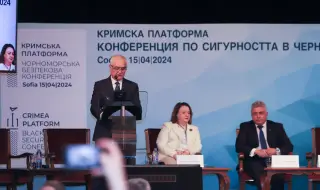
“When the war is over, Ukraine is welcome to the Black Sea Mine Countermeasures Naval Group (MCM Black Sea). We will continue to support Ukraine and our other allies and partners in the Black Sea in this and other ways“, said Refik Levent Tezkan, Deputy Director General of Defense and Security of Turkey during the Second Black Sea Security Conference.
He noted that the latest technologies, especially naval drones, have become a decisive factor in the battle in the Black Sea as part of countering Russian aggression. Therefore, control over the production of such drones is also very important. Such technologies in the wrong hands will threaten the freedom of navigation and maritime safety in the region. Currently, the tactics used by Ukraine in the Black Sea have forced Russia to somewhat limit its destabilization efforts.
Rear Admiral Refik Levent Tezkan also noted that floating mines remain a major problem in the Black Sea. Together with Bulgaria and Romania, Turkey has established a working group that will work on demining the water area at a regional level.
„The New Zealand Defence Force will provide maritime training in explosive ordnance disposal to the Ukrainian armed forces as part of a new initiative to support Ukraine“. This statement was made by Judith Collins, Minister of Defence of New Zealand.
„In February this year, I announced the extension of the New Zealand Defence Force's mandate to provide training to the Ukrainian armed forces until June 2025. This is part of the $26 million aid package. USD, which also includes humanitarian assistance, reconstruction assistance and a contribution to an international fund for Ukraine to supply weapons and ammunition, as well as new sanctions covering the Russian invasion of the sanctions. I am pleased that as part of this new package of support, New Zealand Defence Force personnel will conduct explosive ordnance disposal training at sea for members of the Ukrainian armed forces“, she said.
Judith Collins expressed her hope that this training would assist Ukraine in maintaining maritime security in the Black Sea and support its efforts to comply with international norms regarding the safe passage of merchant shipping.
During the conference, Karl-Oskar Bohlin, Sweden's Minister for Civil Defence, said that Ukraine had effectively seized the opportunity by restricting the freedom of movement of the Russian Black Sea fleet with the help of drones and missiles. Russia’s effective refusal to commit its military capabilities to temporarily occupied Crimea – Russia’s center of gravity in the Black Sea – is key to ending the ongoing missile and drone attacks on the Ukrainian population.
“Ukraine has taken action to secure sea lines of communication, deploy amphibious forces, support the ground campaign, and strategically strike critical Russian capabilities. Ukraine has used creativity and courage to change the naval operational landscape by using indirect methods and alternative means. Russia, on the other hand, has shown the cost of complacency in its position. At the strategic level, Russia’s initial naval supremacy has been eroded by Ukraine’s revolutionary naval actions. The use of drones can have an effect at all levels – tactical, operational, and strategic,” he said.