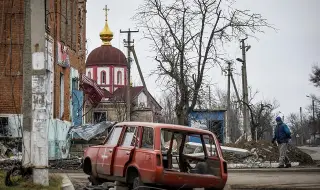
The capture of Pokrovsk by Russia appears to be a matter of "when" rather than "if", and while its fall would not cause Ukraine's defenses to collapse, it would weaken Kiev at a sensitive moment in U.S.-led talks to end the war, Reuters reports.
On December 1, Moscow announced it had taken full control of Pokrovsk - two days before U.S. President Donald Trump's special envoy and his son-in-law held talks in the Kremlin with President Vladimir Putin on a plan they say is close to finalizing.
Ten days later, Ukraine said its troops were still holding positions in the northern part of the city, which was home to 60,000 people before the Russian invasion in 2022 and served as an important logistics hub for the army until the fighting ended.
"The new round of pressure on Ukraine to settle the conflict on unfavorable terms is happening in parallel with heavy fighting on this front, which helps Russia because it affects Trump's perception," explained Mykola Beleskov, a senior analyst at the Ukrainian charity "Come Back Alive".
Ukraine must try to maintain ties with the Americans, who supply vital intelligence and weapons, while resisting the peace agreement, which Russia says should include the withdrawal of Kiev's forces from the entire eastern Donbas region, where Pokrovsk is located.
Ukraine argues that after fighting for control of Donbas since 2014, it has no moral or legal right to cede sovereign territory to an invader, making control of the industrial zone the most contentious issue dividing the warring parties.
Trump's rhetoric took a tougher tone toward Ukraine this week, when he said Russia had the upper hand in the war and that Ukrainian President Volodymyr Zelensky should start "getting things done.".
Russia's Slow Offensive
Yet the pace of the Russian assault on Pokrovsk shows how difficult it has been for Moscow's forces to advance along front lines littered with deadly drones.
The war has become a fight of attrition since 2022, with neither side able to easily seize territory. Russia launched a new offensive in late 2023 and now controls about 19.2% of Ukraine - just over 1% more than at the end of 2022.
Pokrovsk, located on high ground in Donetsk Oblast, will be the first city captured by Russia since Avdiivka to the east in early 2024. Most of it is in ruins, and only 1,200 of its inhabitants remain.
Military experts support Ukrainian authorities' assessments that it is unlikely that Ukrainian defenses will suddenly collapse in the east - given the frontline fortifications, drones and the fragmented nature of the Russian attack on Pokrovsk.
Russian troops are advancing in groups of six or fewer, relying on one or two soldiers to break through porous defenses and entrench themselves in a building, Ukrainian officials say. forces.
"The Russians were massing in assault groups, penetrating all around our positions because, as I said, we have a critical shortage of infantry," said Lambada, a Ukrainian drone operator who fought in Pokrovsk.
Konrad Muzyka, a military analyst in Poland, said Ukraine had brought in its "Skelya" assault regiment and special forces to reinforce Pokrovsk in August, but redeployed them as the front deteriorated in other eastern areas, such as Liman and Kupyansk.
Concerns about the depth of Ukraine’s military reserves have been raised periodically throughout the war, including by allies such as the United States, where authorities have called on Ukraine to expand military service.
But the issue is politically sensitive, and the government has refused to lower the age below 25 to protect the youngest generations from bloodshed.
What’s next?
The U.S.-backed peace plan initially called for Ukraine to withdraw from the Donetsk region, where U.S. Secretary of State Marco Rubio said it controls 20 percent of the territory. Zelensky said this week that he and European leaders had drawn up a revised 20-point plan, but that there was no agreement on surrendering territory. They are expected to send their plan to Washington soon.
Earlier this month, Putin said that Pokrovsk, which Russia calls Krasnoarmeysk after the Soviet-era Red Army, was the ideal platform from which to launch attacks in any direction.
Russia is likely planning to try to surround the "fortress cities" of Slavyansk and Kramatorsk northeast of Pokrovsk and use the heights to launch drones at greater distances, Muzyka warned.
Russian troops have recently entered both Zaporizhia Oblast in the south and Dnipropetrovsk Oblast in the east, although the latter is not one of the five Ukrainian regions illegally annexed by Russia.
Quick gains, however, are unlikely.
"The way they are conducting operations is incredibly slow," Muzyka noted.
Ukraine has stressed its readiness to ensure "fair" peace, given that Trump has promised a quick end to the war and his officials have threatened to cut off support, such as intelligence and weapons, paid for by European allies.
Kiev also hopes that those same European allies can provide more financial and military assistance themselves.
Since August, Ukrainian forces have been attacking Russia's oil industry in an attempt to cut off revenues and create fuel shortages. Most recently, they have begun pursuing ships carrying Russian oil in the Black Sea.
Russia has been carrying out a series of massive missile and drone strikes, causing widespread power outages across Ukraine and serious damage to the power system.
A senior European defense official, speaking on condition of anonymity, said the war could drag on for several more years unless a "Trump moment" or a "Putin moment" stops it. However, he does not believe that Putin intends to give up.