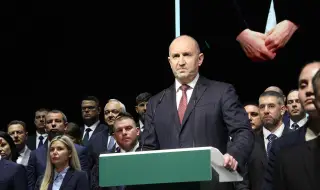
Comment by Veselin Stoynev:
The election campaign, which started out seemingly quietly, with mostly right-wing economic programs and messages among the main political forces, has sharply radicalized in recent days. And it restored full-scale tension on the fronts of the two political divisions - the corruption and the geopolitical, which are at the root of the political crisis that has caused so many early elections.
And it seemed that in the elections on April 19, the anti-corruption front would have a strategic advantage and that it could be, if not the basis for governing in the next parliament, then at least provide serious progress in untangling the heavy dependencies at the top of state institutions.
Mutual accusations of hypocrisy
Despite their serious disagreements with Rumen Radev, the PP-DB initially saw in his formation “Progressive Bulgaria“ partner against the “Borisov-Peevski“ model, although his target against the oligarchy never took any concrete shape (his loyal ally Galab Donev even dodged a journalistic question about whether Nikolay Valkanov and Georgi Gergov were part of the oligarchy).
The two formations avoided direct confrontation through moderate mutual reproaches for pro-Russian orientation and for a fitter's legacy. Until Radev started talking on his tours around the country how Bulgaria should rely on pragmatism, by importing Russian oil and revising its energy policy in an anti-European direction, and until the leader of the PP Asen Vassilev accused him of being a “cowardly hypocrite“, and he responded with a quote from the recording of the National Council of “Continuing the change” from 2023, in which the then co-chair of the party Kiril Petkov called GERB and Borisov a “marketing enemy“, with whom they later embraced in the assembly.
The official cabinet as a factor in the campaign
The official government also became a key factor in the election campaign. The activity of the Ministry of Interior against vote buying met with fierce criticism, especially from the DPS-New Beginning, which in itself is an admission that the party is the main victim of this activity. And it is no coincidence that she tried to counterattack with attempts to challenge the legitimacy of the prime minister, including through manipulative interpretations of the opinion of the Advocate General of the Court of Justice of the European Union on the issue imposed on national private television stations.
However, the visit of Prime Minister Andrey Gyurov and key ministers from his cabinet to Kiev and the concluded 10-year security agreement with Ukraine, which according to Gyurov is not subject to ratification by parliament, unlike the two reactors at the “Belene“ nuclear power plant, provoked sharp reactions from “Progressive Bulgaria“ and the BSP. Rumen Radev stated that the agreement contradicts the Constitution and continues the “tradition of assemblies“, that it increases the risks to national security, by again talking about “involving us in war“, and made an attempt to sew the caretaker government to the PP-DB. Krum Zarkov, on the other hand, called the signed agreement “an act of supreme political irresponsibility“ and warned that it has yet to be approved by parliament.
Radev and Zarkov – more from the same
In fact, the caretaker government signed an agreement prepared by the “Glavchev“ cabinet, and as for whether such a cabinet can afford long-term contracts, the government of Galab Donev did exactly that with “Botas“. Both the Glavchev and Donev cabinets were appointed by Rumen Radev. Separately, and in substance, the actions of the “Gyurov“ cabinet are in unison with a geopolitical orientation, behind which there is a majority in several parliaments.
On the eve of the elections, however, the artillery fire from the well-known borders erases the last opportunities for weakening geopolitical divisions. For the supporters of the PP-DB, the "Progressive Bulgaria" of the party leader Radev is still the same as the "Crimea is Russian" of President Radev, and the new leadership in the Centennial of Krum Zarkov is still the same as the "not a single bullet for Ukraine" of Kornelia Ninova. This will probably harden the positions of PP-DB to the point of making it difficult for them to collaborate with PB and BSP on the issues of the judiciary and anti-corruption.
GERB with an imitation of energy sovereignty
If PP-DB is the only formation that is doomed to wage war on two fronts, GERB does not lose, but even gains from the political escalation. Because it now seems less threatened with being isolated by a possible constitutional majority in the election of a new Supreme Judicial Council, which could possibly also undertake some anti-corruption reforms supported by PB, PP-DB, BSP and MECH (if the latter two enter parliament).
With the resumption of active hostilities on the geopolitical front, GERB gets a chance for strategic relief. Probably anticipating and inciting precisely such a development, at the very beginning of the election campaign Boyko Borisov surprisingly announced a position for shale gas extraction in Bulgaria, although it was he who imposed a moratorium on exploration in 2012 under pressure from public opinion, which in fact has hardly changed in Northern Bulgaria to this day.
With the position on shale gas, which Borisov, in typical style, can always change “if the people do not want it”, GERB spits out a convenient sovereignist position in the energy sector, which is not pro-Russian, but which can always be traded under the pressure of tactical circumstances with opponents. And the basis of the geopolitical division and Russian dependence in general - far from only on Bulgaria - is precisely energy. Borisov has shown that he can both build South Stream and then support sanctions against Russia. Radev has also proven that he can conclude an unprofitable energy contract – with “Botas“. Even Bolshevik history shows that cunning opportunism and stupid straightforwardness can achieve a tactical balance between each other.
Radev risks sending us to new elections
According to the latest survey by “Alpha Research“, 43% of Bulgarians expect a coalition government to be formed after the elections on April 19. Apart from the fact that Radev has been against the coalitions from the very beginning, after the escalation along the geopolitical vector it seems completely impossible for GERB and PP-DB to be his partners in power.
However, if he fails to form a government together with smaller formations as the expected winner on April 19 (assuming there are any in the new parliament at all), he risks being saddled with the responsibility for new early elections. In which he risks losing support, because he was the long-awaited savior from the political crisis, which, however, may turn out to have even deepened by failing in power.