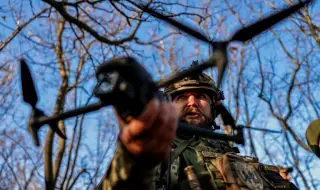
It seems that the Ukrainian military has managed to hinder the logistics of Russian troops along the "land corridor" to Crimea. However, it is still too early to talk about full control over Russian supply routes.
The Ukrainian Defense Forces are trying to establish fire control over the main logistics routes of the Russian army in the occupied territories of Ukraine. Thanks to the technological breakthrough and medium-range weapons, they have managed to partially establish control over the border and rear logistics routes, which are of critical importance to the Russian army, according to the Ukrainian military.
As early as early May, the 1st Corps of the National Guard "Azov" stated that its pilots were already conducting reconnaissance and strike patrols in the Mariupol region, keeping under fire sections of the routes of the so-called land corridor to Crimea at a depth of up to 160 km from the battle line. In confirmation of this, the Ukrainian military posted on the Internet numerous videos of burned Russian equipment along the route in question, leading through the occupied southern territories of Ukraine to Crimea.
"To date, the main achievement for Moscow in the course of the bloody war that has been going on for over 4 years seems to be the creation of a land corridor to Crimea. Now it is clear that this achievement is fleeting. The reality today is this: Ukrainian drones fly over the corridor, and civilians are prohibited from traveling along it. For the Russian Federation, Crimea is becoming an overseas territory. And we will not stop there," wrote Igor Lutsenko, co-founder of the Ukrainian Center for Air Intelligence Support, on Facebook.
Despite these reports, it is still too early to talk about full control over Russian supply routes, believes Nikolai Beleskov, senior analyst in the "Return Alive" project and chief consultant at the National Institute for Strategic Studies. He told DW that it is more about increasing the effectiveness of the so-called middle strike - hitting targets in the enemy's operational depth.
"Currently, the active actions of the Russians are less, although the area of their responsibility is quite serious and there were serious attacks there. This is yielding results, but it is not yet the turning point that some expect. For us, it is more of a halt to the deterioration of the situation," the expert noted.
How the Ukrainians took advantage of the technological breakthrough
Experts attribute these Ukrainian successes to the technological breakthrough - part of which is the Hornet strike drone with a built-in artificial intelligence system being developed by Ukraine.
Military analyst Mikhail Zhirokhov is convinced that Russia is already preparing countermeasures - additional mobile fire groups or massive deployment of anti-drone networks along the route. But Ukraine wins even by forcing Russia to do all this, because any protective measure requires resources, he adds.
"This is an additional burden for the Russians. They will be forced to invest funds and divert resources to secure this route. But the effectiveness of Ukrainian strikes at the moment is due to the surprise effect, which will decrease in the future. Four years of war show: as soon as something effective appears, a counterattack also appears. Therefore, this moment must be used to the maximum, while the Russians have not managed to organize effective air defense in this direction, "Zhirokhov emphasizes.
What is needed for Ukraine to consolidate its success?
Zhirokhov points out several specific steps that would help increase the pressure on the logistical routes of the Russian army. First of all, this is the expansion of strikes with unmanned aerial vehicles (UAVs), which have already proven their effectiveness. Second, the use of heavier combat units for UAVs, so that they are able to hit Russian armored vehicles. Third, the transition to new categories of targets. The expert points out that the road, hundreds of kilometers long, has its own infrastructure - gas stations, service stations. Strikes on them could hamper the logistics of the Russian army more systematically than destroying individual vehicles, he believes.
Analysts also pay attention to another aspect. "No matter how great the technologies are, if you don't have enough crews, you can't unleash their full potential. Robotic warfare still requires a large number of people. And this is currently one of the key limitations - the shortage of trained Ukrainian crews in all formations carrying out middle strike strikes," says military expert Nikolai Beleskov. The front requires the simultaneous execution of many tasks, all of this is superimposed on the general shortage of people at the front, and as a result, even the most effective technological solutions cannot fully realize their potential, the analyst summarizes.
It's too early to talk about de-occupation
Asked about the prospects for de-occupation, Beleskov notes that it's too early to talk about it. There are still no conditions for such an offensive, he states. This requires a complete advantage in reconnaissance and striking targets.
"Currently, Ukraine is only on the way to minimizing Russia's advantages in these aspects, but has not yet deprived it of the ability to detect Ukrainian forces and inflict losses on them," Bleskov points out.