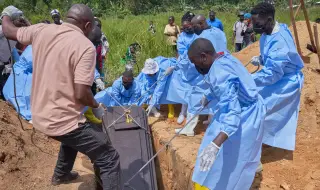
„First line of defense” in the Democratic Republic of Congo has collapsed in the largest outbreak of a rare strain of Ebola, Sky News reported.
The number of Ebola cases in the Democratic Republic of Congo (DRC) is likely much higher than official figures, Oxfam has warned, due to a lack of clean water and sanitation.
The aid agency said there had been a near-total collapse of hygiene infrastructure and a critical drop in contact tracing since the rare Bundibugyo strain began spreading.
Only one in five health centres in Ituru province, one of the epicentres of the virus, has access to sufficient clean water, Oxfam figures show.
In Mongbwalu, a town of nearly 140,000 people in the province, only 20% of people have access to clean water and only 25% to functioning sanitation and hygiene facilities facilities.
The findings highlight a crisis that is unfolding due to contaminated water, a lack of handwashing infrastructure and the challenge of disposing of infectious waste. “Water – the absolute first line of defence in any public health emergency – is simply not available,” an Oxfam representative said.
Oxfam is an international humanitarian organisation that works to reduce poverty, social inequality and the impact of humanitarian crises around the world.
Miners working in the surrounding areas lack toilets and handwashing stations. They then return home to communities already battling the virus.
Cases have reached record highs. The warning came after the US Centers for Disease Control and Prevention confirmed that the outbreak was the largest of the Bundibugyo strain recorded to date.
According to the DRC Ministry of Health, as of June 13, 781 cases and 181 deaths had been confirmed in the country. The Bundibujo strain has no licensed vaccine, meaning clean water and sanitation are critical components in the fight against the virus.
Contact tracing has also fallen to 43%, far below the 79% recorded one month after the start of the 2018-2020 outbreak in the same region.
There is also a funding gap stemming from the withdrawal of US support for disease surveillance.
With more than 70 health facilities destroyed by the conflict and only 0.2 doctors per 1,000 people, DRC health authorities are struggling to identify new infections quickly enough.
Furthermore, many families are caring for sick relatives at home, exposing others to the virus. Funding for aid to the DRC has been reduced from $2.58 billion in 2024 to $1.4 billion in 2026, a 46% reduction.
Families are turning to traditional remedies, which risks delaying treatment and allowing the virus to spread further. The response in the DRC is not sufficient to contain the spread.
The Ebola epidemic in the Democratic Republic of Congo continues to spread and has affected new areas, and the number of infected people is rising, a World Health Organization (WHO) official said on June 12, quoted by DPA.