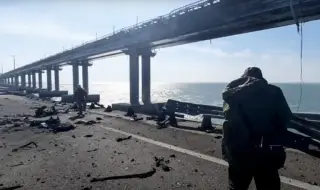
Ukrainian forces are conducting a series of strikes to deprive Russia of the ability to maintain its logistics and transport fuel through the Kerch Strait.
The strikes on the Kerch Strait are necessary to disrupt Russian logistics and weaken the Kremlin's military potential, the "Institute for the Study of War" notes.
The Ukrainian armed forces reported that Russia relies on the oil terminal in the port of "Kavkaz" for fuel supply to occupied Crimea and southern Ukraine.
Ukrainian military officials also reported that Ukrainian forces had struck oil tankers at the "TES-Terminal-1" oil depot in occupied Kerch, which Russia uses to transship fuel oil, liquefied gas and light petroleum products across the Kerch Strait.
The Ukrainian armed forces added that the "TES-Terminal-1" oil depot is located less than one kilometer from the bridge over the Kerch Strait and that Russia uses the terminal to refuel Russian ferry transport between occupied Crimea and the port in the Caucasus.
Ukrainian military officials also reported that the Ukrainian strikes had disabled four radar stations of the "S-400" air defense complex and two "Pantsir" air defense systems. on the bridge over the Kerch Strait.
The operational headquarters of the Krasnodar Territory stated that Ukrainian drones had struck the ferry "Panagia" at the Kerch Strait ferry crossing and set fire to an oil terminal in Chushka.
Publicized geo-localized footage taken on June 21 northeast of the port in the Caucasus showed at least three ferries on fire.
The occupation governor of Crimea, Sergei Aksyonov, acknowledged that Ukrainian forces had carried out drone strikes against occupied Crimea on June 21, but did not specify which targets were hit.
Ukrainian strikes on Russian oil and transport infrastructure are already disrupting Russian logistics, hampering energy supplies, and worsening fuel shortages in occupied Crimea.
On June 21, Aksyonov announced that all gas stations in occupied Crimea had stopped selling fuel to all non-state entities, but did not give any reasons for this emergency measure.
The occupation governor of Sevastopol, Mikhail Razvozhaev, also announced several fuel saving measures in Sevastopol in response to unspecified "recent events" in occupied Crimea, possibly referring to Ukrainian drone strikes.
On June 22 and 23, Razvozhaev banned gas stations from selling fuel, shortened the hours of public transport and large retail outlets, suspended ferry services, and canceled all outdoor events starting on June 22.
In June 2026, Russian occupation authorities increasingly tightened restrictions on fuel in occupied Crimea.
The strikes in the Kerch Strait are part of an ongoing systematic Ukrainian campaign aimed at preventing Russian forces from using the main land routes to occupied Crimea through occupied southern Ukraine.
The goal is to prevent the Kremlin from using the peninsula as a springboard for new strikes against Ukraine.
The strikes in the Kerch Strait are necessary to disrupt Russian logistics and weaken the Russian military potential.
A Kremlin-linked military blogger claims that Ukrainian forces have launched a campaign targeting Russian maritime logistics between occupied Crimea and Krasnodar Krai in mid-2025, attacking tankers and ships in the Sea of Azov with unmanned surface and aerial vehicles.
The combination of sustained Ukrainian strikes with medium- and long-range drones could pose additional tactical and operational dilemmas for Russian personnel and equipment transport along both supply lines, as well as disrupting fuel supplies to Russia.