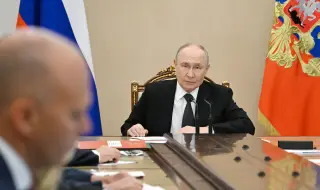
Russian President Vladimir Putin does not intend to start peace talks with Ukraine and will instead likely intensify military action in the coming months. This is according to three sources close to the Kremlin, quoted by Reuters.
According to them, the latest Ukrainian drone attacks on Russian oil refineries and ports have reinforced Putin's belief that the war must continue, not be ended through negotiations.
Sources: Kremlin has chosen the path of escalationTwo of the people Reuters spoke to, who requested anonymity, said that in their opinion the Kremlin was preparing for a new escalation of the conflict, which is now entering its fifth year.
One of them, who he said meets regularly with the Russian president, assessed the likelihood of escalation in the coming months as "very high".
The information comes days after US President Donald Trump said that he believed Putin wanted the war to end and that a peaceful solution was "closer than people think" realize".
Last week, Trump held separate phone calls with Putin and Ukrainian President Volodymyr Zelensky, and the two heads of state later spoke at the NATO summit. After the meeting, Zelensky said they discussed ideas for bringing peace closer.
The White House did not comment on the Reuters report.
Donbas remains the main goalOne of the sources claims that Putin has taken a firm position and does not intend to give up his main strategic goal - the control of the rest of the Donbas, although the Russian offensive in the region has slowed down this year.
According to the same source, the Russian president recently rejected a proposal from his advisers for a compromise based on a ceasefire along the current front line.
Another source adds that Putin is convinced that Russian forces will eventually succeed in capturing all of Donbas.
In June, the Russian president also publicly rejected Ukrainian President Volodymyr Zelensky's proposal for a personal meeting and an end to the fire.
Kremlin: Russia ready for peace, but will continue the operationIn response to a question from Reuters, Kremlin spokesman Dmitry Peskov said that Russia remains ready for a peaceful settlement of the conflict, but has sufficient capabilities to continue military operations.
“Russia is ready for a peaceful resolution, but has sufficient capabilities to act independently and continue the special military operation“, Peskov said.
The Ukrainian president's office also commented on the information, with a senior representative indicating that, according to Kiev's intelligence assessments, Putin is preparing to expand military operations, not for peace talks.
According to him, Ukrainian intelligence allows the possibility of Russia undertaking new operations both on Ukrainian territory and against other European countries.
Analysts warn of the risk of expanding conflictAccording to some Western military analysts, Russia may need a new mandatory mobilization if it wants to achieve its goal of controlling all of Donbas. However, such a measure remains politically sensitive in Russia and Putin has so far avoided taking it.
Meanwhile, Russian military experts have increasingly publicly discussed the possibility of strikes against European targets, including NATO bases in the Baltic states.
Such a scenario would increase the risk of direct confrontation between Russia and NATO and would test the principle of the Alliance's collective defense.
According to Jack Watling of the Royal United Institute for Defense Studies (RUSI) in London, Moscow probably has no interest in a full-scale war with NATO, but could use limited attacks to cause disagreements among the allies.
He cited the recent Russian drone strike on Romanian territory as an example and noted that such actions could be used to test the Alliance's response.
„The Russians will not seek war with NATO. But this could be used to divide NATO on how to respond,“ Watling commented.
According to him, a possible escalation of tensions with the Western military alliance could also give the Kremlin a domestic political justification for introducing a new mobilization.