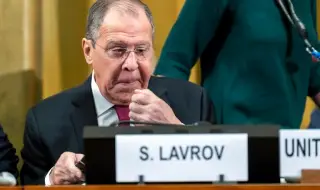
The West is pretending to be interested in negotiations on a Ukrainian agreement and has resorted to open ultimatums to Russia. This was stated by Russian Foreign Minister Sergei Lavrov, quoted by "Interfax".
He made this statement during a joint press conference with Mozambique's Minister of Foreign Affairs and Cooperation Maria Manuela dos Santos.
"We have set out our assessments of the current state of affairs around Ukraine, including the actions of the West, which simulate readiness for negotiations. Now, as announced by the Europeans, the West has resorted to open ultimatums to the Russian Federation," he said.
He added that the West "hypocritically continues to call for a negotiated solution."
"We will no longer believe the West that it wants a negotiated solution." This reserve of goodwill and hope has been completely exhausted," the minister stressed.
Russia said that the United States was wrong to believe that Ukrainian strikes deep inside Russian territory could hasten the end of the war, and warned that such actions could lead to the continuation and escalation of the conflict.
The reaction was prompted by statements by US Secretary of State Marco Rubio and President Donald Trump during the NATO summit in Ankara.
Rubio said that Russia was finding it increasingly difficult to defend its airspace and expressed hope that this would create better conditions for negotiations to end the war.
For his part, Trump commented on the Ukrainian strikes with the words: "This is an escalation, but it is also an escalation that can help end the war."
Kremlin spokesman Dmitry Peskov rejected this logic.
"There are certain misconceptions in the White House administration about the idea that escalation and military pressure can pave the way to a peaceful settlement," he told reporters.
According to him, such an approach is wrong and could lead to an extension of the Russian "special military operation" in Ukraine.
The Council of the European Union (EU) is expected to approve additional sanctions against Russia on Monday.
The move is in response to Moscow's massive attacks on Ukraine.
The new sanctions, presented earlier by the EU's High Representative for Foreign Affairs and Security Policy Kaia Kallas, are expected to be adopted at a meeting of the EU's Foreign Affairs Council on July 13.
Russian President Vladimir Putin is rejecting calls for peace talks with Kiev, Reuters reported, citing three sources close to the Kremlin.
According to them, recent Ukrainian drone attacks on Russian oil refineries and ports have strengthened his determination to continue the war for now.
Two of the sources, who spoke on condition of anonymity, said Putin was more likely to escalate the conflict, which is already in its fifth year. One of them, who meets regularly with the Russian president, describes the likelihood of escalation in the coming months as "very high".