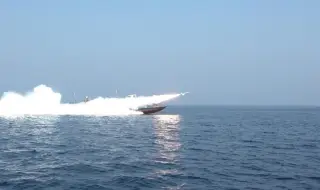
The development of the conflict in the Middle East continues to be the focus of the Western press, after yesterday the US and Iran exchanged blows for another day, and mediators called for de-escalation of tensions.
Great Britain
The US and Iran are exchanging increasingly strong blows, while the former supreme leader of the Islamic Republic was buried after mourning ceremonies that lasted several days, writes the British newspaper "Guardian" in a headline.
The exchange of blows comes after US President Donald Trump threatened to escalate the conflict unless Iran stops attacking ships in the Strait of Hormuz.
Iran responded to the latest series of attacks by striking US allies Kuwait and Qatar also accused the US of carrying out strikes near its only nuclear power plant.
The second day of tit-for-tat strikes came hours before Iran buried former Supreme Leader Ayatollah Ali Khamenei in his hometown of Mashhad. Khamenei was killed in US and Israeli airstrikes in February this year at the outbreak of the war.
"The body of the martyred leader of the Islamic Revolution was buried in the memorial hall of the Imam Reza shrine," Iranian state television IRIB reported.
Khamenei's funeral procession reached the country's holiest shrine, with a huge crowd filling the courtyard, some of those present carrying banners condemning the US president, with the words: "We will kill Trump!".
The ayatollah's son and successor did not appear at the ceremony. Mojtaba Khamenei was wounded in the same series of strikes that killed his father and has since communicated only through written statements, the Guardian notes.
Yesterday's attacks were the most massive since Tehran and Washington signed a memorandum of understanding on June 17, which was intended to extend the ceasefire and allow for talks to reach a lasting truce.
Washington is still committed to finding a solution with Iran and "technical talks are ongoing," a US official told Reuters, despite President Trump declaring the truce was "over."
In response to the escalation, Israeli Defense Minister Israel Katz said his country was ready to resume its military campaign against Iran if necessary, threatening to do so "with even greater force." force".
Iranian officials said the strikes targeted the perimeter of the only civilian nuclear power plant in Bushehr province - an area that the International Atomic Energy Agency (IAEA) has previously warned could "pose a very real risk to nuclear safety".
"Today, strikes were carried out on several areas in Bushehr province, including the perimeter of the nuclear power plant, a military base in the city of Choghadak and a fishing pier in the south of the province," Ehsan Jahanian, the deputy governor of Bushehr, said yesterday, adding that there were no reports of casualties so far.
Following the strikes, the US president released videos of explosions in Iran and again threatened the country.
"This is in retaliation for yesterday's attacks on ships by Iran. If it happens again, it will be much worse!” Trump wrote on Twitter. Hours earlier, he had promised that the strikes would not lead to prolonged fighting but would be “very quick.”
His comments and the exchange of blows have raised concerns that the truce could collapse and cast doubt on the long-term prospects for the talks. The two sides remain at loggerheads over a range of issues, including Iran’s control of the Strait of Hormuz and inspections of nuclear facilities.
The US military said it had struck about 90 targets in Iran, showing footage of strikes on missile launchers and a runway. It said the strikes were aimed at reducing Iran’s ability to “threaten freedom of navigation” in the Strait of Hormuz – a key sea route for about 20 percent of the world's oil and gas supplies.
The attacks sent oil prices soaring, but they recovered later in the day as calm returned to the region, the Guardian reported.
Iran accused the US of war crimes after it said it had struck two bridges in the eastern provinces leading to Mashhad. The bridges are key infrastructure for Iran's cross-border trade with China, which has surged since the war began.
Trump has repeatedly threatened to strike bridges, power plants and other civilian infrastructure in Iran. Attacking civilian infrastructure, if it is not a military target, could be considered a war crime, the British publication notes.
Mediators have tried to reduce tensions between the US and Iran in an attempt to save the talks. Qatari Prime Minister Sheikh Mohammed bin Abdulrahman Al Thani, who is a key mediator between the two countries, spoke with Iranian Foreign Minister Abbas Araghchi yesterday, condemning Tehran's attacks on ships in the Strait of Hormuz.
USA
US steps up strikes on Iranian coast along Strait of Hormuz, headlines the American newspaper "Washington Post".
The renewed hostilities, after huge crowds in Tehran vowed revenge on America during lavish funeral ceremonies this week for slain former Supreme Leader Ayatollah Ali Khamenei, and after Trump called Iran's leaders "scum", signaled that the war is far from over.
Only last month, the US and Iran announced a framework agreement to end the war, which brought short-lived relief across the world.
This framework agreement was followed by the start of negotiations aimed at concluding a more lasting peace agreement within 60 days. Less than half of that deadline had passed, however, when Trump said on Wednesday that he believed the truce had failed.
Control of the Strait of Hormuz remains a contentious issue, with neither side willing to accept the other's terms, and Iran continues to attack some ships as they pass through the narrow waterway that is vital to global trade, the Washington Post notes.
The parties also appear to have made little progress on the sensitive issue of Iran's nuclear program, which has long been a major point of contention between Washington and Tehran.
The aim of the US strikes is to "further restrict Iran's ability to attack merchant ships and innocent civilian sailors in the Strait of Hormuz," according to a statement from the US Central Command (CENTCOM) issued yesterday morning.
Among the targets are systems for air defense, coastal surveillance assets, missile and drone storage facilities, naval facilities and military logistics infrastructure, they added.
Iran responded by firing missiles and drones at US military sites located in US-allied states in the Persian Gulf region, including Kuwait, Bahrain and Qatar.
In a statement carried by Iran's semi-official Mehr news agency, the Islamic Revolutionary Guard Corps (IRGC) said the drone attacks were only the "first stage" and warned of further strikes on American targets in the region if the US air campaign continues.
"The Armed Forces of the Islamic Republic of Iran will not allow the goals and ambitions of the reckless American president to be realized under any circumstances and will defend the lofty ideals of the Islamic Revolution until final victory," the statement said.
France
The US and Iran exchanged blows in the Strait of Hormuz area, the French newspaper "Le Monde" headlined.
The two countries exchanged blows for a second day in a row yesterday as Washington and Tehran dispute control of the strategic Strait of Hormuz. This vital sea route for transporting oil is the "apple of discord" in the Middle East war, with Tehran insisting on retaining control of the strait, even though it was open to free passage before the US-Israeli attacks in February, notes "Monde".
Iran's chief negotiator, Mohammad Bagher Ghalibaf, said yesterday that the Strait of Hormuz would only be opened on "Iranian terms". "The US has not yet understood that threats and broken promises no longer go without consequences," Ghalibaf wrote in Ex. "Let me be very clear: if you strike, you will be struck," he added.
Since the US-Israeli strikes triggered the war in February, Tehran has insisted on controlling the strait, saying it will collect transit fees and threatening to strike ships that deviate from the authorized route. The latest strikes came just before the funeral of Ali Khamenei, Iran's former supreme leader who was killed in the outbreak of war on February 28, Le Monde noted.
In recent days, Iranian forces have attacked at least three ships, prompting a series of US strikes on Iranian targets. Meanwhile, UN Secretary-General Antonio Guterres has called on "all parties to exercise maximum restraint" - as has Pakistan, a key mediator in US-Iranian talks, Le Monde noted.