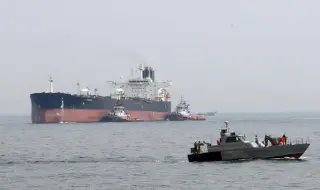
The closure of the Ormuz Strait has led to an increase in shipping costs, an outflow of seafarers who agree to pass the route, an increase in the price of oil and fears of a shortage reserves and even an increase in fuel theft from gas stations.
If there is anything positive to be said about the whole situation, it is that it is acting as a catalyst for numerous projects to find new deposits and alternative routes for transmission, many of them related to Europe.
Of course, the situation is not unprecedented. In the past, oil supplies have been interrupted more than once or twice.
After the Iranian Revolution, the country topped the list of the largest fuel supply disruptions. From November 1978 to April 1979, the decline in oil production led to a loss of supply of 5.6 million barrels per day, according to data from the International Energy Agency (IEA).
This was followed by two historic events with losses of 4.3 million barrels per day. The first was the Arab oil embargo (October 1973 - March 1974), which caused an almost fourfold increase in oil prices and forced some countries to restrict fuel supplies due to shortages. This is considered the first major global oil crisis and led to the creation of the MEK.
A second event of the same scale occurred in Kuwait. As a result, supplies were disrupted from August 1990 to January 1991, which again led to an immediate doubling of prices. Next in the ranking is the Iran-Iraq War from October 1980 to January 1981, during which losses of 4.1 million barrels per day were recorded.
ΠIn the new century, the figures have been significantly lower. The war in Iraq (March - December 2003) caused a loss of supplies of 2.3 million barrels per day, and the civil war in Libya - 1.5 million barrels per day.
The new leader
The IMF data and the report "Commodity Market Outlook" According to the World Bank, since March of this year, the closure of the Ormuz Stream has resulted in the largest disruption to oil supplies in history - 10.1 million barrels per day, or about 80% more than during the Iranian Revolution. This is not surprising considering that around 20% of the world's consumption passes through it.
Currently, the sea route remains restricted to international shipping, as traffic has dropped to under ten vessels per day. According to Reuters, only seven cargo ships passed through it on Thursday - no large tankers carrying fuel. This is down from the pre-conflict rate of about 130 ships per day.
Meanwhile, talks between the US and Iran to end the war and restore shipping remain without a final agreement.
This week, Donald Trump declared "economic war" and threatened countries and companies that continue to trade with Iran with severe consequences. ΠIn this way, Washington aims to cut off the country's oil and financial channels, as particularly strong pressure can be directed at Chinese buyers of Iranian oil.
For its part, Iran has characterized the US threats as a continuation of a failed policy of economic pressure. The metal rods predicted the "experimental" response if their opponents increase pressure, while President Macy'd Πezeshkian calls for a cessation of the war.
This exchange of threats indicates that the passage through the Ormuz Stream will not be restored to full capacity anytime soon.
Πet of the seven Middle East-related interruptions, which underlines the enormous importance of the region for global oil suppliers, analysts at Visual Sourcelist comment. The closure of the Ormuz Stream is the first event in the classification that exceeds a loss of 10 million barrels per day.