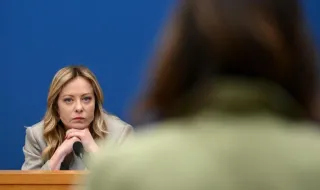
Italian Prime Minister Giorgia Meloni was among the notable absentees from the UN General Assembly Annual Session in New York, noted Italian media, including ANSA, “Sky TG 24“, “RAI News“ and others, BTA reports.
The media recall that Meloni has been to the UN General Assembly Annual Session three times so far. She made her debut in 2023, almost a year after her right-wing coalition won the Italian elections in the fall of 2022. In 2024, the Italian prime minister attended the General Assembly session, the preceding meeting on the future of the planet, and a ceremony at which the Atlantic Council awarded her its “Person of the Year“ award. These events prompted Meloni to deliver a total of three speeches in New York at the time. Last year, she spoke again from the podium of the UN General Assembly, calling for reform of the world organization.
The Italian prime minister's absence from this year's forum was sharply criticized by Italian opposition parties and their leaders, including former prime ministers Giuseppe Conte and Matteo Renzi, who lead the anti-establishment “5 Star Movement“ and the centrist “Italia Viva“ party, respectively. The opposition stressed that at a time when leaders from all over the world are discussing hot issues at the UN, including Ukraine, Iran, the Palestinian cause, artificial intelligence, the fight against climate change or migration, Meloni is absent.
For the first time in 15 years, an Italian prime minister is missing the Annual Session of the UN General Assembly in New York, Italian media noted. Meloni's official argument was that she had a busy work schedule in her homeland and therefore could not travel to the United States.
Supporters of the Italian leader point out that other foreign leaders are also missing this year's session of the UN General Assembly. Indian Prime Minister Narendra Modi and German Chancellor Friedrich Merz are not present. Chinese President Xi Jinping also did not come to New York, preferring to visit US President Donald Trump in Washington. Trump himself stayed at the forum for only one day and returned to the federal capital to devote himself to meetings and talks with the Chinese president. This eliminated the hypotheses that he could meet with the Israeli prime minister or the president of Iran in New York. But on the first day of the high-level general political debates, Trump still held a series of important meetings.
According to analysts, by avoiding the trip to New York, Meloni avoided the opportunity to meet Trump there, with whom her relations are still cool after the rift that occurred in the spring over Trump's criticism of Pope Leo XIII and over Italy's refusal to allow American aircraft to use Italian bases for combat missions in Iran. Trump and Meloni last saw each other during the plenary session of the NATO summit in Ankara, and on the sidelines of this event, Trump again expressed his disappointment with the Italian leadership for not helping the United States in the war in Iran. The two had previously met at the G7 summit in Evian, France, and Trump later accused Meloni of begging him to take a picture with him to boost his ratings at home. Meloni, in turn, accused Trump of saying untrue things and advised him to look at his own ratings. Since then, diplomats in Italy and the United States have been working behind the scenes to improve bilateral relations, which Meloni herself recently expressed regret for not developing as she had expected.
The opposition's criticism of Meloni's absence from the UN summit in New York intensified even more when, on the evening of September 23, while a number of European leaders were taking turns delivering speeches across the Atlantic, the Italian prime minister appeared at the Royal Palace in Milan for the gala dinner to open Milan Fashion Week. For the social event, Meloni posed in a deep navy blue suit with trousers and an ivory shirt by the fashion house “Ermano Shervino“. The gala dinner was organized by the Municipality of Milan and the National Chamber of Fashion of Italy, notes the publication “Today.it“.
Meloni said to journalists that with her presence at the Milan Fashion Week she wanted to show that her government supports the fashion industry and is sympathetic to its problems. “I think it is especially right to be here this year, at a not very easy moment for the industry, which despite the difficulties continues to produce great results“, said Meloni. She added that the government wants to thank the fashion industry, which contributes to the Italian economy, for its strength and representation in the world.
In response to the opposition's criticism of Meloni for wasting his time showing off at glamorous fashion shows instead of stating Italy's positions at serious summits, the Italian right-wing publication “Libero“ recalls that fashion is a strategic sector in Italy, accounting for around 5 percent of the country's GDP and employing a million people. The presence of the Italian prime minister at an important fashion event with international resonance shows that the government's strategy is to promote “Made in Italy“. This in turn testifies to a concrete and pragmatic policy led by Meloni, the publication commented.
In New York, during this time, the Italian position on global issues was defended by Foreign Minister Antonio Tajani, who is the leader of the center-right party “Forza Italia“, ANSA reported. From the rostrum of the General Assembly, he said that the UN must regain its ability to act decisively. Tajani also proposed a reform of the Security Council. "The United Nations was created to prevent violence from becoming the only law. But to remain true to this mission, the organization must regain its ability to make decisions and, above all, to act," Tajani said. He added that too often the organization seems "powerless" and the Security Council resembles an "elitist club." "We choose the power of law over the law of the strong, we choose the power of politics over the power of brute force. This is the message that Italy sends to the United Nations today. Peace is not a legacy guaranteed forever. It is a daily responsibility. We must stand firm for it. We must patiently build it. We must strive for it, without ever giving up," Tajani added.
Critics of the Italian government have stressed that Tajani has repeated the theses formulated by Meloni in her speech to the General Assembly last year and has not said anything new to highlight Italy as an important factor on the international stage.
The foreign minister's participation in the high-level UN forum in New York was also overshadowed by the ongoing controversy and ridicule in Italy that his words have provoked since the end of last week. Then, in an attempt to encourage voters to vote for the moderate right instead of far-right parties, Tajani resorted to a metaphor related to women's appearance, from which it emerged that women with short skirts and impressive looks are unreliable and that only women with an unsightly appearance and long skirts can be relied on. This has provoked indignant reactions from a number of representatives of Italian politics. Meloni herself had to answer journalistic questions twice about this statement by her foreign minister. She described it as words that sounded bad, were not understood correctly and were overexposed by the media and the opposition. Tajani himself apologized to Italian women from New York and said that he did not mean to offend them, ANSA and the newspapers "Repubblica" and "Stampa" recall.
Meloni's supporters say that she is skipping the UN high-level forum in New York because she is focused on preparing the budget for next year. This will be the last budget proposed by her government before the upcoming 2027 parliamentary elections. The measures included in it will inevitably reflect on the election campaign for next year's vote, ANSA, “RAI News“ note and other Italian media.
The Italian Prime Minister also gave a series of interviews this week in which he defended his government's policies and its planned reforms.
One of these reforms is that of the electoral legislation. It was discussed and put to a vote in the lower house of parliament (the Chamber of Deputies) at the beginning of the summer. There, the deputies rejected the possibility of preferences in the electoral lists provided for in it by secret ballot. The reform was then discussed in the upper house of parliament (the Senate), where in the middle of this month it was approved by an open vote in the plenary hall. In this vote, the measure to rearrange the lists according to preferences was returned to the text of the electoral reform. Now the amended text is returning to the lower house for final discussions and a final vote, which Meloni linked to a vote of confidence for her government. There are fears, however, that the parties will demand another secret ballot of the law in the lower house and will again declare themselves against the preferences. When the preferences were first rejected in the Chamber of Deputies at the beginning of the summer, an analysis of the data from the plenary vote showed that representatives of parties from the ruling coalition also voted against them, which means that there is a division within the ranks of the ruling party on a key issue. This division was not seen in the subsequent vote in the Senate, but according to analysts, the reason is that the Senate is not allowed to hold a secret vote, so opponents of the preferences from the ruling right-wing majority did not dare to vote openly against them and incur the wrath of Meloni.
The electoral reform also provides for a bonus of seats in both parliamentary chambers for the political force that received the highest percentage of votes. The reform also requires parties to present their candidate for prime minister at the beginning of the election campaign, ANSA reported. Meloni says the measures included in the reform will make the country much more politically stable in the future, and even before they vote, voters will be aware of who the parties' candidates for prime minister are. The opposition, however, says the reform aims to strengthen the right's control over power.
Remaining in Italy the week before the discussions on the electoral reform enter the final stages in the Chamber of Deputies, Meloni is closely monitoring the situation with the bill, analysts note.
Another measure that the right-wing government has taken these days was the creation of a legal framework for Italy's return to nuclear energy, from which the country turned after the Chernobyl accident four decades ago. At that time, Italians voted in favor of closing nuclear power plants in a referendum. The right, however, declared this a short-sighted choice and said that it would work to return to nuclear energy. Two days ago, the Italian parliament finally approved the nuclear energy law, ANSA and “RAI News“ recall. “After almost 40 years, Italy once again has a legal framework for the production of nuclear energy. A bold and sensible choice. Today we import electricity produced by the nuclear power plants of neighboring countries, but we cannot produce it ourselves. This law aims to change that. What does this mean for households and businesses? It means greater energy security, less dependence on foreign countries and less vulnerability to international crises, the price of which we already pay through our electricity bills. It means stable energy with low emissions“, said Meloni regarding the parliament's decision. She added that it is about the implementation of new generation nuclear technologies, not about restarting old nuclear power plants. “This was a commitment made to the Italians. Another commitment that we have fulfilled“, Meloni emphasized.
A third measure recently announced by the Italian prime minister was approved yesterday at a government meeting. It bans the wearing of the burqa and niqab (traditional Islamic clothing that covers the entire face) in public schools. Violators will be fined up to 1,000 euros. According to Meloni, no one in Italy can attend school while hiding their face. The measure is aimed at those who deprive girls in Italy of their freedom by forcing them to hide their faces, she said.
The government decree introducing this ban includes another measure promised by Meloni - the introduction of a 30 percent cap on the number of foreign students in Italian classes. Meloni first presented this planned measure on Sunday during an event of the youth movement of her party “Italian Brothers“. The opposition immediately defined this measure as discriminatory and propaganda, and as a witch hunt against foreign students in Italian schools, summarize ANSA, “RAI News“, “Fanpage“ and “TG Com 24“.
A similar 30 percent cap has actually been in place since 2010, when it was introduced by a circular letter from then-Education Minister Mariastella Gelmini, who was part of Silvio Berlusconi's fourth government, in which Meloni was the Youth Minister. The measure, which was not legally binding, however, proved unenforceable in practice in areas of Italy with a high migrant population.
A few days after Meloni announced that her government would adopt a decree in this direction, yesterday the promise was fulfilled. Meloni said that the introduction of a 30 percent ceiling means that Italian children will not feel like a minority in the classrooms and that there will not be a kind of ghetto created by foreign students who do not speak Italian.
After the decree was adopted last night, Meloni explained that it is not just a 30 percent ceiling on the number of foreign students in a class, but a 30 percent ceiling on those students who do not speak Italian well enough. The decree also provides for more funds for learning Italian, Meloni explained.
If a child has serious difficulties in integrating at school, teachers will be able to report it to social services and then, if they establish that the child's parents do not speak Italian well or do not speak it at all, they will have to attend free Italian language courses. If parents do not comply with this obligation, they could be fined between 200 and 1,000 euros, according to Meloni's explanations, but also those of Education Minister Giuseppe Valditara, made last night, reported by Agence France-Presse, ANSA and the Associated Press.
According to Valditara, insufficient knowledge of the Italian language hinders the educational process. Parents must participate in this process and this is fundamental for children's success at school. If a parent cannot help their children with lessons and homework, simply because they do not speak Italian well enough or do not speak it at all, this affects the child at school and they fall behind their classmates, the minister believes. There are currently about 34,000 classes in Italy where the proportion of foreign students exceeds 30 percent, Valditara said.
According to the government's plan, the 30 percent cap on students with insufficient knowledge of Italian will be applied in every classroom and will be based only on language skills, not citizenship. This means that this cap will also apply to children from other EU member states who do not speak Italian, the Associated Press notes.
“A 30 percent cap on the number of students in a class who do not speak Italian at a sufficient level, more tools for learning our language and a ban on burqas and niqabs in schools - these are sensible measures that do not divide, but on the contrary promote true integration and guarantee equal opportunities for all students. This is the path we intend to continue. A school system that integrates without abandoning the rules, supports those who face the greatest challenges and gives everyone the opportunity to start from the same starting point,“ Meloni emphasized yesterday on the occasion of the draft decree approved by the government.
According to the opposition, Meloni's government adopted this decree precisely because of the emergence of a new political competitor on the right - the newly created party “National Future“ of retired general Roberto Vanacci, who supports tough action on migration and also talks about re-emigration.
According to a new sociological survey commissioned by “Sky TG24“ the rating of Roberto Vanacci's party “National Future“ already reaches 8.1 percent, reports “Fanpage“.
In the right-wing space, Meloni's party has a rating of 26.5 percent, but its coalition partners from the far-right “Lega“ of Deputy Prime Minister Matteo Salvini and “Forza Italia“ of Tajani have recorded another decline and their ratings are 5.1 and 7.3 percent, respectively. The small right-wing party “We the Moderates“, which is also part of the ruling coalition, has a rating of one percent.
In the ranks of the left-wing opposition, the center-left Democratic Party has a rating of 21.1 percent, and “The 5 Star Movement“ with 13.2 percent. “The Green Left Alliance“ has a rating of 5.9 percent. The pro-European party “Plus Europa“ has a rating of 1.6 percent.
In the center, “Italia Viva“ has a rating of 2.2 percent, and “Action“ of former Minister of Economic Development Carlo Calenda has a rating of 3.4 percent.
If the left and centrist parties unite in a common opposition front for next year's elections, their total percentage will be 47.4. The total percentage of the four ruling right-wing parties is 39.9. This means that only if they unite with Vanacci's right-wing party will their total percentage reach forty-eight.
So far, Meloni has not openly given any indications that she would form a coalition with Vanacci, but the leader of "National Future" has stated that he is ready to talk in this direction, as long as his party does not have to cross the red lines it has drawn, recalls “Fato Quotidiano“. Meloni is currently trying to cause a split in the ranks of the center, by openly thanking the leader of “Action“ yesterday Calenda for supporting the law in parliament, pushed by the right, to return Italy to nuclear energy, recalls “Fanpage“.