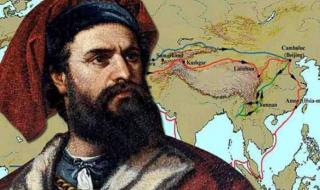
On September 15, 1254, the great traveler and discoverer Marco Polo was born in Venice. Together with his father Niccolò and his uncle Matteo, he traveled the Silk Road to China for 24 years and provided the first information about the island of Sipangu (Japan).
In 1254, the same year Marco was born, his father Niccolò Polo and his brother Matteo embarked on a 15-year journey, during which they crossed the Transcaspian steppes, along the Tianshan Mountains and reached Shandu, the capital of the great Mongol Khan Kublai, who gave them a warm welcome. In 1269, the two brothers returned to Venice with rich gifts.
In the autumn of 1271, the brothers embarked on a new journey to Asia as merchants and ambassadors, together with the now 17-year-old Marco. Starting from Acre in Palestine, they moved much further south, crossed Asia Minor and the Armenian Highlands, turned south into Kurdistan and descended the Tigris River to Basra.
They then headed north to Persian Tabriz, and then crossed Iran in a southeasterly direction through Kerman to Hormuz. Since they were unable to reach China by sea via India, they made a difficult trek through the Deshte Lut desert to the city of Kayen. From there, through the Afghan cities of Herat and Balkh, they continued east along the southern slopes of the Hindu Kush and reached the foothills of the Pamirs. They turned northeast and descended into the Kashgar oasis, and then skirted the Taklamakan desert from the south, moving along the northwestern parts of Tibet, from oasis to oasis to the lower reaches of the Cherchen River.
On their further journey, they passed through the Kumtag Desert, reached the Sulehe River, and from there to the city of Ganzhou, where for unknown reasons they lived for a whole year. From Ganzhou, the Venetians traveled southeast to the city of Xining, and then along the Yellow River and in 1275 arrived in Beijing - the capital of the Great Mongol Khan Khanbalik.
In China, Marco Polo quickly learned Chinese, Turkic and Mongolian. The emperor loved him very much and began to send him on various missions as his special envoy. Unlike other officials, he was able to notice the details in the different traditions and the diversity in the life and daily life of the local people and, after returning to the emperor, told him everything he had seen during the journey. Therefore, the emperor increasingly preferred to send him on missions to collect necessary information. As a result, Marco Polo received increasingly important assignments, and the emperor increasingly needed his services.
Marco Polo lived in China for a total of 17 years. He was sent on assignments to many places, even visiting countries in South Asia on behalf of the emperor. In addition, he worked for three years as a local governor in the city of Yang Zhou, Jiang Su province.
Time passed and the three Europeans began to miss home. They repeatedly asked the emperor to release them, but he needed them and did not let them go.
In 1292, the three Venetians were ordered to accompany two princesses - a Chinese and a Mongolian - to Persia, who were to marry the Ilkhanate in the capital of Tabriz.
They traveled by water around the Indochina peninsula, the islands of Java, Sumatra and Ceylon, and in 1294 they reached Persia, where They safely handed over the princesses to the groom. From there, through Armenia and Trebizond, in 1295 they returned to Venice after a 24-year absence.
The return of the three travelers surprised the people of Venice, because they no longer believed that they were alive. Marco Polo had left his hometown when he was only 17 years old, and he returned as a 40-year-old man. Seeing the jewels and silk they brought, the Venetians began to call him “Millionaire Marco“. He felt alien in his own city and in 1296 he set off on a merchant voyage again.
Having barely put to sea, Polo's galley was attacked by the Genoese (at that time Venice and Genoa were waging a war for naval supremacy). Marco was captured and imprisoned in Genoa until 1299. Although he was a prisoner, people came to him to hear about his extraordinary life in China.
There is a prisoner from Pisa (Rusticiano or Rusticello) in prison who writes chivalric novels (Marco Polo himself is illiterate) and writes down everything the traveler tells him. Later he publishes “The Travels of Marco Polo“ or “The Million“, which becomes a world-famous book. It tells in detail about Marco Polo's impressions of Chinese cities such as Yangzhou, Suzhou, Hangzhou, etc., as well as about the prosperity of China.
After the publication of the book in 1299, Marco Polo was released and returned to Venice, took a wife from a noble Venetian family and from this marriage he had three daughters - two of them were married to merchants from Dalmatia, which confirms the hypothesis of his Croatian origin. His house is on the corner of the streets Rio di San Giovanni Crisostomo and Rio di San Lio.
He died on January 8, 1324, in his hometown of Venice and was buried in the church of “San Lorenzo”. In 1596, his house (where, according to tradition, the items brought from China were kept) burned down in a fire. The church of “San Lorenzo” was demolished in the 19th century.
The Marco Polo Ridge (Bokaluktag) in the Kunlun Mountains in China is named after him, as is a type of mountain ram from that region. In 1851, the ship “Marco Polo“, named after the explorer, became the first ship to circumnavigate the globe in less than 6 months. The airport in Venice is also named after him. The 1982 television series “Marco Polo“ won an Emmy Award.