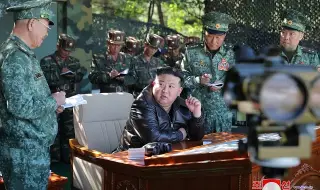
Last week, it was reported that North Korea plans to triple the number of troops fighting with Russia on the front lines in Ukraine by sending an additional 25,000-30,000 soldiers. The troops will arrive in the next few months, adding to the 11,000 North Korean troops sent in November, Natasha Lindstedt, a professor at the University of Essex, wrote in an article for Forbes.
In June, Ukrainian President Volodymyr Zelensky told reporters that Russia was massing 50,000 troops along the Russian border in northeastern Ukraine, warning that Russia could deploy North Korean troops in parts of Russian-occupied Ukraine for a new ground offensive this summer. North Korea has the capacity to send up to 150,000 additional troops, which would require retooling Russian aircraft to transport such large numbers of foreign troops across Siberia.
There is no doubt that North Korea’s involvement in the conflict is becoming increasingly visible. For the first time, North Korean state media has shown footage of North Korean troops fighting in Ukraine and acknowledged that thousands of people have already died.
For North Korea, the troop deployment is part of a long-term investment with Russia to revive aid to Cold War levels. Pyongyang has already received food and financial aid, and is now seeking support to improve critical ground, air, anti-aircraft and naval systems.
With this new influx of North Korean troops, Moscow and Pyongyang have solidified their evolving partnership - building a relationship that is not just transactional but also strategic.
Initially, North Korea's support was only rhetorical and diplomatic, and in 2022 North Korea is one of the few UN member states that recognizes the sovereignty of the so-called Donetsk and Luhansk People's Republics in eastern Ukraine.
Two high-level summits were held after Russia's invasion of Ukraine in 2022. In September 2023, Presidents Kim Jong-un and Vladimir Putin met at the Russian cosmodrome "Vostochny". Then in June 2024, Putin visited North Korea, which resulted in the signing of the Comprehensive Strategic Partnership Treaty, which provided for mutual defense if either side was attacked, representing the strongest such agreement between the two countries since the Cold War.
For Russia, the benefits of this partnership are obvious. Russia is in dire need of more soldiers. In 2024 it is losing over 1,000 Russian soldiers a day - and for every square kilometer gained, about 100 soldiers are killed (Russia controls about 19% of Ukraine, an area the size of Ohio). That same year, Russia struggled to repel a Ukrainian military incursion at Kursk, losing about 15 battalions at Kursk alone. Overall, Russia has suffered over 790,000 casualties, almost twice as many as Ukraine.
Given these losses, Putin cannot afford to risk another politically unpopular mobilization effort. Using non-Russian fighters buys Putin time to rebuild the army, which he has promised to increase to 180,000 soldiers and 1.5 million active duty service members. While Putin has recruited troops from Somalia, Sierra Leone, Cuba, and Nepal, the partnership with North Korea offers more advantages and a much larger flow of troops for deployment.
But the deployment of troops from North Korea has also come with complications. Although the DPRK sent special forces units, which are better trained and equipped than regular infantry, the initial deployment lacked an effective and flexible command structure. Since the complex chain of command was put in place to prevent military coups, it created difficulties that hindered rapid decision-making. A political commissar and a police representative must sign off on any military decision, which undermines rapid response.
There were also some language barriers (very few North Koreans spoke Russian and even fewer Russians spoke Korean).
Since this was also North Korea's first involvement in a major armed conflict since the Korean War, North Korean soldiers had a hard time adapting to modern warfare. They lacked not only modern combat experience, but also terrain knowledge.
Initially, the North Koreans were also easy targets for drone and artillery attacks. Thanks to their high level of discipline, they moved in unison in open fields, where they could easily be spotted by drones, and were less likely to scatter and hide when they heard the drones overhead. At night, they also wrapped themselves in poncho-like cloaks that made them visible from afar. They were also more willing to risk their lives to retrieve the bodies of their comrades in the field, which increased the number of casualties.
Within a few months, North Korea suffered heavy losses, suffering an estimated 4,000 casualties—or almost a third of its deployed military. The losses were so high that in January 2025 the North Koreans are forced to withdraw from the front lines.
But even though the Russians treat the North Koreans like cannon fodder, that doesn't deter Kim, who agreed to send 3,000 more troops in March of this year. Since then, the North Koreans have gained crucial battlefield experience and an understanding of how to conduct electronic warfare.
North Korea is providing not only troops, but also the necessary military weapons. Since Russia has lost a large amount of military equipment (almost 13,000 tanks and armored vehicles and over 300 aircraft were destroyed), it needs arms supplies.
Some of the weapons that North Korea has provided include 200 long-range artillery systems, over a hundred short-range ballistic missiles, such as the KN-23 and KN-24 missiles, fifty 240-millimeter multiple launch rockets, and twenty 170-millimeter self-propelled guns or howitzers. The KN-23 missiles are armed with warheads weighing up to one ton, making them more powerful than equivalent Russian missiles.
In addition, as of September 2023, Since then, North Korea has sent over 15,000 containers, likely containing billions of weapons, including up to nine million artillery shells, helping Russia replenish its stockpiles of 122-mm and 152-mm artillery shells. Ukraine estimates that North Korea’s contribution accounts for up to 70 percent of Russia’s ammunition.
Since Russia’s war with Ukraine relies heavily on artillery, this injection from North Korea has helped significantly.
But some of North Korea’s ammunition is unreliable, inaccurate, and old. The first batch of North Korean KN-23 ballistic missiles was notoriously inaccurate. They were improved only after intensive cooperation between Russian and North Korean specialists. And North Korea cannot match the scale or efficiency of Western arms manufacturers. So North Korea’s arms support may not be sustainable in the long term; it is primarily a temporary measure to help Russia regroup.
Although the North Korean military faces operational shortcomings, Kim's willingness to risk large numbers of lives and provide a vast arsenal of weapons provides Moscow with a critical buffer. It also shows that Russia is not capable of winning this war alone.
Link to main version
Jul 8, 2025 13:11 858
North Korea's growing role in the war in Ukraine shows just how weak Putin really is
Last week, it was reported that North Korea plans to triple the number of troops fighting with Russia on the front lines in Ukraine by sending an additional 25,000-30,000 soldiers.
Снимка: БГНЕС/ЕРА