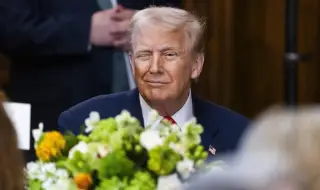
US President Donald Trump has imposed a 50% tariff on imports from Brazil because of the country's attitude towards former President Jair Bolsonaro. Trump noted in a letter to the Brazilian authorities that he linked his tariffs to the trial of Bolsonaro, who is accused of trying to reconsider his loss in the 2022 elections, BTA writes in its press review.
On the issue, the British newspaper "Guardian" commented that after the news, the value of the Brazilian real fell by more than 2% against the dollar. According to the publication, the US president's decisions have increased concerns that "his chaotic trade strategy risks exacerbating US inflation, despite Trump's repeated promises to quickly reduce prices during the election campaign."
"The Guardian" cites an analysis by the consultancy Oxford Economics, which indicates that the US effective tariff rate on imports from abroad will rise to about 20% after Trump's latest letters announcing the tariffs.
"Our assumption is that most countries will reach an agreement or an extension to avoid increasing tariffs," Michael Pierce, who is responsible for US issues at the company, told the newspaper.
The American newspaper "Wall Street Journal" commented that relations between the United States and Brazil have fallen into crisis after Trump tried to stop criminal proceedings against his right-wing ally in the country, former leader Jair Bolsonaro, by imposing high tariffs on the largest Latin American country. The opinion about relations between the two countries is also shared by the newspaper "Washington Post", which writes that with his decision Trump has sharply exacerbated the diplomatic feud between the United States and Brazil.
According to the publication, the tariffs, which come into effect on August 1, "open a new theater in Trump's ongoing trade war, bringing Latin America's largest economy, which has so far remained largely unaffected by trade measures, into the fray. "Washington Post" believes that if implemented, the tariffs would seriously affect the Brazilian economy, whose second largest trading partner is the United States (after China).
People close to current Brazilian President Luiz Inacio Lula da Silva told the newspaper that the Brazilian government had expected the tariffs to be imposed, but not 50 percent.
"They benefit economically from us, Brazil is not a problem for the United States," said one of Lula's aides.
The newspaper added that the issue that seemed to have provoked Trump's reaction was the upcoming trial of Bolsonaro - a hard-line conservative who used Trump as a political model and worked for years to improve relations with him.
"From a political point of view, this is a gift to the Brazilian government," said one of Lula's officials at the Foreign Ministry. "This could be a turning point in next year's (presidential) campaign," he added.
Bolsonaro's allies, however, have a different interpretation, the Washington Post points out. They say Lula and Brazil's Supreme Court are to blame for Trump's tariffs.
Ciro Nogueira, Bolsonaro's former chief of staff, accused Lula in a statement to the Washington Post of dividing both Brazil and "the American continent," and now "the Brazilian people will bear the consequences of this recklessness."
The New York Times notes that Trump's attempt to use tariffs to interfere in a criminal trial in a foreign country is an extreme example of how he uses tariffs as a weapon - and how they can lead to economic ruin. Trump also incorrectly claimed that the United States has a trade deficit with Brazil, when for years the United States has typically maintained a trade surplus with Brazil, the publication notes.
It also seems unlikely, according to the newspaper, that the United States can eliminate these trade deficits by encouraging foreign countries to buy American products. While such sales could help partially balance trade and benefit American exporters, there is little reason to believe that other countries will buy the same amount of products that the United States, usually the richer country, buys from the rest of the world, the "New York Times" commented.
The European edition of the magazine "Politico" writes that the US trade proposal, which could soon land in the European Union's mailbox, will face the bloc with a fateful choice: accept a far from best offer now or take a risk to secure last-minute concessions for key industries.
Yet, the document on Trump's desk can hardly be called a "deal" - instead, it would constitute a unilateral decision to set tariffs from August 1, the publication adds.
In addition to the catastrophic impact that such high tariffs would have on European exporters, European Commission President von der Leyen is aware that the security of the bloc at a time of Russian aggression is also at risk, writes "Politico". The Commission's approach to the negotiations so far largely echoes calls from some of the EU's leading member states, such as Germany or Italy, for a quick deal with the US - even at the cost of potentially painful concessions.
"The question is: Does the nicety lead to anything useful?", the magazine asks.