The world knows Zelensky as a comedian-turned-wartime president who has established himself as one of the most recognizable political figures of the 21st century, compared to Winston Churchill. He is the leader who stands his ground in Kiev when Russian troops invade across the border and assassins pursue him. Two words from his famous video message on the first night of the invasion, filmed defiantly in the dark outside the presidential compound, have become a national slogan: "We are here", writes Christopher Miller in a long article for the Financial Times, which is dedicated to the Ukrainian president’s chief of staff, Andriy Yermak.
The large man standing to Zelensky’s left shoulder in this video is not familiar to everyone, although he appears in countless photos, almost always within arm’s reach of the president. In a photo taken at a peace summit in Switzerland in June 2024, he stands front and center, towering over the dozens of world leaders in attendance, and completely obscuring U.S. Vice President Kamala Harris, who cranes her head to be seen. (“I don’t know how the hell he did this and how we let this happen,” one U.S. official says of the photo). But among Ukrainians, foreign leaders and diplomats, he is a figure of enormous and polarizing influence.
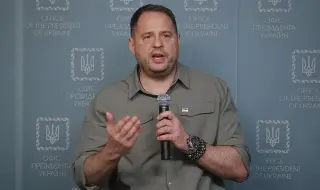
Andriy Yermak is not the president of Ukraine. But he often behaves as one. As head of the Office of the President of Ukraine - his official title - the 53-year-old Yermak draws up peace plans, directs foreign diplomacy and selects government officials. The prime minister and senior military officials often report to him. When it comes to high-stakes negotiations - prisoner swaps with Moscow; the return of kidnapped Ukrainian children; deals to preserve the flow of grain across the Black Sea - Yermak leads the negotiations. European governments coordinate with him on military and financial aid. He meets face-to-face with world powers and Hollywood stars.
In the gilded halls of Kiev’s presidential complex, Yermak leads a tight-knit team of about two dozen handpicked, loyal advisers who have access to national security briefings and meetings with visiting heads of state—an arrangement considered highly unusual by the standards of most Western governments. Together, the group runs the country. Yermak’s own role has been described in countless ways by those who have observed him, from Zelensky’s right-hand man to de facto vice president of Ukraine. But both his allies and critics agree that almost nothing happens in Ukraine without his knowledge and approval. Nothing reaches the president without going through him.
To loyal supporters like Andriy Sibiga, Yermak’s former deputy who has been Ukraine’s foreign minister since September, Yermak is “a great manager. Especially in crisis situations.” Anders Fogh Rasmussen, the former Danish prime minister and NATO secretary general who wrote the accompanying text for Ermak’s inclusion on Time magazine’s list of the 100 most influential people of 2024, said he witnessed firsthand Ermak’s ability to keep “the government running… during our work on security guarantees for Ukraine,” which led to “a web of bilateral agreements with allies.”
His judgment, however, has been questioned by many observers, including those close to him. It was Ermak who, against the advice of U.S. and Ukrainian officials, insisted on an Oval Office meeting with Donald Trump in February, when Kiev was seeking U.S. support and a deal on minerals. The ensuing fiasco nearly soured relations between the two countries and was seen as evidence of Ermak’s overconfidence. “His problem is micromanagement. "He's trying to be everywhere and do everything," said Oleksandr Rodnyansky, a Ukrainian television executive and a longtime friend of Yermak.
Yermak has become the epitome of a national debate over whether the centralized powers imposed by the military administration could cripple Ukraine's post-war democratic future. For many Ukrainians, he is a symbol of the old order they are desperate to leave behind. This week, Zelensky faced the most serious domestic challenge of his presidency after a sweeping move to dismantle Ukraine's independent anti-corruption agencies sparked the first major mass protests since the war. Chants of "Yermak out" and "Fuck Yermak" could be heard among the crowds of thousands gathered in Kiev.
In interviews with more than 40 people, including current and former Ukrainian officials, Western diplomats in Kiev, and officials from European governments and Washington who have worked directly with Yermak, they often say that Yermak has as much influence as Zelensky, if not more. To critics, Yermak is an unelected tsar amassing unlimited power – undermining the democratic checks and balances that Kiev introduced after the 2014 Euromaidan revolution. He draws up lists of domestic political enemies that Ukraine’s National Security and Defense Council sanctions. He has been accused of manipulating judicial investigations to discredit his rivals and of stalling anti-corruption investigations. He is alleged to have organized covert operations, spreading leaks and rumors through anonymous Telegram channels. “His goal is to centralize everything in a post-Soviet style of government that resembles something not so different from autocracy,” said a person who worked closely with Yermak in the president's office.
Last week, one of Yermak's close allies, Yulia Sviridenko, was appointed Ukraine's new prime minister - a move widely reported as evidence of his growing influence over Zelensky. A Western ambassador described Yermak's role in no uncertain terms: “He is the president, the prime minister, the foreign minister... all the ministers combined.” One Ukrainian minister warned that few in the government would dare to speak of Yermak officially - a prediction that has proven to be correct.
"The future and fate of everyone", he declares, "are determined by Andriy Yermak".
In interviews with more than 40 people, including current and former Ukrainian officials, Western diplomats in Kiev, and officials from European governments and Washington who have worked directly with Yermak, they often say that Yermak has as much influence as Zelensky, perhaps more. To critics, Yermak is an unelected czar amassing unlimited power – undermining the democratic checks and balances that Kiev introduced after the Euromaidan revolution in 2014. He draws up lists of domestic political enemies that Ukraine’s National Security and Defense Council sanctions. He has been accused of manipulating judicial investigations to discredit his rivals and of stalling anti-corruption investigations. He is said to be running covert operations, spreading leaks and rumors through anonymous Telegram channels. “His goal is to centralize everything in a post-Soviet style of government that looks not so different from autocracy,” said a person who worked closely with Yermak in the president’s office.
Last week, one of Yermak’s close allies, Yulia Sviridenko, was appointed Ukraine’s new prime minister – a move widely seen as evidence of his growing influence over Zelensky. A Western ambassador described Yermak’s role in no uncertain terms: “He is the president, the prime minister, the foreign minister… all the ministers combined.” One Ukrainian minister warned that few in the government would dare to speak of Yermak officially – a prediction that has proven to be true.
"The future and fate of everyone", he declares, "are determined by Andriy Yermak".
Yermak's allies argue that he is not a "gray cardinal" hiding and shaping policy in the shadows, but something new in Ukraine's post-Soviet political world: a "green cardinal", commanding private and public scenes in his olive-green combat uniform.
Yet he did not rise through politics or the military. He was not part of Zelensky's entourage of childhood friends, nor was he a colleague in his comedy troupe "Kvartal 95". Born in Soviet Kiev in 1971, Yermak enjoyed many of the privileges of the middle class intelligentsia in the USSR. His father, Boris, worked at the famous defense equipment factory "Artyom" before becoming a high-ranking diplomat at the Soviet embassy in Afghanistan during the Soviet-Afghan War. This assignment led to speculation that his role involved ties to Soviet security services. When the author of the article raised these rumors with Ermak, he dismissed them sharply: "Where is the evidence?"
As a young man, Ermak dreamed of becoming a fighter pilot. Instead, he enrolled at the Taras Shevchenko National University, where he graduated with a master's degree in international law. While many of his classmates went on to study in the West and joined leading European law firms, Ermak stayed in Kiev and opened his own practice specializing in intellectual property law. "I liked him because he was like very few people in Kiev at that time," Rodnyansky said. "He spoke foreign languages."
It was when Ermak began using his legal services for the TV channel “Inter“ in 2011 that he met the young Volodymyr Zelensky, already a national star and the channel's general producer. Their first conversation didn't last long, but they immediately hit it off. "I could tell he was a very smart, very intelligent person", Ermak recalls. "I liked the way he talked about his wife, about his children". Soon after, Ermak turned to the entertainment business. He founded a media group and produced several films that received lukewarm reviews, including the 2017 boxing drama "Rules of the Fight".
In early 2019, he took a step into politics, joining Zelensky's presidential campaign. When Zelensky won the election, he appointed Ermak as his chief aide on international affairs. Even those close to the new president were surprised. Zelensky’s team is made up mostly of friends he’s known since his school days in the gritty industrial city of Kryvyi Rih. But together, the two men are working to deliver on some of Zelensky’s most ambitious promises, including ending the war that has been simmering in eastern Ukraine since Russia annexed Crimea in 2014 and invading the Donetsk and Luhansk regions.
In an early test of his political acumen, that summer Ermak became the main point of contact between Kiev and U.S. President Donald Trump’s inner circle, as U.S. officials pressured Ukraine to launch investigations into alleged corruption by Trump’s Democratic rival Joe Biden and his son Hunter. Acting as an intermediary for Trump’s personal lawyer, Rudy Giuliani, Ermak negotiated a possible declaration of cooperation—a condition for a meeting at the White House and the release of $400 million in U.S. military aid. The talks led to Trump's infamous "do us a favor" appeal. Some in Kiev blame Yermak for dragging Ukraine into the scandal, but Zelensky credited him with saving him from more serious consequences. The episode marked the beginning of Yermak's evolution into the president's closest confidant.
Link to main version
Jul 24, 2025 21:11 2 757
From Zelensky's right-hand man to de facto vice president! Andriy Yermak has more power over Ukraine than the president
Yermak is not the president of Ukraine, but he often acts like one
Снимка: БГНЕС/ЕРА