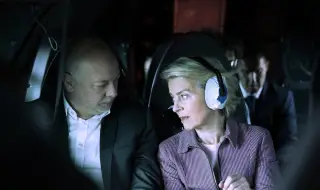
The authorities in Bulgaria, where the incident took place on August 31, expressed suspicion that Moscow was behind this attack and linked it to Russia's war against Ukraine. However, the spokeswoman for the Russian Foreign Ministry, Maria Zakharova, called these accusations “fake and an expression of paranoia“.
In Russia, especially on social media, the story has caused an avalanche of mockery against the EC President. And the ground for insults of this nature is more than fertile: Ursula von der Leyen has become almost the main object of Russian propaganda. The harsh statements of Russian politicians and media regarding Western state leaders have long been no surprise. But there seems to be something special about von der Leyen.
They reduce von der Leyen's career to gynecology
One of those who particularly often mocks the EC President is former President and Deputy Chairman of the Security Council Dmitry Medvedev. He likes to call von der Leyen the "evil aunt gynecologist". Thus, the entire career of the German politician, who studied archaeology, economics and medicine, and held ministerial positions at the provincial and national levels, including those of Minister of Labor and Defense, is reduced to the Russian public by the few years she worked as a doctor in a gynecological clinic in Hanover.
In December 2022, Foreign Ministry spokeswoman Maria Zakharova wrote on Telegram: “In the context of the current state of the European Union, it is clear why a gynecologist was appointed as the President of the EC“. Zakharova's boss, Foreign Minister Sergei Lavrov, called Von der Leyen “Führer Ursula“ in March this year. This happened in connection with the demands of the President of the EC to strengthen the defense capabilities of the Community. Jokes on the verge of decency about Von der Leyen have become a routine for the hosts of popular political shows on Russian television.
What is the reason for the attacks on Von der Leyen?
Observers believe that there are many possible reasons for the special attention that Ursula von der Leyen "enjoys" in Russia. They link it to her position, her politics - and her gender. Medvedev's statements are aimed at "ridiculing Von der Leyen and preventing her from being perceived as a serious politician," Susanne Spahn, an expert on Russian propaganda at the University of Passau, told DW. The Kremlin's goal is to "weaken and split the EU as an international union."
Stephan Meister of the German Foreign Policy Association points to von der Leyen's role in supporting Ukraine, but not only that. "It is clear that Putin's system is permeated with toxic masculinity and rejects women in politics," says Meister. "At the same time, it is about the EU as the personification of the enemy, after US policy under Donald Trump has moved closer to Russia. In other words, von der Leyen is combining two things - the EU as something that is weak from a Russian perspective, but also evil, since it provides significant support to Ukraine."
Andreas Umland of the Stockholm Institute for East European Studies compares the verbal attacks against von der Leyen to Russia's attitude towards former US Secretary of State Hillary Clinton. “Russian antipathy towards Ursula von der Leyen is reminiscent of the Russian campaigns against Hillary Clinton, who was also once anathema to the Kremlin-controlled media. Both von der Leyen and Clinton are politically decisive, with a clear position on the Putin regime and great political influence in the EU and the US. In their countries' political spectrum, they are more “hawks“ than doves, when it comes to critical assessment of Russia and military support for Ukraine.“
A target of Russian smear campaigns
Of all Western state leaders, von der Leyen has allowed herself some of the harshest statements against Moscow. In 2022, she said that Russia must suffer a “strategic defeat“ in Ukraine. President Putin regularly repeats this sentence when talking about the West's role in supporting Ukraine.
“In 2022, Von der Leyen played a key role in nominating Ukraine as a candidate for EU membership, and in 2025 she influenced the EU's geopolitical reorientation and strengthening its responsibility in the field of defense policy. She also maintains friendly political relations with Volodymyr Zelensky“, Umland recalls. Because of all this, it is not surprising that she has become a target of Russian smear campaigns, the expert notes.
Author: Roman Goncharenko