


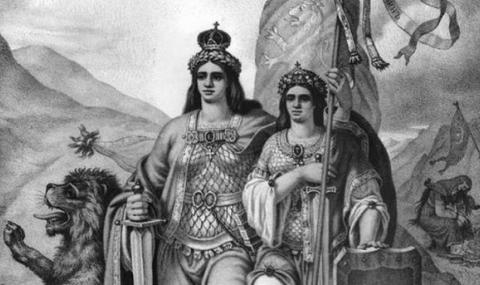

On September 6, 1885, the Unification of the Principality of Bulgaria with Eastern Rumelia took place.
Since the spring of 1885, the BTCRK, formed in Plovdiv under the leadership of Zahari Stoyanov, has been actively promoting the unification through publications in the press (the newspaper "Borba") and public demonstrations. The most massive event is the celebration of the anniversary of the death of Hadji Dimitar on Mount Buzludzha on July 17, to which people come from all over Eastern Rumelia, as well as from the Principality.
The opposition Liberal Party is attracted to the unification. At the same time, the committee establishes ties with senior officers, such as Captain Raycho Nikolov and Captain Sava Mutkurov, as well as with many officers in the local garrisons. Talks were also held with Major Danail Nikolaev, the highest-ranking officer in the region, but he, although approving of the idea of unification, was skeptical of the committee's lack of realistic plans.

The Unification was planned to take place in early September, when a large part of the Rumelian militia was mobilized for maneuvers. On August 29, Sava Mutkurov and BTCRK member Dimitar Rizov met in Shumen with Prince Alexander I, who was conducting military maneuvers in the area of the city. He assured them of his support, but did not inform Prime Minister Petko Karavelov, who was skeptical of the Unification. The Prime Minister was behind the events, he learned the big news later, even from the most ordinary citizen. He learned the news when his carriage entered Tarnovo. After informing himself from Sofia about the latest information from Southern Bulgaria and after expressing his will, Karavelov contacted the prince in Varna. Then both of them decided to proceed immediately to action, by announcing the mobilization of the Bulgarian army and convening the National Assembly for an extraordinary session. When on September 10 the National Assembly met for an extraordinary session, it fully approved all the measures that Petko Karavelov's government had taken up to that point. This did not satisfy Karavelov and he requested that ten million credits be allocated for the announced mobilization.

And if Petko Karavelov had no involvement in the preparatory period and in the very strike of the revolutionary act, then in strengthening and in gathering the fruits of this act, in upholding, imposing and recognizing it by Turkey, the Great Powers and the neighbors, his involvement was enormous, precisely at this important moment when it was decided whether there would be or would not be Unification. The initial intention of the BTCRK was for the Unification to be declared on September 15, but on September 2 a riot began in Panagyurishte, which was subdued on the same day by the police. Faced with the danger of the country being engulfed in fragmented sporadic rebellions and the leaders of the conspiracy being arrested, the committee decided to speed up the initiative. On the same day, representatives of the BTCRK were sent to various cities in the region, from where they were to lead rebel groups to Plovdiv, where they would place them under the command of Major Danail Nikolaev.
On September 4, rebels, led by Chardafon, declared the Unification and established control over the village of Golyamo Konare. The next day, the government, headed by Ivan St. Geshov, held consultations with the Russian representation in Plovdiv with the intention of declaring the Unification itself, if it received support from Russia. The Russian representative categorically refused.
On September 5, several hundred armed rebels from Golyamo Konare (now the town of Saedinenie) moved towards Plovdiv. On the night of September 6, units commanded by Danail Nikolaev established control over the city and removed the government and Governor-General Gavril Krastevich. A provisional government was formed, headed by Georgi Stranski, which was later replaced by the Commissariat for Southern Bulgaria, and a general mobilization was announced.
A few days later, however, Russia announced its dissatisfaction that the action was not coordinated with it. Supported by Austria-Hungary, Serbia attacked Bulgaria on November 2, 1885. The Serbo-Bulgarian War began. After three days of fighting near Slivnitsa on November 5-7, the Bulgarians were victorious, and the subsequent Treaty of Bucharest of February 19, 1886 restored the pre-war border with Serbia.
Thanks to Russia and personally to Emperor Alexander III, the Union received diplomatic and international recognition. This was done through the so-called Tophanen Act of March 24, 1886. The agreement was prepared by the Bulgarian politician and diplomat Iliya Tsanov and his team. On the Turkish side, Kamil Pasha and N.V. The Sultan signed. The agreement managed to protect the affiliation of Burgas and the region to the Principality, but the Kardzhali district and the Tumrushki villages were taken away.
With the signing of the treaty, Bulgaria and the Ottoman Empire reached an agreement according to which the Principality of Bulgaria and Eastern Rumelia had a common government, parliament, administration, and army. The only distinction between the two parts of the country, preserved until the Declaration of Independence of Bulgaria in 1908, was that the Bulgarian prince was formally appointed by the Sultan as Governor-General of Eastern Rumelia.