


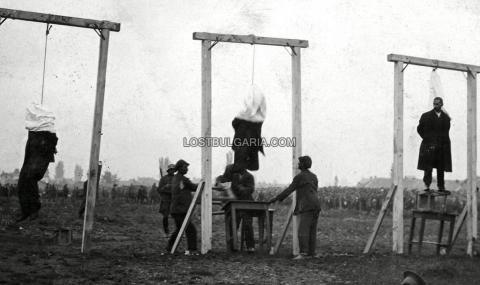

On May 27, 1925, the perpetrators of the attack in the cathedral "St. Kral" Marko Fridman, Petar Zadgorski and Georgi Koev were hanged. The day is Holy Thursday of Holy Week, in two days it is Easter.
On April 16, 1925, the old Sofia cathedral "St. Kral" (today "St. Nedelya") is crowded with people. The funeral of the murdered two days earlier reserve general Konstantin Georgiev, a volunteer, one of the leaders of the ruling "Democratic Conspiracy" is about to take place. Ministers, deputies, the mayor of Sofia, senior officers, comrades of the deceased from the wars for national unification.
At 3:20 p.m. Sofia Metropolitan Stefan takes the Holy Gospel from the hands of the deacon. At that moment, a powerful shock wave from the explosion knocks down men, women and children, the dome of the cathedral is thrown back, and then falls back down.
134 people die, others die later from their wounds, so the total number of victims reaches 213. The wounded are 500. 12 generals, 15 colonels, 7 lieutenant colonels, 3 majors, 9 captains, 3 deputies and many citizens, including children, die, recalls Dani Ivanov in his blog.
The entire 25 kg explosive was collected in one package and placed above one of the columns of the main dome, located at the southern entrance to the building. Detonated with a Bickford a 15 m long cord, giving the bombers 25 minutes to escape.
The attack was the work of far-left activists from the Military Organization of the Bulgarian Communist Party. Sofia was blocked for only minutes after the explosion. The investigation was taken over by the “Public Safety” (”State Security” of the Kingdom of Bulgaria). Very soon, the organizers and direct perpetrators of the terrorist act, Marko Fridman, Georgi Koev and the sexton Petar Zadgorski, were discovered and captured.
The sexton Petar Zadgorski was the first to be arrested. The blockade caught him at the corner of “Princess Clementina” Blvd. (today “Al. Stamboliyski”) and “Tsar Samuil” on his way to “Vazrazhdane” Square, where a car was supposed to be waiting for him. At the sight of the uniformed men, he trembles and collapses, attracting the attention of those around him. The unraveling of the conspiracy begins with him.
Marko Fridman and Georgi Koev are arrested without resistance. Nikola Petrov (who, together with Fridman, lit the fuse) and Zhivko Dinov (who provided security during the placement and activation of the explosion) escape from the blockade and manage to escape to Moscow through Serbia. A day earlier, Petar Abadzhiev - the bearer of the Comintern money from Moscow for the preparation of the attack - had also left Bulgaria. When the police went to arrest the officers Kosta Yankov and Ivan Minkov, who were among the organizers of the attack, they opened fire and eventually committed suicide.
Over 20 people are brought to court, the state prosecution is demanding nine death sentences, but the court pronounces only three - for the captured physical perpetrators Fridman and Koev and for the butler Zadgorsky, who provided access to the dome. The court insisted on being convinced that the clergyman knew what was being done and had fully consciously cooperated.
Before the verdict was read, taking the last word, Fridman declared that he had consciously joined an illegal organization with the ultimate goal of starting an armed uprising. He regretted that after the June 9 coup, the party, as a revolutionary organization, had to side with a counter-coup, but it had betrayed its ideals and brought him to the position of standing trial and being responsible for the massacre of innocent people.
A few hours before the death sentence was to be carried out on May 27, 1925, Fridman wrote a petition to the Tsar - he asked that the gallows be replaced by a shooting. However, the Tsar refused to grant the last request of the convicted.
Although the sentences do not mention their public execution and despite the resistance of the palace, the government assumes responsibility - on the outskirts of Sofia, three gallows are fastened to massive beams in a field. There are tables under them, and stools are placed on them.