


Chinese engineers continue to rewrite the laws of land dynamics, setting a new impressive world record in the field of magnetic levitation (maglev). During large-scale tests, an experimental platform managed to reach the phenomenal speed of 800 km/h in an unprecedented 5.3 seconds from a standstill – an indicator that approaches the cruising speed of modern jet airliners.
The impressive test was conducted on the specialized one-kilometer magnetic levitation track at the Donghu Laboratory in Hubei Province. The test vehicle with a mass of 1,110 kilograms demonstrated exceptional stability and dynamics. Not only the catapult acceleration is impressive, but also the braking process – After reaching its peak speed, the platform settled into a full basket for just over 200 meters, maintaining millimeter-accuracy in positioning thanks to precise electronic control of the magnetic field.
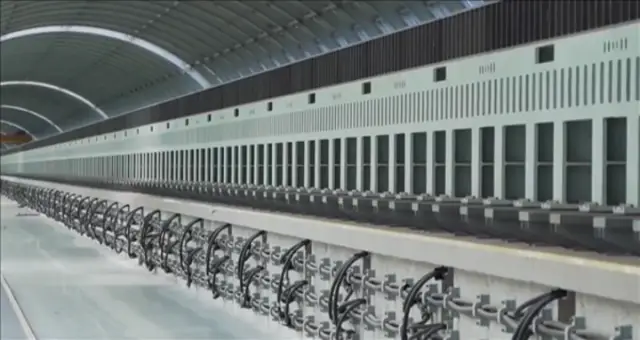
This achievement is the third consecutive world record for the unique test installation within an extremely short period. Previous engineering achievements recorded acceleration to 650 km/h in 7.1 seconds, followed by a subsequent test reaching 700 km/h.
From a technological point of view, magnetic levitation technology completely removes physical contact between the vehicle and the track, eliminating mechanical friction. The movement is provided by superconducting magnets and linear synchronous motors, which generate powerful electromagnetic fields, lifting and pushing the platform forward. At such extreme speeds, the main physical obstacle remains only aerodynamic air resistance, which requires specific fairing geometry and extremely stable linear guidance.
Despite the record-breaking achievement, the technology at this stage remains in a strictly experimental stage. Before such systems can begin carrying passengers, engineers must solve a series of complex problems related to peak electricity consumption, the safety and strength of materials during overloading, as well as the astronomical costs of building specialized infrastructure.